How-To Guide
End an Etsy promotion without confusing a stopped campaign with an expired coupon
Distinguish stopping an Etsy targeted campaign from the expiration of coupons already issued before writing an end-of-offer social post.
A shop can stop sending a targeted offer while a buyer still holds a valid coupon from that campaign. That distinction matters when a seller posts “all discounts end tonight” on Instagram or X.
Before making an end-of-offer announcement, identify exactly what is ending: a public sale, a manually shared promo code or the sending of targeted offers. The same sentence does not accurately describe all three.
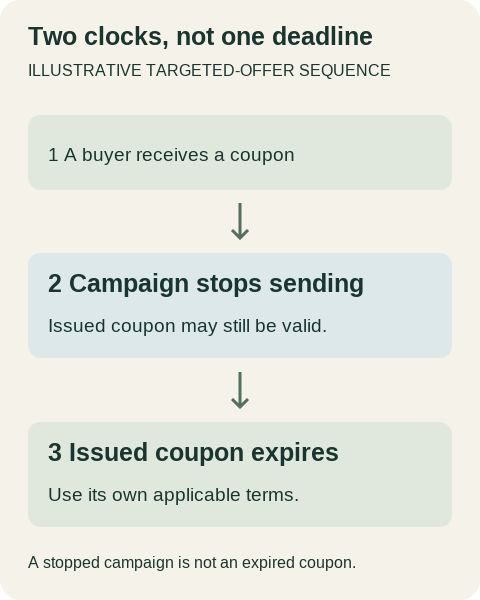
Illustrative sequence only. No real coupon, dates, duration or account behavior is shown.
 Superdirector
Make it work for your brand
Find it. Remake it. Post it. Superdirector turns the viral formats in your niche into your brand's carousels, X posts and video scripts, and keeps the calendar full.
Start with two different questions about expiration
In a historical seller discussion about coupons that could not be deactivated, a merchant reported that a paused coupon was still being used. The thread includes speculation about bugs and coupon-sharing sites. Those explanations are not verified, and the report alone does not identify the cause or the exact offer type.
In a separate buyer question about coupon expiration, the buyer wanted to know when a discount ended. That historical interface complaint is not evidence of what every buyer sees today.
Together, the questions show why a useful campaign needs two clocks: when the shop stops issuing an offer, and when an already issued offer stops being redeemable. They do not demonstrate current platform defects or a trend in coupon misuse.
Identify the offer mechanism before writing the countdown
Etsy's sales-and-discounts help, checked October 26, 2026, distinguishes sales, promo codes, discounted bundles and targeted offers. For targeted offers, it explicitly says ending the campaign stops new codes from being sent, while already issued codes may remain redeemable until they expire.
Etsy's Advertising & Marketing Policy likewise distinguishes turning off targeted campaigns from the validity of coupons already sent. It also makes sellers responsible for communicating coupon terms and limitations when sharing them.
That does not mean every manually created promo code has the same lifecycle. The help page separately describes deactivating manually created promo codes. Do not apply the targeted-offer rule to all discounts, or infer that a sale ending revokes every other offer associated with the shop.
Build an offer-state record, not just a discount list
Use a record like this before the campaign's closing post:
| Field | What to record |
|---|---|
| Offer identity | The specific sale, code or targeted campaign being discussed |
| Mechanism | Public sale, manual promo code or targeted offer |
| Audience | Who can receive or redeem this actual offer |
| Issue period | When new offers are being sent, if applicable |
| Redemption period | The applicable expiry for an issued coupon |
| Eligibility | Listings, minimums or other verified conditions |
| Closing copy | The exact thing the announcement says is ending |
| Verification | Current settings and relevant buyer-facing terms checked |
Keep the record private when it contains buyer-specific coupon information. Public creative should explain the relevant terms without exposing someone else's code or implying that everyone qualifies for a targeted offer.
Do not invent an absolute deadline from a relative duration unless you can establish the actual issue event and applicable terms. If the buyer's coupon carries its own expiration, refer them to those details instead of substituting a single shop-wide countdown.
Use two clocks in the explanation
Consider a fictional shop that stops a targeted campaign on Monday. A buyer received a coupon before that stop and its stated redemption deadline is later. The seller should not describe Monday as the moment that buyer's coupon necessarily expires.
The public campaign can end while the issued coupon remains within its own terms. Conversely, a buyer seeing an old social post should not assume that the shop is still issuing the offer now.
This distinction is especially important when reusing a closing-sale video. A dramatic “last chance for any discount” overlay is broader than “this public sale ends.” Changing the caption alone may not correct a contradictory statement burned into the video.
Write the closing post to match the mechanism
These fictional templates serve different situations:
- Public sale: “This sale ends at [verified deadline and time zone]. Check the eligible listings and terms.”
- Manual promo code: “Use [public code] under its stated conditions before [verified expiry], subject to any clearly disclosed redemption limit.”
- Stopped targeted campaign: “We are no longer sending this offer. If you already received a coupon, check its own expiration and conditions.”
These are not ready-to-publish claims until the bracketed details and offer settings have been verified. Avoid “everyone gets a code” or “favorite this item and you will receive a discount” unless that promise is actually supported. Targeted sending and buyer eligibility are not the same as a seller-controlled public giveaway.
On Instagram, pair the closing message with the exact offer it describes. On YouTube, check the spoken deadline as well as the description. On X, avoid a broad pinned claim that remains visible after the offer state changes. Removing a public post does not itself revoke coupons already issued through Etsy.
Handle a mismatch without inventing a diagnosis
If a buyer or seller reports unexpected redemption, first establish the offer type, the issued coupon's terms and the relevant order details. Keep personal and order information out of public comments. A paused campaign label alone does not prove that a valid targeted coupon should have stopped working.
If the observed behavior conflicts with the applicable terms, document the mismatch and use Etsy's support route. Do not tell the buyer that a scraper, platform bug or another shopper caused it without evidence. Likewise, do not use an unresolved report as a basis for a public allegation about Etsy's current system.
This article does not determine a particular order's refund, cancellation or legal outcome. The marketing task is to avoid creating the contradictory promise in the first place.
Review the exact claim before release
Ask a reviewer: Which offer is ending? Does the stated deadline govern sending, redemption or the sale itself? What should someone with an existing coupon do? Could someone without one wrongly infer that they are eligible?
The useful asset is a clear end-of-offer explanation, not manufactured urgency or a guarantee that discounts will improve sales. See the planning workflow to organize the offer-state record and closing copy before the final social cut goes live.