How-To Guide
Check the offer exposure behind an Etsy Offsite Ads order
A recent quiet month does not necessarily restore an option that historical shop activity removed.
By the Superdirector editorial team.
An attributed order can create a real advertising charge without proving that the order would otherwise have been lost. For an Etsy maker, the immediate task is therefore twofold: understand the charge the offer may need to support, and establish whether participation is actually optional for the shop.
Do that before copying another seller's sales mix into a pricing calculation or looking for a daily budget control that this program does not provide. A recent quiet month does not necessarily restore an option that historical shop activity removed.
This original review method uses Etsy documentation checked on October 24, 2026. It does not verify any shop's eligibility, calculate a merchant's profit, interpret local law or recommend a settings change. No advertising, price or account action has been taken.
First identify the program
Etsy Ads and Offsite Ads are different mechanisms. Etsy's advertising policy describes onsite Etsy Ads as cost-per-click advertising with a seller-set daily budget. That control should not be carried over mentally to Offsite Ads.
The current Offsite Ads help page says sellers do not choose the individual listings advertised or set an Offsite Ads budget. Charges attach to qualifying attributed orders. Its $100 USD cap applies to one order, not the total number of orders or a day's exposure.
Before reviewing a cost, retain the program name and the actual order or billing reference privately. A note that simply says “Etsy ads cost” is too ambiguous to support a decision. Stopping an onsite campaign is not evidence that an Offsite Ads charge will stop.
Establish whether there is a genuine participation choice
The policy's standard rule ties mandatory participation to a shop reaching $10,000 USD in a consecutive 365-day period after February 20, 2019. It says the requirement continues for the shop's lifetime even if later sales fall below that level. The policy specifies 366 days in a leap year and EST dates. Its applicable-law opt-out qualification is not interpreted here.
Check the actual historical status and current account information through the authorized account, rather than using only this year's revenue or another merchant's experience. A rough total from another report is not the relevant threshold record.
Consider a fictional maker who previously crossed the threshold but now has lower sales. Their next decision cannot simply be “turn it off because this month is small.” They first need to confirm what options actually exist. If a policy or account discrepancy remains, bring that specific discrepancy for resolution rather than inventing a workaround.
Trace the earlier-click exposure before assuming a clean stop
Under the documented attribution rules, a qualifying offsite click can be followed by attributed shop orders within 30 days. Multiple orders can arise from one click. Etsy's help page also describes the exception when the buyer's final click before ordering is an Etsy Ad, in which case only the Etsy Ads fee applies.
For an eligible seller who chooses to opt out through an authorized action, the policy says removal from display can take up to three business days. Clicks before the opt-out becomes effective can still lead to charges within their 30-day window, subject to the last-click rule. A request date is therefore not a guarantee of no further attributed charges.
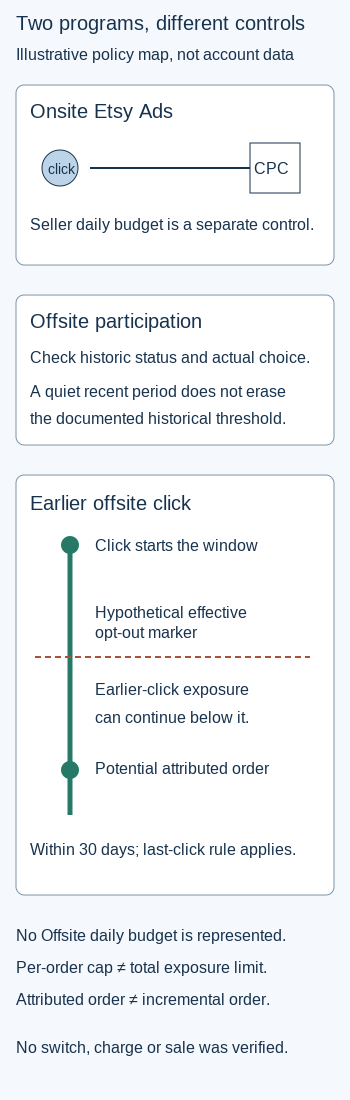
The diagram is a policy explanation, not a forecast. Its marker is hypothetical and applies only where an opt-out is available and authorized. It does not imply that any shop changed participation.
Original visual by the Superdirector editorial team. Creation date not recorded.
Build one actual-order case before averaging anything
Imagine a fictional original-print seller preparing an offer review. The seller starts with an actual applicable order case, not an assumed fraction of future orders. The record separates the item's received revenue, shipping charged, production and packaging costs, fulfillment expense, the relevant advertising charge and other applicable fees.
Etsy's fee policy distinguishes the participation-threshold calculation from the Offsite Ads fee base. The latter can include shipping, gift wrapping, paid personalization and certain taxes under its stated geographic rules. The published rates are 15% or 12% according to the documented qualification. Other transaction and payment fees are separate. Use the current applicable billing definitions and records rather than applying a rate to the item price alone.
Keep each input dated and sourced. If shipping collected is included as revenue, include the associated shipping expense consistently. Do not deduct a cost twice because it appears in both a fulfillment invoice and a unit worksheet. Leave production labor or an unresolved fee unknown rather than entering zero.
The resulting figure is a scoped order contribution, not company profit. A positive number does not establish that fixed overhead is covered; an incomplete number does not establish profitability. Nor does a print-on-demand arrangement make production and fulfillment costs disappear.
For the fictional print seller, the useful outcome might be “the applicable fee is known, but packaging and production costs need reconciliation before this offer can be assessed.” That is actionable without inventing a selling price or projecting future orders.

AI-generated illustrative mockup. No real order or fee was analyzed. The worksheet shows which applicable evidence must be reconciled; an attributed order alone does not establish profitability or participation options.
Illustrative mockup by OpenAI image generation, editorial direction for this article. Created 2026-10-24.
Keep three conclusions apart
First, the platform may attribute an order under its rules. Second, the recorded order may leave a particular contribution after the costs included in the review. Third, the advertising may or may not have caused an additional order that would not otherwise have occurred.
Those are different conclusions. An attributed order and an incurred fee do not, by themselves, answer the counterfactual question. Likewise, a fee-to-revenue ratio is not a profit margin. A store with a different product mix, history or customer base does not supply a reliable future fee-bearing share for your own shop.
If historical records are available, summarize the observed period and its limitations. Do not use that summary to erase an unfavorable individual offer case, and do not treat its mix as fixed for the next period. No causal experiment has been performed for this article.
Bring the owner an available decision
A useful review packet contains the exact program, verified participation status or unresolved question, one supported order-cost case, the remaining exposure window where relevant, and the business constraint that needs attention.
If participation is optional, the owner can assess that actual choice alongside the offer's economics and the evidence limitations. If the standard historical rule makes it mandatory, the discussion may instead concern whether the present offer and fulfillment model are supportable. Neither case automatically justifies raising every price, removing listings or closing a shop.
Any proposed change should identify what it is intended to solve and what remains unknown. A pricing revision can affect buyer response and existing commitments; a change to promotion does not retroactively change an incurred charge. Keep the proposal separate from execution and use the appropriate approval before taking action.
Use merchant questions as prompts, not benchmarks
One new seller's discussion asks whether other shops' attributed-sales shares can guide an across-the-board price increase. A separate merchant question asks about controlling Offsite Ads costs while assuming those orders would not otherwise exist. These are independent qualitative contexts, not verified performance data. Relative dates conflict across observations, and commenters' rates, caps and causal claims were not adopted.
The next small action is to identify one real order case and the shop's actual participation status. If either is unavailable, label the decision incomplete. A defensible exposure review is more useful than a confident recommendation built on someone else's sales percentage.