How-To Guide
What are the best tools to check an influencer's followers for fake engagement?
Choose a fake-follower tool by its actual output, network limits, profile or creator billing unit, free allowance and full subscription commitment.
By the Superdirector editorial team. Retained vendor and reference texts captured November 4, 2026; fully re-read November 5, 2026. No real-account detector test.
At a glance
What are the best tools to check an influencer's followers for fake engagement?
For one Instagram account, start with the free HypeAuditor or Upfluence checker. For repeated Instagram screening alongside discovery, trial Modash or Heepsy. CreatorScore sells a wider, per-creator risk score; Social Blade supplies growth history. Choose by the output you need: an audience-quality score, estimated fake-follower percentage, whole-creator risk score and growth chart answer different questions. None of the retained evidence establishes a most-accurate detector.
- Modash explicitly limits fake-follower and credibility data to Instagram; private follower lists can leave those fields unavailable. General search coverage is not metric coverage.
- A higher HypeAuditor or CreatorScore quality score does not mean a higher fake-follower percentage. Do not average unlike outputs or transfer a vendor cutoff to another metric.
- Sources were captured November 4, 2026 and fully re-read November 5. No real-account tool test was performed. Superdirector publishes this guide; it is not ranked as a checker here.
Choose the metric and network you need
Write the missing answer before buying a report: “For this Instagram, TikTok or YouTube account, I need [estimated suspicious followers, evidence about comments, growth history or a wider risk review].” Add whether this is one account or a recurring shortlist. A tool can support a network for search while withholding its authenticity metric on that network.
| The question | The output that could help | What it does not establish |
|---|---|---|
| How much of this audience does the vendor classify as suspicious? | A named estimate with its population, date and availability limits. | That the creator bought followers, or that the remaining audience will see or buy from your campaign. |
| Do the interactions look manipulated? | Comment and interaction evidence, not just a follower count. | A clean follower reading does not validate every like or comment. |
| When did the account grow? | A dated growth chart with enough history for the period in question. | A spike alone does not identify its cause. |
| Is the creator suitable beyond audience authenticity? | A wider review of content, associations and other risks. | A composite risk score is not a percentage of fake followers. |
This is a tool-purchase guide, not another procedure for manually classifying followers. Our published Instagram follower check covers the evidence ledger for that task. For a broader campaign shortlist, use the 100-point vetting rubric. A low-quality or irrelevant real audience is a separate problem from an invented audience.
Shortlist tools by their actual outputs
These options are ordered by job: free spot checks, database screening, broader scoring, then history. The table records vendor descriptions, not independent results. We did not run accounts with known purchased followers through them. Missing feature evidence stays unknown; a seller’s comparison of a rival is not proof the rival lacks a method.
| Tool | Output on the retained primary pages | Network and availability limit | First route to investigate |
|---|---|---|---|
| HypeAuditor | Free checker lists Audience Quality Score (AQS), follower count and engagement rate. AQS is 1–100, higher is better. These three free outputs do not explicitly include a fake-follower percentage. | Free page: Instagram accounts with at least 1,000 followers. Free quotas and compulsory sign-up conditions are not established. | Try the free output before buying detailed reports or filters. |
| Upfluence | Its free Instagram checker describes a fake-follower percentage from a profile name. The Twitter audit description names follower authenticity. | TikTok and YouTube directory entries describe growth/performance, not the same authenticity field. Method, quotas and private-profile treatment are not established. | A free Instagram spot check; confirm the returned metric and date. Paid platform access is a separate purchase. |
| Modash | Fake-follower percentage, audience credibility and an audience-type breakdown inside discovery. | Its own Help explicitly says fake-follower and credibility data are Instagram-only. Private follower lists can prevent accurate calculations. | A 14-day trial; the pricing page limits it to 20 profile views, among other limits. Not a permanent free roster. |
| Heepsy | Home page says advanced profiles show genuine versus suspicious shares, unusual growth and demographics. | Search/audience analytics cover Instagram, TikTok, YouTube and LinkedIn. The retained pages do not map each authenticity field to each network or explain its calibration. | The free plan includes 10 advanced profiles/month. Confirm the field on your actual network; Plus adds authenticity/quality filters. |
| CreatorScore | A whole-creator composite score,1–100 higher is better, covering seven risk components. Authenticity is one component. | The methodology requires at least 5 public posts/platform in its scoring window. Product-level cross-platform coverage does not guarantee identical follower data everywhere. | One-time score from $9.99 for each of the first 50 scored in a UTC month. Its comparison page advertises a free checker, but its actual access/output was not tested. |
| Social Blade | Daily statistics, growth and history. The retained home page establishes no fake-follower percentage or authenticity score. | Home names YouTube, Instagram, TikTok, Twitch and Facebook. Specific account availability and free-history depth are not established. | Look for available growth context. Membership adds history/features; no membership price was on this retained page. |
For native evidence, the account owner’s YouTube Studio Audience tab reports monthly audience and subscribers; some demographic data may be limited. Relevant owner-provided screens or exports can add context, but are not a fake-subscriber test or independent proof of a fraud rate. We have no readable retained Instagram Help article supporting a comparable export instruction.
Read the score without changing its meaning
Record the metric name and direction before interpreting its number. HypeAuditor’s detection explainer describes a composite AQS, suspicious-follower estimates and supporting metrics for the platform generally; it does not establish that every field appears in the free checker. It also calls fraud detection probabilistic. Source descriptions are useful for comparing scope; they do not validate accuracy.
The original diagram below records signal categories named in the retained vendor texts. Filled means named, empty means not stated on those pages; it does not mean absent from the product. HypeAuditor and Modash describe follower-profile signals. CreatorScore describes commenter-profile signals, so its filled profile circle is not the same population. Social Blade’s growth circle means history is available, not that it diagnoses manipulation.
One seller-authored list, ProveitGo, says HypeAuditor does not analyze individual comments; HypeAuditor’s own detection article explicitly describes comment-text authenticity and interaction patterns. We retain the latter as a vendor-described capability, not as proof of performance. Similarly, CreatorScore’s comparison generalizes Modash authenticity to every database profile, whereas Modash Help specifies Instagram and private-list limits.
CreatorScore’s authenticity component carries 20% of its whole score. Its methodology gives comment-level bot analysis 80% of that component, with follower authenticity blended in only when enough history exists. Its comparison page also describes knockout caps: bot-commenter ratio above 60% caps the whole score at 20; pod probability above 80% caps it at 30. These are the vendor’s scoring rules, not thresholds for other tools or an independently validated share of fake followers.
CreatorScore normally scores a 180-day content window and can widen it once to 720 days for infrequent posters. If every platform lacks enough posts, it describes a Not Enough Data result instead of a score. Its pricing sells whole-history background checks separately at $29.99. Do not infer that a $9.99 scoring pass is the same whole-history product, or that missing history means a safe creator.
Fictional disagreement: Modash returns 12% estimated fake followers, while HypeAuditor returns 31/100 AQS. Those are not two fake-follower percentages. Do not average them, choose the more reassuring result or apply Modash’s 25% guidance to the AQS. First compare account identity, metric, date, accessible data and supporting detail. Record the unresolved difference and the next evidence question. Agreement between two estimates would not by itself establish ground truth either.
Modash publishes its own guidance to aim below 25% estimated fake followers and avoid above 50%; it also says legitimate creators accumulate bots. That is its own rule of thumb for its own data. We adopt no universal acceptance line. A missing field is unavailable, not 0%; a creator declining to share private analytics does not establish why their audience looks unusual.
When enlarged, scroll horizontally to read the diagram.
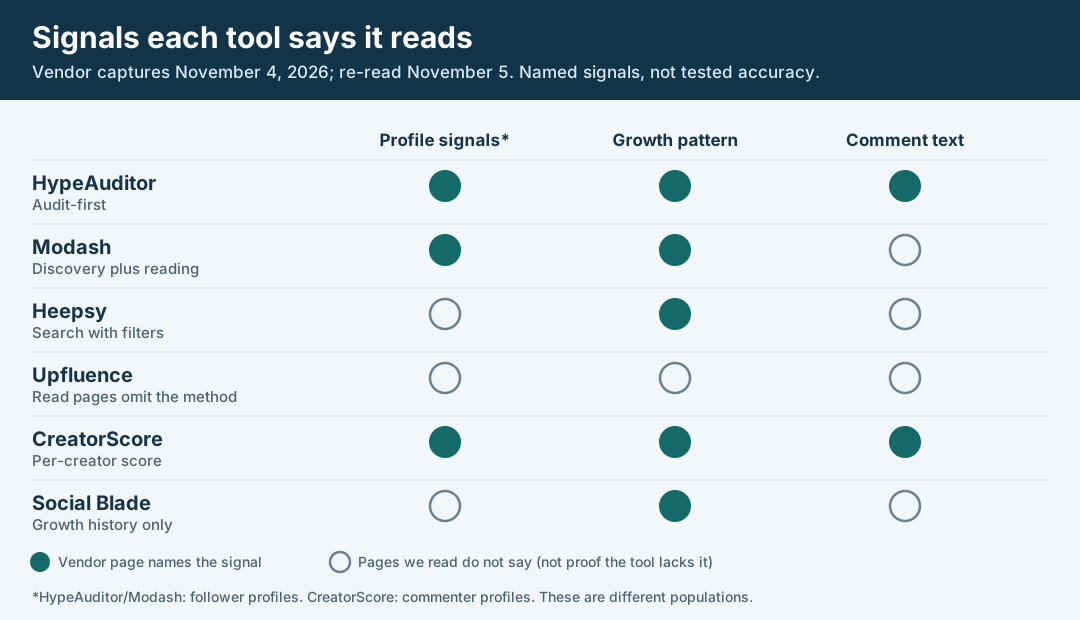
Original source-reading diagram, not a detector test. HypeAuditor and Modash name follower-profile signals; CreatorScore names commenter-profile signals. Empty circles mean the retained pages do not say, not that a product lacks the feature. Captures: November 4, 2026; re-read November 5.
Original visual by Superdirector editorial team. Creation date not recorded.
Compare the same volume and billing term
A person, a single-platform profile opening and a successful authenticity report are different billing units. CreatorScore says one credit covers one creator across platforms. Modash counts each detailed profile opening, even when the same creator is involved;300 openings do not promise 300 distinct creators or 300 usable authenticity estimates. Heepsy lists advanced-profile allowances. Check missing-data and repeat-read charges before pricing a roster.
| Option | Published term in the Nov 4 capture | Relevant unit or condition |
|---|---|---|
| Free spot checks | HypeAuditor and Upfluence advertise free Instagram tools; no established recurring quota. | Verify the actual field, available account and access requirements. Free does not establish accuracy or an unlimited roster. |
| CreatorScore one-time | First 50 creators in a UTC month at $9.99 each; subsequent one-time scores have marginal volume discounts. | 12 distinct first-tier creator scores cost $119.88. Recurring rescoring is $9.99/creator/month; daily monitoring is extra. These buy a wider score, not just follower percentages. |
| CreatorScore credit pack | $449 upfront for 50 nonexpiring credits; displayed equivalent $8.98/creator. | Unused capacity is prepaid money. Do not compare the unit price while omitting the upfront purchase or assuming every profile has enough data for a score. |
| Heepsy Starter | $89 billed monthly, or $69/month displayed on annual billing;100 advanced profiles/month. | The page says advanced profiles carry the reading; authenticity/quality search filters are listed under Plus. Verify the exact network and field. |
| Heepsy Plus | $199 billed monthly, or $149/month displayed on annual billing;500 advanced profiles/month. | Includes authenticity/quality filters. Annual-price and cancel-anytime wording do not establish the upfront charge or refund treatment; confirm actual terms. |
| Modash Essentials | $2,388 paid yearly, equivalent to $199/month;300 profile openings/month. | Monthly billing is offered, but the retained mixed-label card/savings text does not establish its flexible-month price. We do not derive $299. The authenticity fields remain Instagram-only. |
| HypeAuditor Basic | Its own cost blog says from $299/month billed annually; the pricing page is a demo form. | The blog puts the Account Quality Score search filter in higher tiers. That does not prove Basic lacks every quality report. Exact report allowance and higher-tier quote are unknown. |
| Upfluence paid platform | Custom quote; its FAQ states a 12-month minimum. | Separate from the free checker. No per-check price or authenticity-report allowance is established. |
One batch versus recurring work. Twelve first-tier one-time CreatorScores total 12 × $9.99 = $119.88. Heepsy Starter’s listed monthly subscription is $89 for its profile allowance, but that does not make the underlying outputs equivalent. Modash’s $199 annual monthly equivalent is not a $199 one-off invoice: the stated yearly amount is $2,388. Dollar symbols are as displayed; confirm invoice currency, taxes and the relevant checkout terms.
For a repeated budget illustration, assume 20 distinct first-tier CreatorScores each month, with no monitoring or extra checks. That is $199.80/month and $2,397.60 over 12 months. Modash’s stated annual amount is $2,388, but near-equal spending does not establish equal metric coverage, usable reports or risk reduction. Heepsy Plus’s listed monthly price is $199. You still need the same required network/output and a satisfactory actual report before choosing by price.
The useful purchase question is therefore “Which plan gives me the needed evidence for this roster and term?” A numerical crossover alone is not a recommended creator count at which to subscribe. Free checks, missing data, repeat openings, unused credits and wider features can all change the decision. We have not priced staff time or measured time saved.
Check the output in a trial before buying
Use a small sample of the actual accounts and networks you intend to assess. A familiar account can help you understand the interface, but familiarity does not supply labelled ground truth about every follower. A trial can test whether a field appears, whether you can inspect its supporting detail and whether the workflow is usable; it cannot establish detector accuracy by itself.
| Keep with the trial result | Question it answers |
|---|---|
| Exact account URL, network, metric label and direction | Did the tool analyze the intended account and return the kind of result we need? |
| Report date, period, accessible data and missing fields | Is this comparable in scope and time to the other evidence? |
| Named signals and supporting examples | Can we inspect why the estimate or flag appeared rather than rely only on a color or score? |
| Plan, credit/profile charge, export and repeat-read terms | What do we pay for a usable review, and what happens if data is unavailable? |
| Unresolved question and bounded next decision | What remains unknown before we commit to this creator or subscription? |
If the issue remains audience authenticity, continue with the manual evidence ledger. If the broader creator fit is unresolved, use the vetting rubric. The authenticity score glossary defines that wider term, and the platform comparison covers recruiting and campaign operations. No detector output alone clears the whole partnership.
Evidence limits. Seven retained reference pages and 17 primary texts were fully read with their capture hashes checked, using vendor descriptions for product claims and marking seller comparisons as such. Captures are from November 4, 2026; the re-read is November 5. No logged-in account, purchase, report export, real-account comparison, labelled fraud benchmark or support interaction was tested. We make no accuracy ranking, legal finding, accusation about a person, or promised reduction in losses. An unread or untested route remains unknown.