How-To Guide
Which verified UGC examples should a beginner brand study?
Study three dated brand examples through inspected photos and a community screenshot. Adapt the format and product role with an original brief.
By the Superdirector editorial team.
At a glance
Which verified UGC examples should a beginner brand study?
Study Apple’s credited photo outputs, Airbnb’s guest-photo context and Notion’s presentation of community-created templates. These three dated cases show the product as a tool, an experience setting or a workspace. Read the attribution, inspect the actual material, separate observed choices from source claims, and adapt one choice into an original brief with the required permissions. Four stills were inspected; video pacing and campaign outcomes remain unmeasured.
- Three brand-owned historical examples, with four specifically inspected stills and explicit limits.
- Learn product role, attribution and presentation while leaving payment, skill level and performance unknown.
- Use your own contributor, subject and evidence; no source photograph or screenshot is republished.
Choose the lesson from three dated public examples
A beginner brand can study Apple’s credited photography, Airbnb’s guest-photo storytelling and Notion’s presentation of community-created templates. They show three different product roles: the tool that produces an image, the setting for an experience, and the workspace in which someone makes something useful. Adapt the observable choice to your own product and evidence.
This is a small set of verified public examples for a brand beginning to use outside contributions in its content. We read the three brand-owned pages and inspected four specific still images: two Apple photographs, one Airbnb still and one Notion screenshot. The pages describe photographer, guest and community work in different contexts. They do not establish that every contributor was an unpaid customer, an amateur or a beginner.
The examples are dated 2019, 2021 and 2023. They are useful references for presentation, attribution and product role. They are not a current recruitment directory or a ranking of commercial performance. We have no campaign results, private contracts or comparative effectiveness evidence for them.
| Brand and public frame | What was personally inspected | Useful question for a beginner |
|---|---|---|
| Apple — Shot on iPhone winners, February 2019 | The full page plus Alex Jiang’s apartment-court photograph and Andrew Griswold’s droplet photograph | Can the product’s output carry the example while the credit explains which tool was used? |
| Airbnb — Made Possible by Hosts, February 2021 | The full page plus its Landslide-associated family/interior still | Can an actual experience and its context explain the service’s role? |
| Notion — reimagined Template Gallery, June 2023 | The full post plus its published Easlo creator-profile screenshot | Can a creator’s named artifact and use case make the product understandable? |
The list is deliberately limited to the three cases whose selected material we could inspect. We did not turn unavailable galleries or cached snippets into extra examples. Since the inspected material consists of stills, video pacing, cuts, spoken hooks and sound were not assessed. A thumbnail or written campaign description cannot supply those observations.
For the difference between customer posts, commissioned files and creator-account distribution, use the UGC versus influencer guide. This page studies specific examples rather than choosing a creator-supply platform or repeating a general campaign plan.
When enlarged, scroll horizontally to read the diagram.
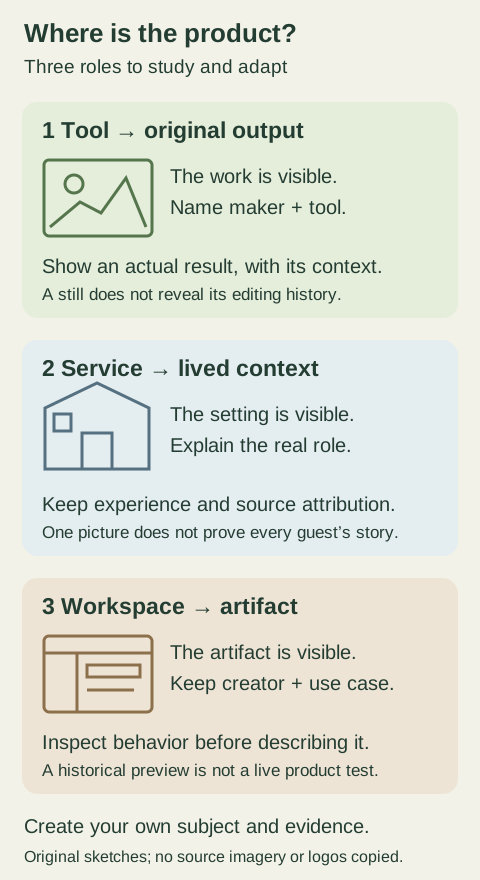
Original generic illustration of the three product roles. It does not reproduce the reference photographs, screenshot or brand logos.
Original visual by Superdirector editorial team. Creation date not recorded.
Study Apple’s credited photographs as product output
Apple’s February 26, 2019 winner page identifies the photographers and iPhone models beside their images. It says the selected photos would appear in physical and online destinations. That statement describes the announced use; it does not reveal individual contracts or establish what the campaign sold.
| Selected still | What is visible | Where the product appears |
|---|---|---|
| Alex Jiang’s photograph, credited to iPhone XS Max | A horizontal view of a multicolored apartment facade, a basketball hoop near the center and people low in the frame | The iPhone is named in the attribution; no phone is visible in this selected photograph |
| Andrew Griswold’s photograph, credited to iPhone XS | A vertical field of water droplets against a blurred colored background, with repeated small refracted patterns | Again the named tool is outside the image; the image itself is the demonstrated output |
The transferable idea is to let a real result made with the product become the subject, then keep its maker and relevant context legible. A drawing tool could show a user’s original drawing. A craft kit could show the actual finished object. A software tool could show a real artifact the person made. Those are original suggested applications, not observed Apple campaign extensions or claims that they will perform similarly.
Apple’s page also includes judges’ commentary on composition. We read those comments but did not independently test the camera features or reconstruct the capture/editing process. The two inspected JPEGs do not prove exposure settings, editing history, effort, cost or a formula for photographic quality.
- Choose an output that actually exists and whose relationship to your product can be supported.
- Keep the creator’s credit and relevant product/version context with the example.
- Describe the visible result accurately; leave unobserved technical or production claims unknown.
- Create a new example with your own contributor and subject. Do not reuse these photographs or imitate their exact arrangement.
A beginner does not need to reproduce an award-winning image to learn this choice. The narrower task is to make one actual product output understandable. If the output could have been made without your product, provide the truthful source context rather than treating the picture alone as proof of its origin.
Study Airbnb’s guest-photo story as an experience
Airbnb’s Made Possible by Hosts page describes a series of videos built from real photographs from guests’ stays. It organizes the stories around named guests and hosts. The source calls several contributors photographers; we make no assumption that the material was casual, unpaid or inexpensive.
We inspected the page’s family/interior still associated with Landslide. It shows a young child, an adult with a baby carrier, luggage and furniture, with open doors toward a deck and water. The scene presents people inside a place. There is no booking interface or phone screen in that selected still.
The written Landslide story names Cole and family, François and Ashley, and a later stay with another host. We did not independently identify the exact property or every person in the still. Keep the source’s narrative attribution separate from an image observation: seeing a family in a room does not prove the booking, the relationship, the experience of every guest or a commercial outcome.
For a service brand, the transferable choice is to show the experience and explain the service’s actual role in making it possible. A workshop might feature a participant’s actual finished work with a permitted story about the session. A rental business might feature a real customer use context. Those are editorial ideas to investigate, not verified examples from those businesses.
| Take from the example | Make it original for your brand | Do not infer from one still |
|---|---|---|
| A specific lived context | Ask the contributor what happened and which facts they permit you to share | That every customer has the same experience |
| The relationship between people and service | Name the actual service contribution with the person’s agreed context | A photograph alone verifies a booking, purchase or satisfaction |
| A readable story around the image | Use the contributor’s real account and approved facts | The montage’s cut speed, music, narration or full sequence |
The videos themselves were not watched. We therefore give no runtime, cut-frequency or soundtrack analysis. If your intended reference is a video, watch the full accessible version before describing its pacing, then record the actual beats you observed. A still can be an image reference without becoming a video review.
Study Notion’s presentation of community-created work
Notion’s June 21, 2023 gallery announcement introduces creator profiles and templates from its community. It also explicitly includes bundles built by Notion. That distinction matters: a gallery can mix company work and outside contributions, so do not call every tile an independent user creation without checking its attribution.
The inspected historical screenshot shows the Easlo creator name and handle, a description and a recommended-creator badge alongside named template previews. Visible examples include Expense Tracker, Book Tracker and Student Planner. The product is present as the workspace/interface in which these artifacts are presented.
This is a brand-published screenshot presenting community-created artifacts. We inspected the picture and the surrounding announcement. We did not open, duplicate or test the templates, inspect a live account, verify the contributor’s biography, or confirm current prices, availability or badges. A historical screenshot is not a current product demonstration.
The transferable choice is to pair a contributor with a useful artifact and a concrete use case. For a brand that sells a tool, it can be clearer to show what someone made and what it is for than to ask for a generic compliment. Use the real contributor’s work and describe only the part you can support.
- Keep the person and artifact connected rather than stripping the credit from a preview.
- Explain one actual use case in plain language. A title such as a tracker names a task; it does not prove the tool improves every user’s results.
- Separate your own examples from community contributions, including who created the displayed material.
- Inspect the actual artifact if you intend to describe its functionality. A preview can support a composition observation while leaving behavior unknown.
For a physical-product brand, the corresponding original idea might be a credited customer-made arrangement or project with the item’s actual role explained. That is a planning analogy. It does not turn a styled brand photograph into evidence of independent customer experience.
Turn one observed choice into an original brief
Choose the example whose product role resembles the evidence you can actually obtain. A camera-output example is useful for a tool that produces something. A guest-experience example is useful when the service context matters. A credited artifact example is useful when a user’s work makes the product easier to understand. None of these choices establishes which format will sell more.
Original fictional exercise: imagine a small brand offering a picnic mat. No such product, customer or campaign was inspected. The brand wants a new contributor to show how the actual mat fits into their own picnic setup. The brief below adapts the idea of a visible product role and clear attribution, without copying any source image or promising an outcome.
| Brief decision | Fictional starting instruction | Evidence still needed |
|---|---|---|
| Question to answer | What does the mat look like in the contributor’s actual picnic setup? | The real product and permitted use conditions |
| Original subject | The contributor’s own picnic setting and composition | Permission to feature the setting and any other visible material |
| Product role | Show the actual mat clearly enough to identify its use | Current product facts and the exact supplied item |
| Creator context | Keep the agreed name/credit and explain what they actually did | Contributor agreement and truthful account of experience |
| Use | Discuss the particular brand channel and intended presentation | Actual permissions, term, editing/cropping and any paid-use scope |
| Review | Check item accuracy, unsupported claims and the approved version | Named brand/product owner and contributor feedback |
| Unknowns | Do not claim durability, comfort, weather resistance, sales or video pacing from a single proposed photo | Actual evidence for any additional claim |
The reference-to-brief sheet and blank CSV help separate what was observed, what the source claims, what remains unknown and the original choice you will make. They are manual editorial aids without account connections, automatic saving or production. The creator brief template handles the fuller assignment.
Public availability is a place to study a reference, not your reuse permission. For a concrete public example of a permission process, IKEA’s published license page asks before using selected visual content and sets its own terms. Its wording, jurisdiction and route are specific to that arrangement. Do not copy a large brand’s license or assume a hashtag, credit or an internet image gives your brand the same rights. Use the usage-rights checklist to name your actual intended use.
When a contribution is an endorsement, apply the relevant market and platform responsibilities. FTC staff guidance for relevant U.S. endorsements describes benefits such as free products, clear disclosure and truthful experience. The selected examples do not reveal all compensation or contractual relationships, so this guide does not decide their compliance or supply a universal disclosure formula.
Sources and inspection limits
Before drafting on November 5, 2026, Pacific time, we read all three brand-owned pages in full and personally inspected the four retained public stills described above. Apple’s page is dated February 26, 2019; Airbnb’s visible publication date and structured metadata identify February 24, 2021; Notion’s post is dated June 21, 2023. These dates describe the examples, not a current campaign opening.
Three full-page text/HTML anatomies informed the attributed example, guest/story context and community-versus-company distinctions. We also read the full public IKEA license text and FTC guidance. We did not copy the reference images into this article’s public assets. The diagram and blank worksheet are original. No video, private analytics, original creator account, contract, payment, campaign result or live template was tested.