How-To Guide
Show an asynchronous game turn without editing it into live multiplayer
Show the actual handoff and waiting period in an asynchronous game demonstration without making it look like live multiplayer.
If players do not need to be present at the same time, make that visible in the demonstration. Show one player finishing a turn, the other player's return and the resumed match. A rapid back-and-forth montage can accidentally sell an asynchronous game as a live session with immediate responses.
For an iPhone game using GameKit turn-based matches, distinguish a turn message from a separate reminder. Apple's documentation describes different behavior depending on whether the receiving game is foregrounded, backgrounded or not running. The app also needs to handle the event that brings a player into the relevant match. Apple's turn-based messaging guide
Two separate discussions identify the timing information worth showing. A GameKit developer testing another developer's game found its invitation-sent message misleading because they expected something on the other device immediately; they also clarified that an invitation did arrive after the first move. A board-game player seeking asynchronous games explicitly wanted to start without everyone occupying a lobby together and to receive useful turn notifications. These are individual experiences and requirements, not proof that any named app behaves the same way today.
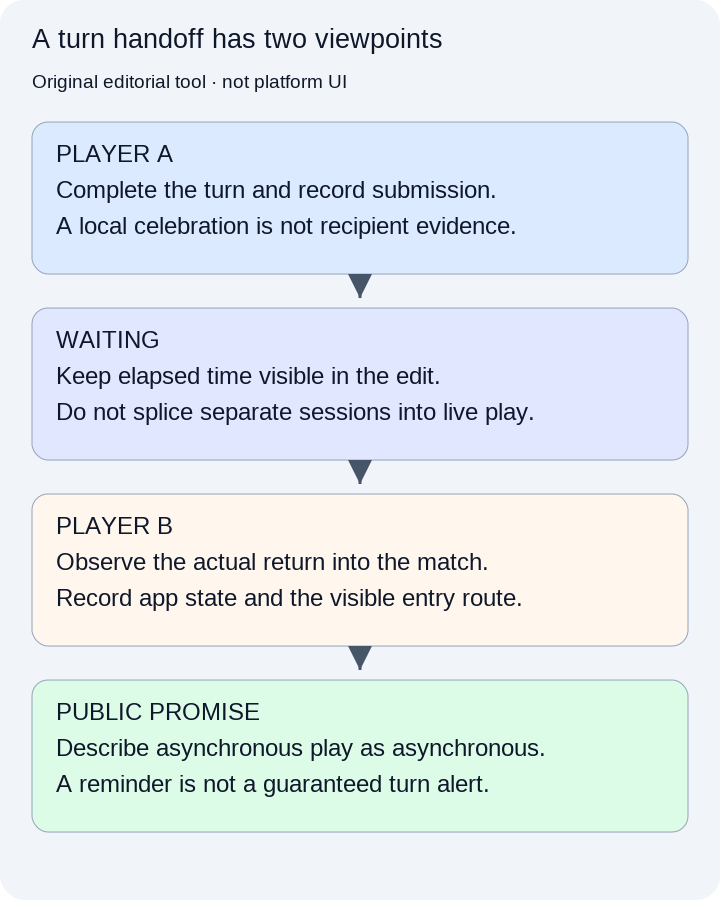
Original editorial decision tool, not platform UI or a measured product result.
 Superdirector
Have your AI do this for your brand.
7 days free, then $29 a month.
Define what the viewer is supposed to understand
The essential promise is not “multiplayer works.” It is “you can complete your part, leave and return to the continuing match under these conditions.” State any actual deadlines or turn-expiry rules before a creator describes the game as play-at-your-own-pace.
For the fictional iPhone strategy game Postcard Islands, imagine two players placing routes on a shared map. One can take a turn during a break and the other later. Those are invented mechanics for a teaching example, not a tested GameKit implementation.
The demonstration should answer four questions: how do I know it is my turn, what commits my move, what does the other player receive, and how do I return to the right match? If the video only shows the board changing, it leaves the defining asynchronous experience unexplained.
Capture both sides of one actual handoff
Use consenting testers and an authorized test match. Identify the build, game mode and match privately so the two recordings can be matched without exposing account information. Start with the first player's current turn and record the action that completes it.
On the receiving side, inspect the intended state rather than assuming all states look alike:
| Receiving game state | Evidence to retain |
|---|---|
| Already in the foreground | The game's own presentation of the incoming turn or match event. |
| In the background | The observed notification and return route, under the tested settings. |
| Not running | The observed notification, launch and match selection. |
Apple distinguishes these presentation paths. A foreground recording with a notification added in the editor is not proof of the real notification route. Keep any explanatory mockup labeled and separate from acceptance evidence.
Preserve the waiting period in the story
The public edit can omit uninteresting elapsed time, but label the omission. For Postcard Islands, a sequence might show “Mara completes her turn,” then “Later, Jules returns,” followed by the actual resumed match. Those fictional names identify roles, not accounts.
Do not use a fabricated timer or make the receiver appear to respond immediately if that would change the viewer's expectation. Conversely, a test conducted quickly does not mean the game requires both players to remain online. Explain the actual supported timing rather than letting the edit accidentally define it.
Show enough of the return to establish continuity: the same match, the relevant prior move and the next available action. A successful launch to the main menu is not evidence that the invitation or notification resumed the intended match.
Keep reminders out of the turn-completion claim
A separate reminder is not the same event as ending a turn. Apple's guide says its reminder notification appears only when the game is not running, unlike the turn-message behavior it describes for a backgrounded game. Do not film one and label it as the other. Apple's turn-based messaging guide
If reminders are part of the product, show them as an optional, accurately described feature. Do not promise guaranteed attention, immediate delivery or a response from the other player. Avoid a campaign that encourages repeated nudges until someone plays; an asynchronous game should not be marketed as permission to pressure a friend.
When a message or return path fails in the rehearsal, retain the first observed sequence and send it to the implementation owner. Do not change notification settings without consent or diagnose every failure as a player mistake.
Frequently asked questions
What must an asynchronous game demonstration explain?
SuperdirectorHave your AI do this for your brand.
7 days free, then $29 a month.