How-To Guide
When party-game visitors arrive alone, treat the group as the acquisition unit
A visitor creates a room in your browser party game and leaves without starting a round. That observation does not tell you whether the game is…
By the Superdirector editorial team.
A visitor creates a room in your browser party game and leaves without starting a round. That observation does not tell you whether the game is confusing, the invitation is broken, or the visitor simply has nobody available to play with right now.
For a game that requires simultaneous human participants, acquisition has a social dependency. Bringing one interested person to the site is not the same as bringing a group into a shared activity. Before buying more traffic or rebuilding the lobby, determine which dependency is missing.
The next decision may concern the audience, the invitation, the product experience or an unresolved technical failure. These are different problems. A new room-code button cannot solve all of them.
Keep the visitor's intention separate from your explanation
A browser party-game developer described individual visitors creating rooms but not starting games. The developer suspected that people did not have friends ready at that moment, but also questioned whether the promotional wording implied immediate access to other players.
The thread contains two important corrections to easy advice. The game already offered both a room code and a copied invitation link. The developer had also tried scheduled “join solo” playtests and found them hard to fill. Recommending a link or a scheduled event without acknowledging those facts would simply repeat work that had not resolved the reported problem.
Treat the author's explanation as a hypothesis, not a diagnosis you can inherit. For your game, ask willing visitors what they expected and what prevented their next step. A person who expected automatic opponents has a different problem from someone who understood the requirement but was browsing during a work break.
Do not infer lack of interest from an unavailable group. Equally, do not interpret curiosity as a promise to organize friends later.
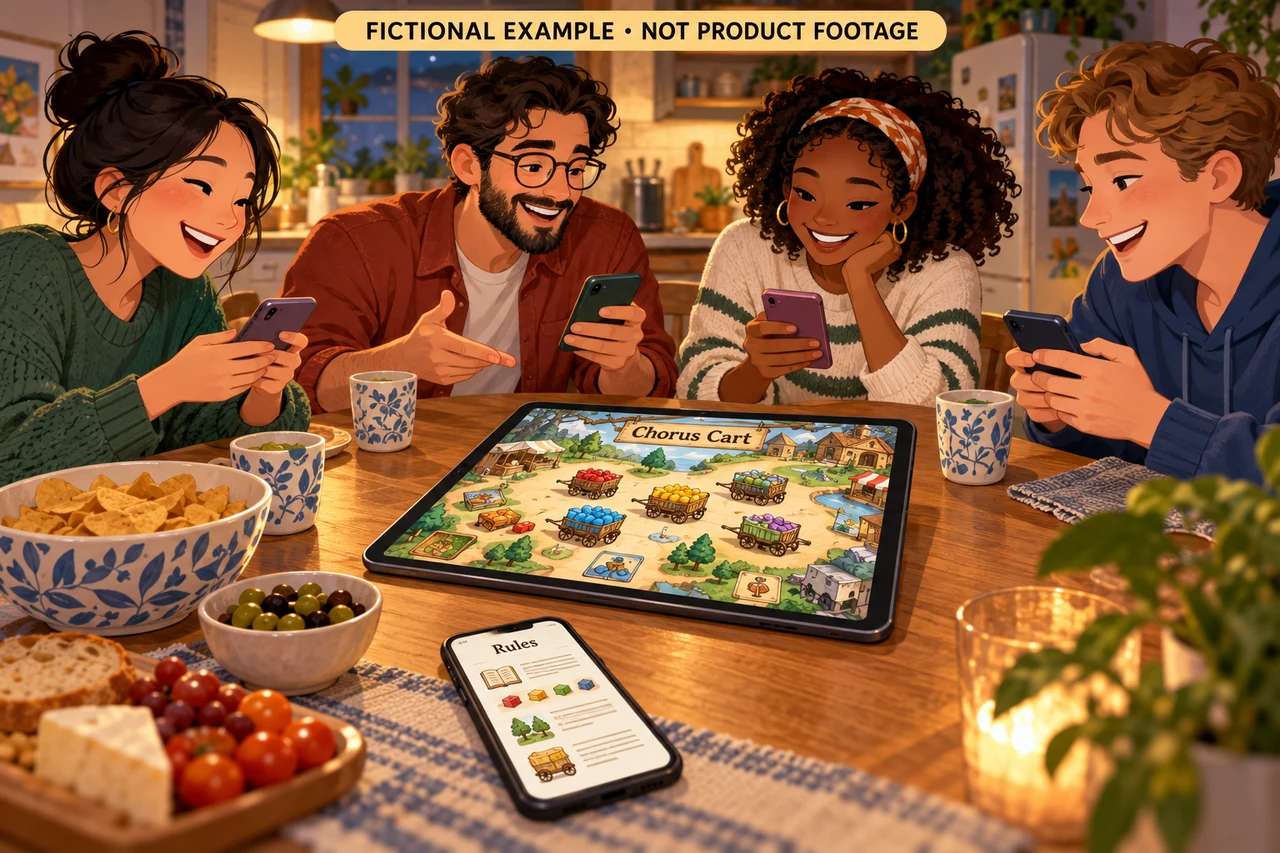
The fictional Chorus Cart scene distinguishes a group ready to trade from one visitor reading the rules. It is not a recruited session or acquisition result. Original AI-generated editorial illustration.
Original visual by Original editorial illustration generated with OpenAI’s built-in image tool. Created 2026-10-24.
Choose what a lone visitor can honestly do
For Chorus Cart, there are several possible invitations, but only those supported by the actual product are valid.
An immediate group-play invitation suits people who already have the required participants available. A later-play invitation can help an interested host understand what to bring to a future occasion. If the game already has a genuine solo demonstration, that can explain a limited part of the experience now. It must not masquerade as the full social game.
These are not instructions to add bots, invent a solo mode or build public matchmaking. Each is a product decision with costs and consequences. A tutorial can teach controls without showing whether negotiation among four people is enjoyable. A computer-controlled opponent may change the experience rather than remove a minor inconvenience.
A separate developer of Hidden in Plain Sight asked whether adding online play would preserve the value of a local social game. In a later reply, the author reported a beta with online and expanded local-player support, and described apparent interest in the latter. That is a scoped development account, not proof that local or online play is generally superior. It reinforces the need to test the social proposition rather than treating a networking feature as an automatic acquisition fix.
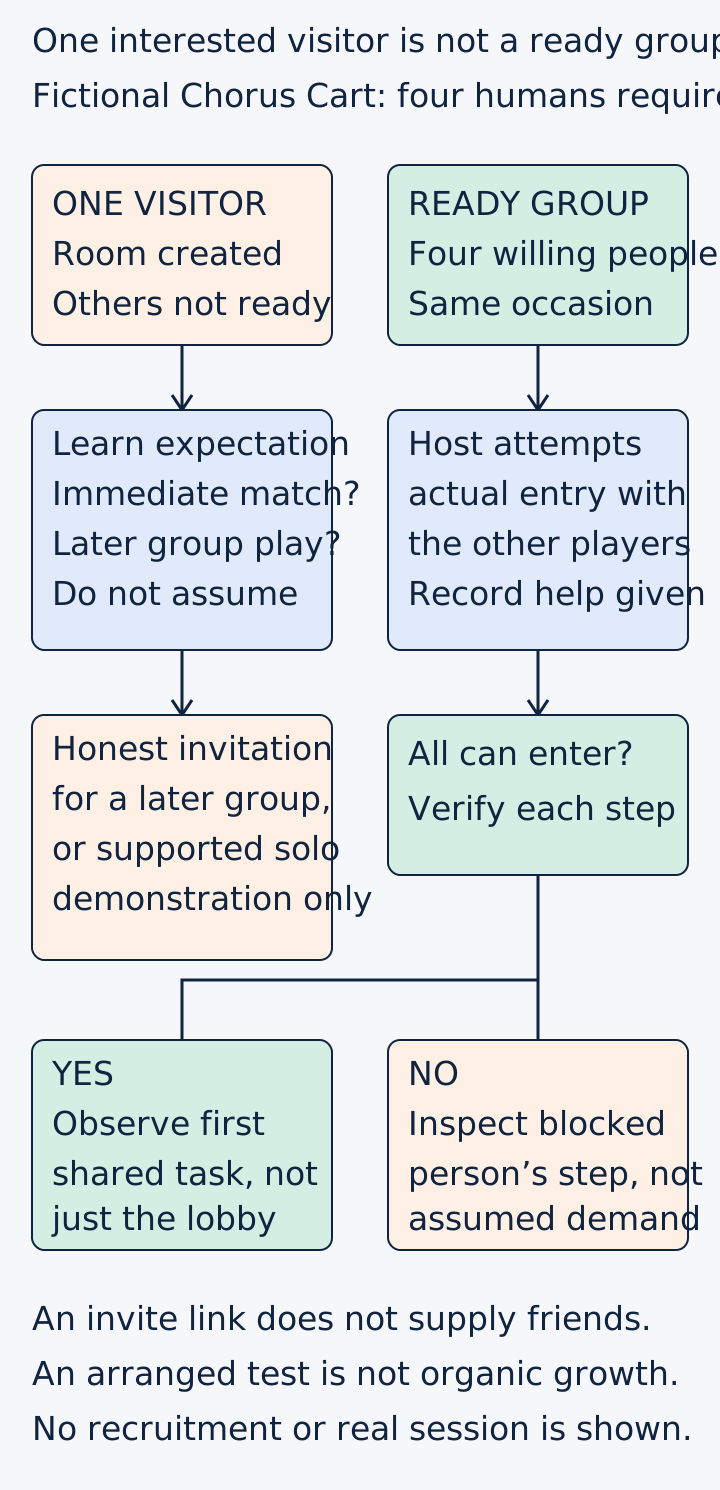
Original decision model for fictional Chorus Cart. No people were recruited and no session, product feature or acquisition result was tested.
Original visual by the Superdirector editorial team. Creation date not recorded.
Use an arranged group test for the question it can answer
A deliberately arranged session can reveal whether a willing group understands the game and whether a host can get it started. It does not establish that strangers will independently organize their friends, or that scheduled recruitment is an effective channel.
If a session is authorized, let a willing participant act as host rather than having the developer operate every step. Record where help is needed and distinguish unaided actions from assisted ones. Observe the first shared task and whether the social interaction the game depends on actually occurs. Do not turn the observation into a rehearsed promotional performance.
Keep recruitment evidence separate. How did this group form? Did the participants already know one another? Was the developer personally coordinating them? Were they compensated under an approved arrangement? These conditions affect what the session can teach about the ordinary customer journey. They do not make the feedback worthless, but they prevent an arranged success from becoming an unsupported scalability claim.
Because the source operator already struggled to fill scheduled sessions, “schedule a game night” is not a conclusion. A useful next investigation might instead identify whether an existing willing group's normal occasion fits the game, or whether the current invitation asks a lone visitor to do too much coordination. Neither possibility authorizes unsolicited recruitment.
Finish with one specific decision
Choose the next action from the evidence you actually have. Clarify an unsupported immediate-play expectation; investigate a host's real group and occasion; inspect an observed entry failure; or evaluate whether a limited solo demonstration is worthwhile. A hold is appropriate when the necessary people or product evidence are missing.
For any later authorized acquisition test, keep individual visits, rooms created, groups assembled, shared rounds started and repeat group play distinct. Do not count empty rooms as active groups or claim that a successful session caused durable retention.
The aim is not to make every visitor bring friends on demand. It is to match the invitation and product to the social unit that can actually use them, then learn where that unit fails to form or begin playing.