How-To Guide
Show how players join your co-op game, not just that four characters exist
Four characters fighting together can mean several different things to a prospective buyer. Perhaps friends arranged a private session.
Four characters fighting together can mean several different things to a prospective buyer. Perhaps friends arranged a private session. Perhaps the player selected a public lobby. Perhaps the game found teammates automatically. A trailer that shows only the fight leaves the entry route to the viewer's imagination.
Before making a multiplayer launch claim, decide which route the released build actually supports. Then record that route, including what happens when nobody suitable is available. A staged successful session is useful footage, but it cannot prove a healthy player population or an instant match.
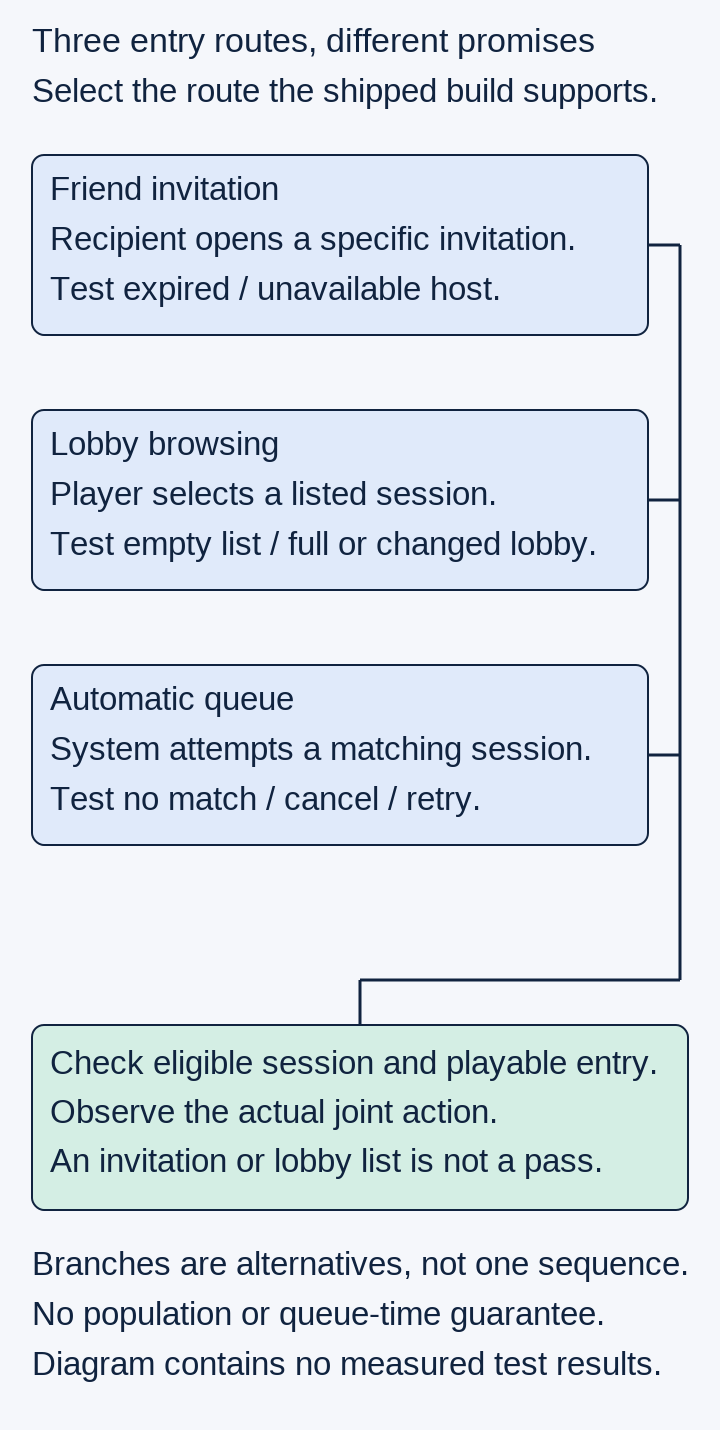
Original worksheet. It does not assert that a particular game implements all three routes or has available players.
 Superdirector
Make it work for your brand
Find it. Remake it. Post it. Superdirector turns the viral formats in your niche into your brand's carousels, X posts and video scripts, and keeps the calendar full.
Separate three promises
Use these working distinctions when reviewing your footage:
- Friend invite: a known player invites another person into a session.
- Lobby browsing: the player chooses an available session from a list.
- Automatic queue: the game searches or groups players without requiring them to select a particular friend or listed lobby.
These are editorial labels for a verification worksheet, not a claim that Steam supplies every feature automatically. Your game may support one, several or none of these routes.
Valve's lobby documentation separates finding and grouping users from connecting them to the eventual game host or server. That distinction matters to a trailer: reaching a lobby is not the same as reaching playable co-op. Steam matchmaking and lobbies
Make a short inventory from the actual build. List the menu label, who can use it, required ownership or access, supported party size and the observed result. Mark an untested field unknown. Do not fill a blank from the design roadmap or a prototype video.
Record an invite all the way into play
For a fictional two-player salvage game, create a private session using the team's approved test setup. Invite the second test account, show the join, and continue until both players perform distinct actions in the same mission.
The evidence receipt should name the build and session type, not expose account credentials or private identifiers. Record any required setup that the public edit might otherwise hide. If both players need their own copy, confirm that requirement for the actual product before writing the caption.
An illustrative caption is: “Friend-invite co-op, shown with two test accounts.” This does not promise an automatic teammate finder. If the game also offers a public route, give that route its own recording rather than letting the viewer infer it from the private session.
The test is incomplete if it ends at an invitation toast. A guest might reach a lobby and still fail to enter the mission. Keep that failure as a separate observation with the first blocked step.
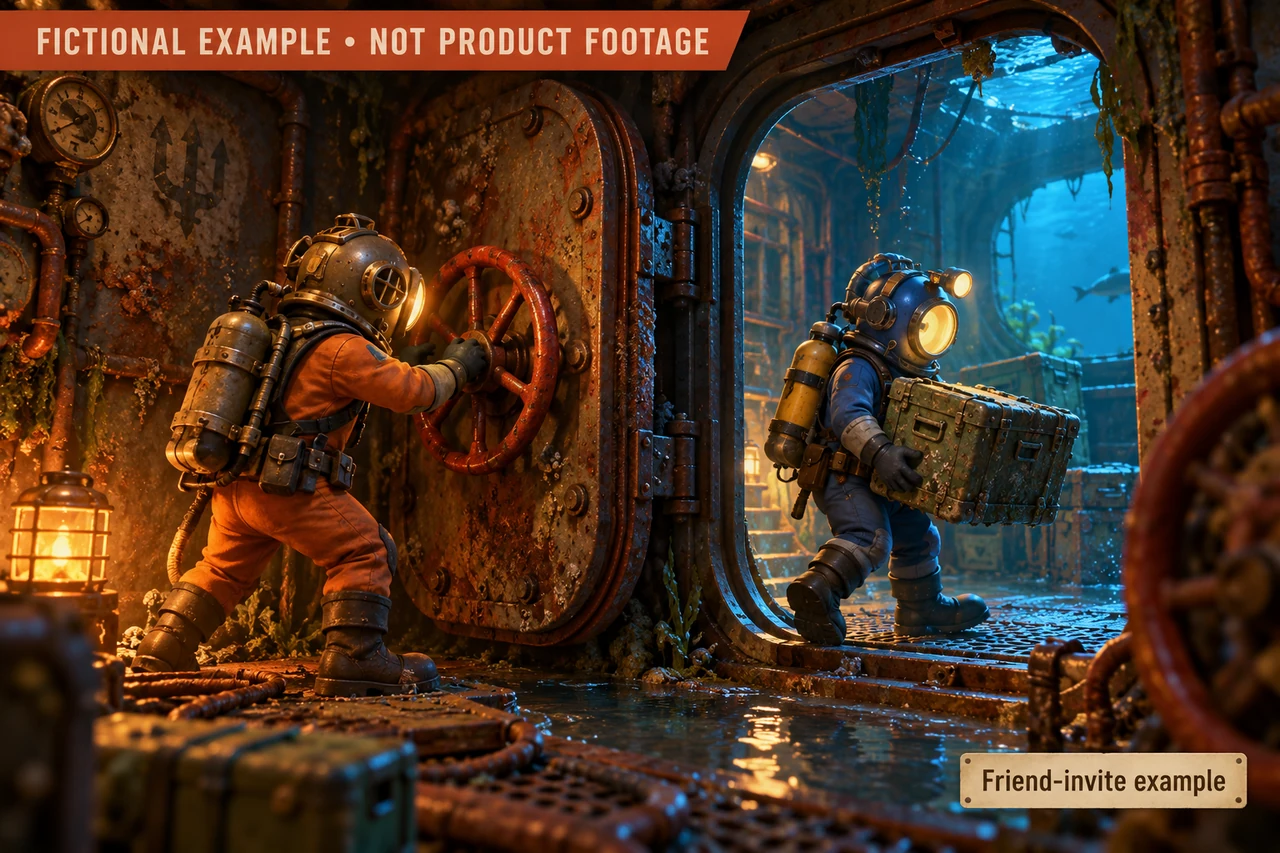
Two fictional salvagers perform complementary actions after a friend-invite setup. The illustration does not imply automatic matchmaking or a tested network session. Original AI-generated editorial illustration.
Capture the no-session case as deliberately as the success
For a public queue or lobby browser, inspect the empty result using a controlled test environment where possible. Does the interface explain the outcome? Can the player cancel? Does it offer another mode that actually works?
Do not invent a solo fallback because it would make the tutorial more reassuring. If a game requires other people to proceed, the explanation should preserve that limitation. If retrying changes region or search criteria, verify the exact behavior before showing it as advice.
Steam's matchmaking API includes distance and open-slot filters, plus sorting options. Those mechanisms describe how a search can be constrained; they do not establish that your game currently has compatible players waiting. Steam matchmaking API reference
Keep the empty path and successful path as separate clips. Combining an empty search with a later staged session into one apparently instant transition misrepresents what happened.
Do not confuse available code with available play
Developer discussions reinforce the need to distinguish implementation plans from shipped features. A historical cooperative-game developer described the scope of matchmaking work and ultimately deciding to release without multiplayer. Treat that as a reported project decision, not proof that multiplayer is generally a bad investment. Historical developer discussion
For your own release, compare the trailer claim against the build that customers will receive. A feature flag enabled in a recording branch may not be enabled in production. A staff-only lobby can demonstrate an interaction while saying nothing about public discoverability.
If the only evidence is a prototype, call it a prototype and keep the launch claim pending. A roadmap commitment is not a substitute for a working join route.
Review the edit from the buyer's point of view
Ask a person unfamiliar with the project to watch the draft. Then ask:
- Would you need to bring a friend, choose a lobby or wait for automatic matching?
- What did the video actually show working?
- What happens if no session is available?
- Did the clip promise a wait time or player population?
Write down their interpretation. If they infer an unsupported feature, revise the menu footage or caption. Do not use an enthusiastic reaction as proof that the joining model was understood.
This is a proposed comprehension check, not a completed experiment. It produces a concrete revision decision without pretending to measure sales uplift.
Keep release evidence and outcomes separate
The completed content packet should contain the mode inventory, uncut successful route, empty-result route, captions and exact build identifiers. A product owner should verify the final menu and store description agree with the footage before publication.
After release, queue observations need a date, region, mode and test conditions. A single successful match cannot establish always-on availability. Views, qualified visits and paid purchases are different outcomes and should remain separate from technical join success.