How-To Guide
Explain both sides of an app referral reward before creators share the link
Show each person’s eligibility, qualifying action and confirmed benefit before a creator presents an app referral reward.
By the Superdirector editorial team.
A viewer can add a friend, install an app or accept an invitation without satisfying the conditions for a referral reward. A creator who says “use my code and we both get this” can therefore make a misleading promise even when the code itself works.
Before distributing a referral creative, write two explanations: what the inviter must do and receive, and what the invited person must do and receive. Connect them through the actual qualifying event. Do not treat sending, friendship, installation and reward delivery as interchangeable milestones.
Use the question people actually ask
In one Finch customer discussion, a person expected rewards after adding friends and later explained that they had previously used the app. Replies distinguished adding existing friends from a new-user referral. This is a historical expectation problem, not proof of the current eligibility of that account.
A separate customer discussion describes a friend downloading and accepting an invitation while neither person saw the expected reward. The thread does not establish the cause or a resolution. Do not turn it into a claim that the program is broken or that all rewards arrive after a particular delay.
Together, these are qualitative evidence for a specific content decision: the campaign needs to explain what counts, for whom, and what confirmation follows. They do not establish referral conversion rates or justify pressuring people to recruit friends.
Build a two-sided reward card
For a fictional language-practice app called Phrase Garden, imagine a proposed referral benefit that unlocks a practice theme. The example does not assert that the app exists, that referrals improve learning, or that this reward structure is commercially effective.
Before filming, fill in a card using the real product's current rules:
| Field | Inviter side | Invited-person side |
|---|---|---|
| Who is eligible? | Actual account and campaign requirements | Actual new or existing user requirements |
| What action matters? | Deliberately sharing the supported invitation | The precise qualifying action, not merely opening the link |
| What is received? | Exact benefit, including any cap | Exact benefit; do not assume it matches the inviter's |
| When does it count? | Confirmed rule and any processing state | Confirmed attribution window or other deadline |
| How is it checked? | Supported progress or reward record | Supported confirmation and help route |
A single “reward unlocked” graphic cannot substitute for these answers. If one side gets a theme and the other gets progress toward a later reward, say that. If returning accounts can connect socially but do not qualify for the acquisition reward, explain the distinction without implying that they are unwelcome.
Resolve source conflicts before making a countdown
Finch's official Invite Rewards page, checked on October 26, 2026, distinguishes new-user eligibility and the two sides' benefits. It also contains a conflict: one section says five days to enter referral information, while another refers to a 48-hour window. This article does not choose one deadline or diagnose the service's actual implementation.
That is a practical stop condition. If your own help page, app screen and creator brief disagree, do not publish a deadline until the accountable product owner resolves it against the actual current rules. A search excerpt or old customer reply should not win merely because it makes cleaner copy.
Keep the resolution record dated. A later rule change can leave an old creator caption or pinned explanation promising an obsolete reward. Update or retire the affected asset rather than leaving viewers to discover the discrepancy after joining.
When enlarged, scroll horizontally to read the diagram.
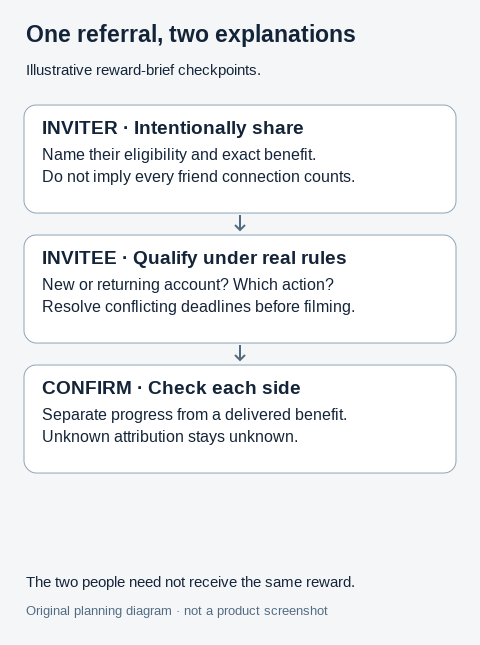
Original two-sided referral model, not a tested reward flow.
Original visual by Superdirector editorial team. Creation date not recorded.
Rehearse three cases without sending real invitations
First, inspect an authorized test case representing an eligible new participant. Follow the actual invitation route and verify the qualifying event in the supported test environment. Record each side's state separately. Do not manufacture production accounts or recruit real people merely to make a marketing test pass.
Second, inspect a returning participant if the product distinguishes that case. The explanation should say what still works and what reward does not apply. Do not advise deleting accounts, changing identities or repeatedly reinstalling to bypass eligibility. A reinstall is not evidence of a genuinely new customer.
Third, inspect an unconfirmed or failed attribution state. If the product cannot establish that the qualifying event occurred, the creator should not promise a manual reward or a guaranteed support fix. Provide the actual private help route and the minimum information it needs. Do not ask viewers to post account details, private messages or a friend's information in public comments.
Keep these as proposed checks until they are performed. The fictional Phrase Garden plan supplies no test result.
Measure the qualifying event, not the loudest count
For later authorized evaluation, keep shared invitations, arrivals, eligible participants, qualifying events and confirmed benefits separate. A large share count does not establish delivered rewards or useful new users. Missing attribution should remain unknown rather than being credited to the most recent creator link by guesswork.
Ask a reviewer to explain what each person receives and which action triggers it. If they say “adding any friend is enough” when that is false, revise the content. If the team itself cannot resolve the reward rules, hold the referral promise. The next useful acquisition asset may be a plain product demonstration until the offer is ready to explain.