How-To Guide
Design a dating-app invitation without turning Contacts access into a mass message
A person who lets an app see a contact has not necessarily decided to invite that contact. And a recipient who receives an invitation has not become a member.
A person who lets an app see a contact has not necessarily decided to invite that contact. And a recipient who receives an invitation has not become a member. A referral feature needs to preserve both distinctions before it becomes a growth channel.
For an adults-only dating-app founder, the useful deliverable is an unsent, two-sided invitation prototype: what the sender knowingly chooses, and what the recipient can reasonably understand. This is a product-planning exercise, not a message campaign or a claim that a particular service broke a rule. Use invented contacts throughout.
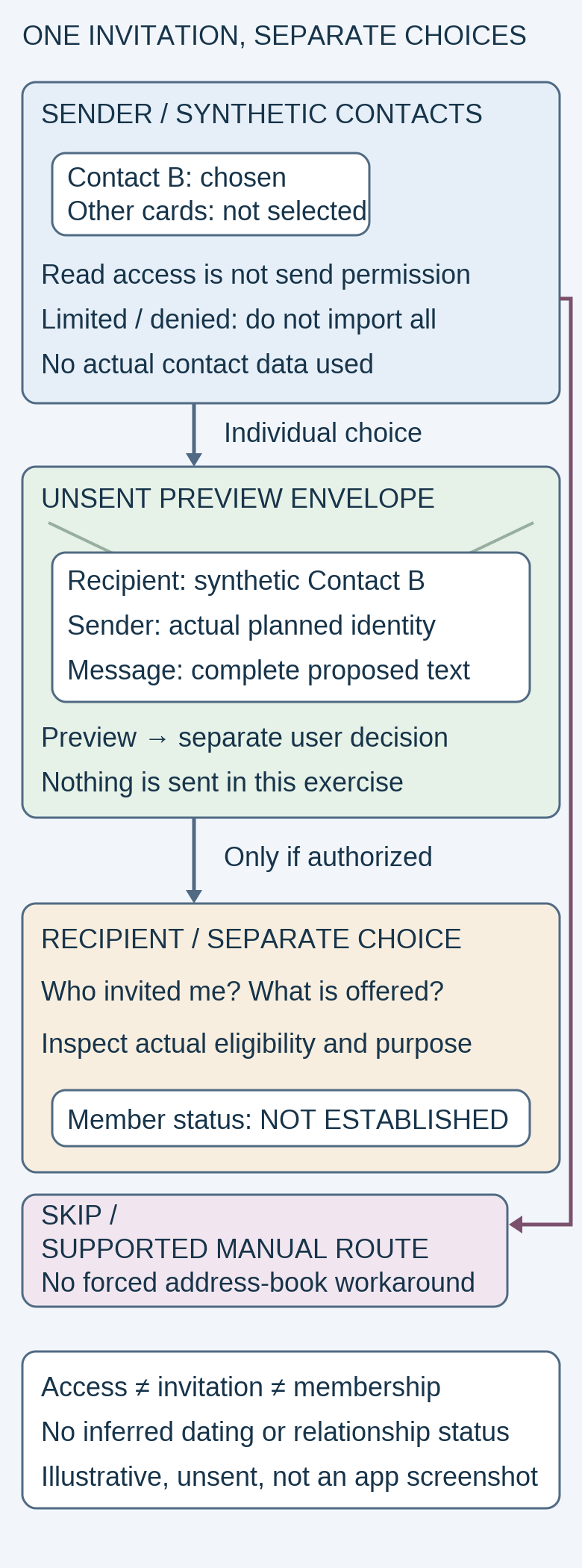
Illustrative planning diagram only. The cards are synthetic; no device interface was captured and no invitation was sent.
 Superdirector
Make it work for your brand
Find it. Remake it. Post it. Superdirector turns the viral formats in your niche into your brand's carousels, X posts and video scripts, and keeps the calendar full.
Start with the question the recipient will ask
“Why did I receive this?” is a different question from “How do I install the app?” A download destination cannot repair an invitation whose origin is unclear.
Two independently authored recipient discussions about the same service describe uncertainty over invitation provenance and the meaning of mutual contacts. In the second discussion, people also question passing a similar invitation to others. These are qualitative reports, not verified descriptions of the service's internals. Replies disagree and make unverified allegations; this guide does not adopt them. The posts do not establish prevalence, a legal violation or a conversion rate.
The editorial lesson is narrower: explain the invitation itself before asking a recipient to interpret a relationship graph. Do not imply that a named contact has a dating profile, is single, is nearby or wants to meet them merely because an address-book relationship exists. An entry in a contact list can represent many kinds of past interaction. Its existence is not evidence of current participation.
Separate three decisions in the product specification
First, what contact information may the application access? Second, whom does the person intentionally choose to contact? Third, what does the recipient decide after receiving a clear invitation? These are different actors and different permissions, not three automatic steps in one conversion funnel.
Apple's App Review Guidelines, section 5.1.2(v) require individualized user initiative for contacting people through information collected from Contacts or Photos. They prohibit selecting all contacts by default or providing a Select All option, and require explaining the recipient-visible message and sender before sending. Nearby sections also constrain repurposing collected data and using it to build a contact database. These are platform requirements, not a complete legal or product-readiness assessment.
Translate that boundary into a design review question: can the team point to a separate, understandable invitation choice after any contact-access decision? If the only evidence is a permission dialog followed by an automatic dispatch, the proposed flow is not ready to promote.
Do not count a screen that says “Continue” as evidence of informed intent when it hides the communication's meaning. Inspect the full screen, the action label, the destination and any default selection together. A paragraph in a policy document is not a substitute for a clear moment of choice.
Limited access is not a broken version of full access
Apple's Contacts guidance describes full, limited and denied access. With limited access, the person chooses which contacts the app may use and can change that set later. The framework also distinguishes not-yet-determined and restricted states. These technical states do not authorize invitations by themselves.
Specify what the proposed feature does when access is limited or unavailable. A supported manual share route may be appropriate; a clear way to skip may be enough. Do not claim your app offers either until it actually does. Do not route a refusal into an upload-your-entire-address-book workaround.
For this planning exercise, use a synthetic contact set that can change between scenes. A contact previously available to the prototype may no longer be available in the next scene. The design should not silently rely on a stale list or treat a missing entry as permission to retrieve it elsewhere. Actual behavior needs exact-build review; this article does not implement Contacts APIs or request device permission.
Worked scene one: one deliberately chosen invitation
Imagine a fictional prototype called CommonGround. Its contact panel contains only invented entries: Contact A, Contact B and Contact C. The test person chooses Contact B. This is a design fixture, not a live address book.
Before any send choice, the prototype displays the proposed recipient, the identity that would appear as sender, and the complete message content. The reviewer checks those elements together. If the transport would use the app's identity rather than the person's name, the preview must describe that actual arrangement rather than impersonate a personal message.
The prototype then offers a separate choice to proceed or abandon. In this exercise, it remains unsent. The learning question is whether someone can explain what would happen and who would see it, without guessing. Record an unclear explanation as a design defect to investigate, not proof that the person consented because they tapped through.
Keep the recipient-side sketch alongside the sender preview. It should describe an invitation to inspect the app's actual offer and eligibility, not announce that a friend has joined or supplied a dating recommendation unless the real product can legitimately support that statement. No real sender identity, affiliation or private relationship information belongs in this fictional demonstration.
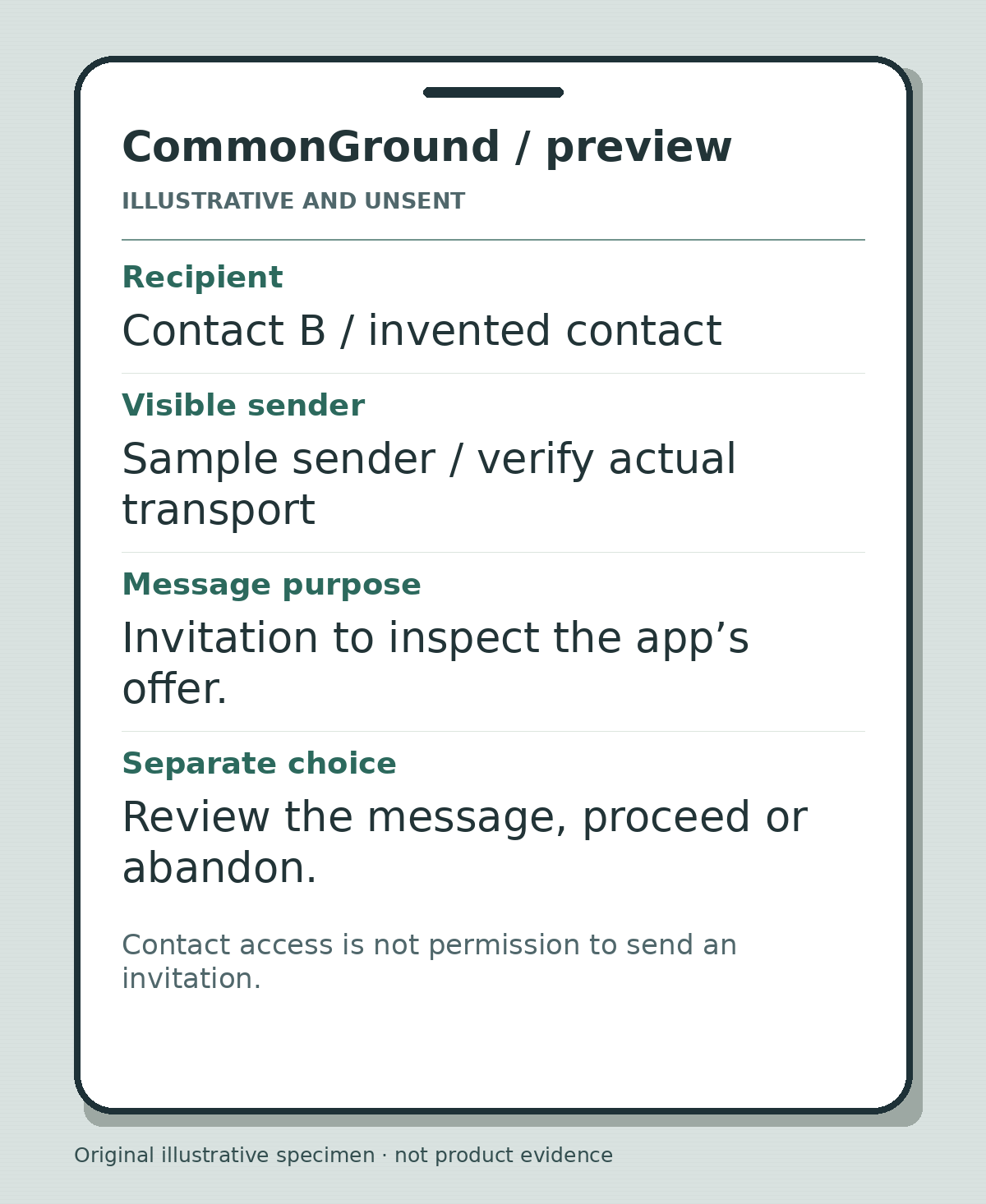
Original unsent invitation-preview concept using invented contacts. It neither sends a message nor implies that any contact is a member, single or interested in meeting.
Worked scene two: no contact access and no penalty
Run a second scene with access denied, then with a limited set that excludes Contact B. The proposed interface should not insist that the tester reveal everyone else's details to continue.
If the actual product supports manual sharing, inspect that path separately. If it does not, the prototype should show a straightforward skip rather than invent a working feature. Verify that the app's unrelated useful task remains understandable. The design aim is a genuine optional invitation, not a disguised requirement to recruit a quota before seeing what the service does.
Compare the two scenes using the same recipient questions. A manual route does not make misleading membership language acceptable. Equally, a good recipient explanation does not cure automatic sending. Both sides need review.
Reject the convenient but misleading shortcut
The counterexample is a prototype that grants Contacts access, preselects every entry, sends anonymous invitations automatically and then calls those recipients new members. This combines several distinct failures. It is a fictional rejected design, not an accusation about the service mentioned in the research.
Replacing “all contacts” with a smaller default batch does not resolve the central problem. Nor does calling a delivery event an activation. The founder needs to know whether a person chose the communication, whether the recipient understood the offer and whether anyone later completed useful participation. Those questions cannot be answered by a growing address list.
Review the artifact before setting a daily volume target
Use the blank invitation worksheet to record the contact-access condition, individual selection, sender preview, recipient explanation and supported skip route. Keep real contact data out of the planning document.
For a later, separately authorized product evaluation, distinguish selection, explicit initiation, verifiable delivery, accepted participation and repeated useful work. Record unavailable delivery or attribution as unknown. A preview impression is not a message, and a received message is not agreement to join. Avoid retaining personal relationship details merely to enrich a funnel report.
The next small action is to review the two unsent scenes with the product and privacy owners, fix any ambiguous recipient inference, and then validate the actual candidate build. A reviewed sketch does not establish compliant operation, recipient understanding or campaign results.