How-To Guide
Show the credit cost of the app task, not just the subscription badge
Explain feature access, usable credits, configured task cost and refresh rules before presenting a paid app operation as included or unlimited.
A paid subscription can unlock a feature while a separate credit balance limits how often someone can use it. If the launch video shows only a Pro badge and the finished result, a buyer may reasonably miss the second boundary.
For an app founder offering credit-metered actions, the creator brief should explain the demonstrated task's cost before the person commits to it. Keep access, balance, deduction and replenishment separate. A large credit number is not meaningful until the viewer understands what consumes it.
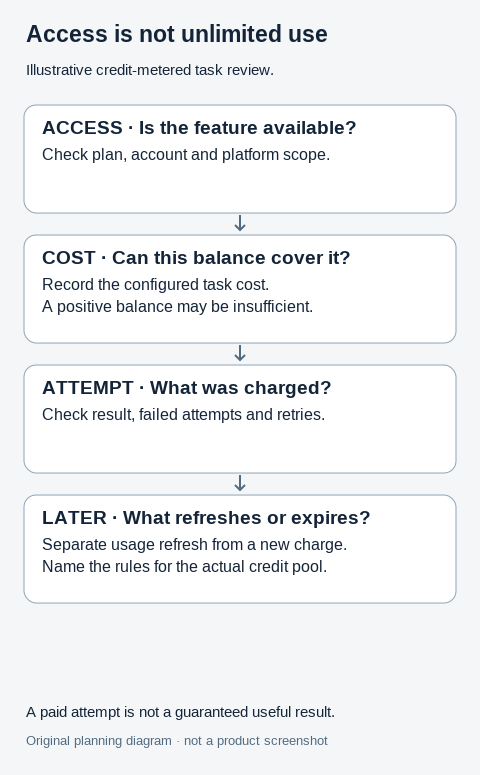
Original metered-task decision model, not an actual price or allowance.
 Superdirector
Make it work for your brand
Find it. Remake it. Post it. Superdirector turns the viral formats in your niche into your brand's carousels, X posts and video scripts, and keeps the calendar full.
The problem is not merely a confusing price
A CapCut customer describes buying an annual plan while expecting unrestricted feature use, then discovering credits. In a separate customer question, someone who exhausted a balance asks about replenishment and unlimited access.
These are independent historical reports of expectations, not a verified account audit or evidence of current CapCut terms. The first was cross-posted elsewhere; that duplicate is not a second observation. Neither discussion supplies a universal price, allowance or refresh schedule for another app.
They support a narrower acquisition decision: when a creator demonstrates a metered feature, explain both the right to access it and the quantity of use the offer provides. Do not let the word subscription imply unlimited attempts.
Separate four questions on the offer card
| Question | What the team must verify |
|---|---|
| Can this account access the feature? | Actual plan, account and platform requirements |
| Can it afford this action in credits? | Current valid balance and exact configured task cost |
| What happens when an attempt runs? | Actual deduction event, failure handling and retry policy |
| What happens later? | Refresh timing, carryover or expiry, and any separate purchase behavior |
A balance can be positive but insufficient for the chosen action. A feature can be accessible but require an additional purchase after the allowance is exhausted. A refresh can replenish a usage allowance without being the subscription's next charge. Each distinction needs the real product's explanation.
As a product-specific example, Instories' credit guide distinguishes plan-dependent balances, subscription-credit resets without carryover, and one-time credit packs. It says task cost can vary with settings such as length, resolution and model. Those are that service's documented rules, not a template for imposing the same policies on your customers.
Make the example calculable without pretending it is a quote
Consider a fictional app called Motion Postcard. For a purely illustrative exercise, suppose its test account has 30 usable credits and one chosen operation costs 8 credits. Three charged attempts would use 24 and leave 6. That remaining balance would not cover a fourth identical attempt.
These numbers are invented teaching inputs, not prices, platform rates or observed product results. The calculation assumes each attempt is charged at the same cost. It does not establish how many usable outputs the person will get, whether a failed attempt is charged, or whether another setting changes the cost.
That is the point of the example. “30 credits included” does not communicate the same thing as “unlimited creations.” Nor does three affordable attempts guarantee three satisfactory results. A creator should not turn the arithmetic into a productivity claim.
Capture the cost before the action
For the real app, use harmless original input and a permitted test account. Record the settings that determine the cost, the displayed charge if available, the starting balance and the resulting state. If the product does not expose a useful cost explanation before commitment, flag that gap rather than drawing a reassuring fictional confirmation screen into the video.
Keep the source recording of unsuccessful attempts as well as the selected result. If the creative shows only the final successful output after several charged attempts, explain the relevant preparation rather than implying a first-attempt outcome. Do not promise automatic refunds or restored credits unless the current policy and observed behavior support that claim.
Do not perform paid generations merely to follow this article without authorization. A draft storyboard can identify missing proof; it cannot replace proof. If the required test would incur spend, have the responsible owner authorize it separately.
Show the insufficient-balance branch without manufacturing pressure
The user should understand whether the actual options are to wait for a refresh, buy a separate pack, change the task configuration, or use a different supported feature. Only show options the real app offers. Do not make an unavailable downgrade or free alternative look functional.
Keep the billing explanation precise. If a pack is a one-time purchase, do not call it a subscription. If the offer renews, do not present it as a single payment. If credits expire or do not carry over, explain the applicable pool and rule rather than using one blanket label for every balance.
Do not use an approaching refresh as a fabricated urgency cue. “Your credits reset soon” can describe a meaningful limit, but it must match the actual account's terms and timing. A creator's own promotional allowance may not be the allowance a new buyer receives.
Review understanding before increasing distribution
Ask a reviewer whether paying unlocks the tool, unlimited use, a fixed allowance, or some combination. Ask how they would know the cost of the specific action and what happens when the remaining balance is too small. If those answers are guesses, revise the offer explanation before buying more attention.
For later authorized measurement, distinguish feature access, attempted actions, charged actions and useful completed outputs. A credit deduction is not evidence that the customer received a satisfactory result. Keep unknown failure and retry behavior visible in the campaign record.
The release gate is not “the balance looks generous.” It is whether the person can understand the actual cost of trying the advertised task without having to purchase first to discover the limit.