How-To Guide
Announce an iOS subscription price increase without misleading existing customers
It also provides exports of current and upcoming subscription prices.
By the Superdirector editorial team.
A new price on your purchase screen does not tell every existing subscriber what they will pay next. Before writing an announcement, identify which customers are affected, which prices are preserved, and which renewal conditions remain unresolved.
This guide covers communication planning for App Store auto-renewable subscriptions. It is not a recommendation to raise prices and does not cover every billing provider. If your app has not launched and has no paying subscribers, prepare the policy and worksheet only. Do not invent an existing-customer cohort to make a launch story sound established.
Start with the exception sheet
Apple allows developers to preserve current prices for existing subscribers when scheduling an increase. It also provides exports of current and upcoming subscription prices. A planned change is scoped by storefront and billing plan type, and a second scheduled change can overwrite the first. Apple subscription pricing guide
Use the price communication worksheet to record each relevant product, billing route, storefront, current cohort and planned change. Record the source of each field, not merely the number copied into a slide. A price export is not a subscriber or entitlement export: connect those price records to separately verified cohort evidence before assigning recipients.
Do not assume preserved pricing just because the founder intends to reward early customers. Confirm the configured choice and the affected plan. Conversely, do not tell every subscriber they are receiving an increase merely because the public new-customer price changed.
Separate three audiences before drafting
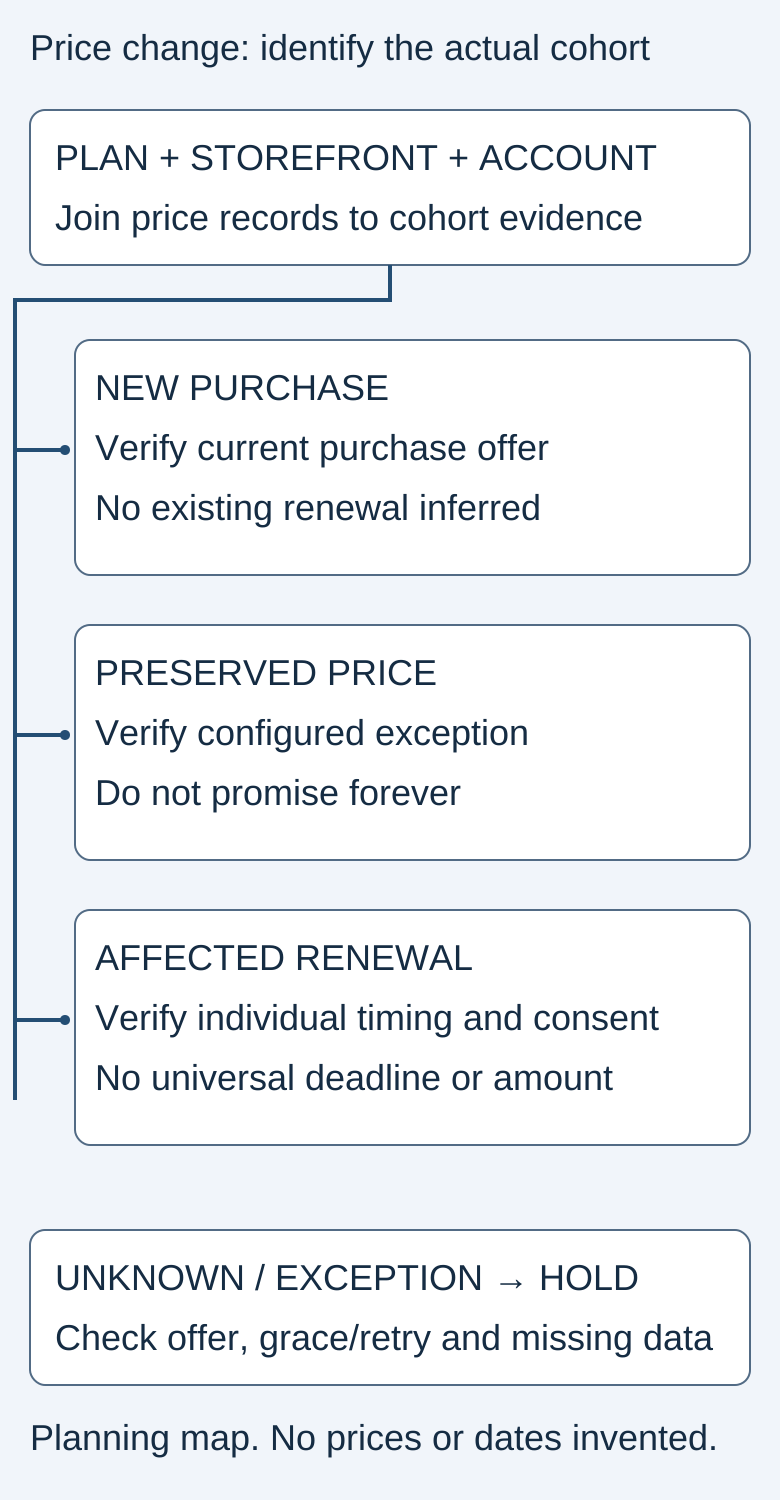
An editorial planning map, not a report of actual subscriber counts or configured prices.
Original visual by the Superdirector editorial team. Creation date not recorded.
New purchasers need accurate purchase-screen pricing and duration. Current subscribers with a verified preserved price need a clear explanation of the exception. Affected subscribers need information that matches their own renewal and consent situation.
Those categories are the start of a review, not an exhaustive billing engine. Flag trial or promotional-offer customers, billing retry or grace-period accounts, and any other state that prevents a reliable blanket statement. Keep unknown cases out of a definitive “your price changes on this date” message until the owner can verify them.
For an iOS productivity app, use one real plan record as the worked example. Capture the displayed price and the configured existing-subscriber treatment in an authorized private record. Do not include customer identifiers or assume one sample proves every storefront.
Let the verified state determine the message
Here are two illustrative message structures, not ready-to-send announcements:
Preserved cohort: identify the plan and state that the verified current subscription price is unchanged by this particular increase. Explain where the customer can inspect their subscription details. Do not promise “forever” unless a separately reviewed commitment actually supports it.
Affected cohort: explain that a change applies, direct the customer to their individual amount and renewal information, and distinguish an informational notice from a request that requires consent. Insert a date or amount only when it is verified for the recipient’s applicable state.
Neither structure needs an invented claim about rising infrastructure costs or dramatic new value. If the reason for the decision has not been provided and approved, leave it out rather than manufacturing a persuasive rationale.
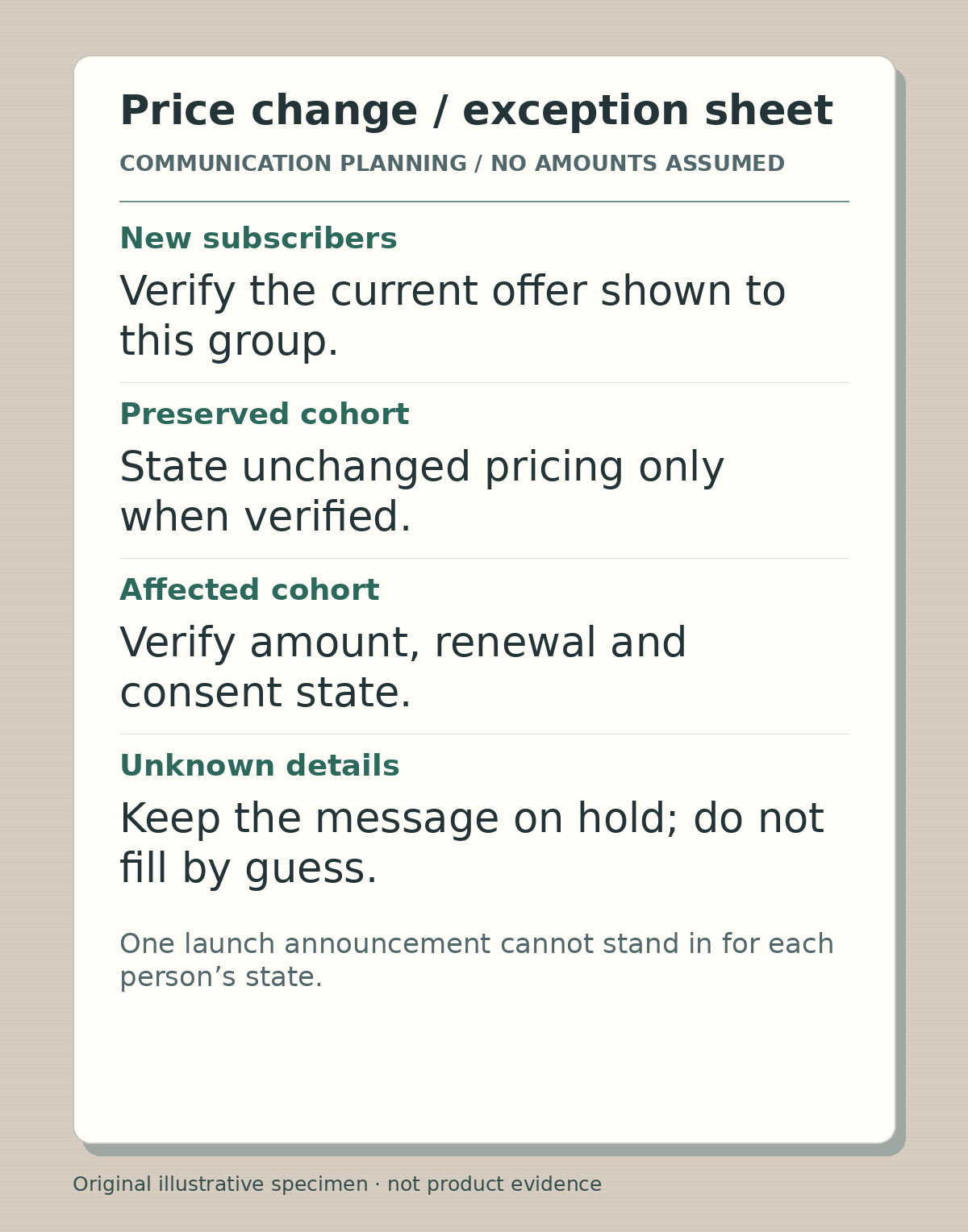
Original planning sheet separating three subscription audiences. It is not a customer notice, a price change or a claim that anyone’s price is preserved.
Illustrative worked example by Editorial assistant, original text and raster artwork. Created 2026-10-24.
Do not turn notification rules into a universal promise
Apple’s customer guidance distinguishes price increases that require opt-in from those that can proceed with advance notification under specified conditions. When consent is required and the customer does not opt in, the subscription does not renew. Regional requirements and the history and size of increases matter. Apple customer price-change guidance
The developer guide additionally describes special timing for introductory/promotional offers and recovery from billing retry or grace. Use the applicable account state and current rules rather than promising one charge date for everyone. Apple subscription pricing guide
Avoid “Apple will automatically renew everyone tomorrow.” Also avoid describing your own explanatory email as proof that Apple’s required notice or consent process has completed. Those are separate observations.
For support readiness, rehearse three questions: “Am I affected?”, “What happens if I do nothing?”, and “Where can I see my own details?” If the team cannot answer without guessing, the announcement is not ready.
Resolve conflicting advice with primary evidence
A regional-pricing discussion contains conflicting comments about whether Apple supports preserving existing prices. The official configuration guide does support that option; a confident forum reply is not a substitute for checking it.
A separate developer pricing discussion asks about changing subscription pricing while weighing retention. That is a useful operational question, not a reusable conversion or revenue benchmark. Both source dates are approximate in the retrieved pages, and neither conversation measures search popularity.
Check consistency, then seek the release decision
Compare the purchase screen, proposed announcement, support response and configured price record. Each should describe the same plan and scope. Save the exact revision reviewed and the exceptions that remain unresolved.
Do not change prices or send the announcement simply to finish this checklist. Pricing commitments and customer communication need their applicable approvals. If a setting changes after review, repeat the affected checks rather than reusing an obsolete sign-off.
After authorized execution, distinguish prepared copy, actual delivery, consent status, successful renewal and continued useful product work. Measure confusion or support contacts with a defined period and denominator. Clearer wording may help customers understand the change, but reduced churn is a hypothesis until observed with suitable evidence.