How-To Guide
Change the app’s future offer without charging earlier buyers again for the same function
The useful deliverable is a continuity plan, not a release recipe.
A new subscription offer does not erase what earlier customers bought. Before redesigning a paywall, map the primary function included in the old purchase, the genuinely additional service in the proposed offer, and the evidence needed to keep those benefits separate.
The useful deliverable is a continuity plan, not a release recipe. It should explain what remains available to an earlier purchaser, what a new customer is considering, and what happens when purchase evidence cannot yet be verified. No price, entitlement or account changes are performed in this guide.
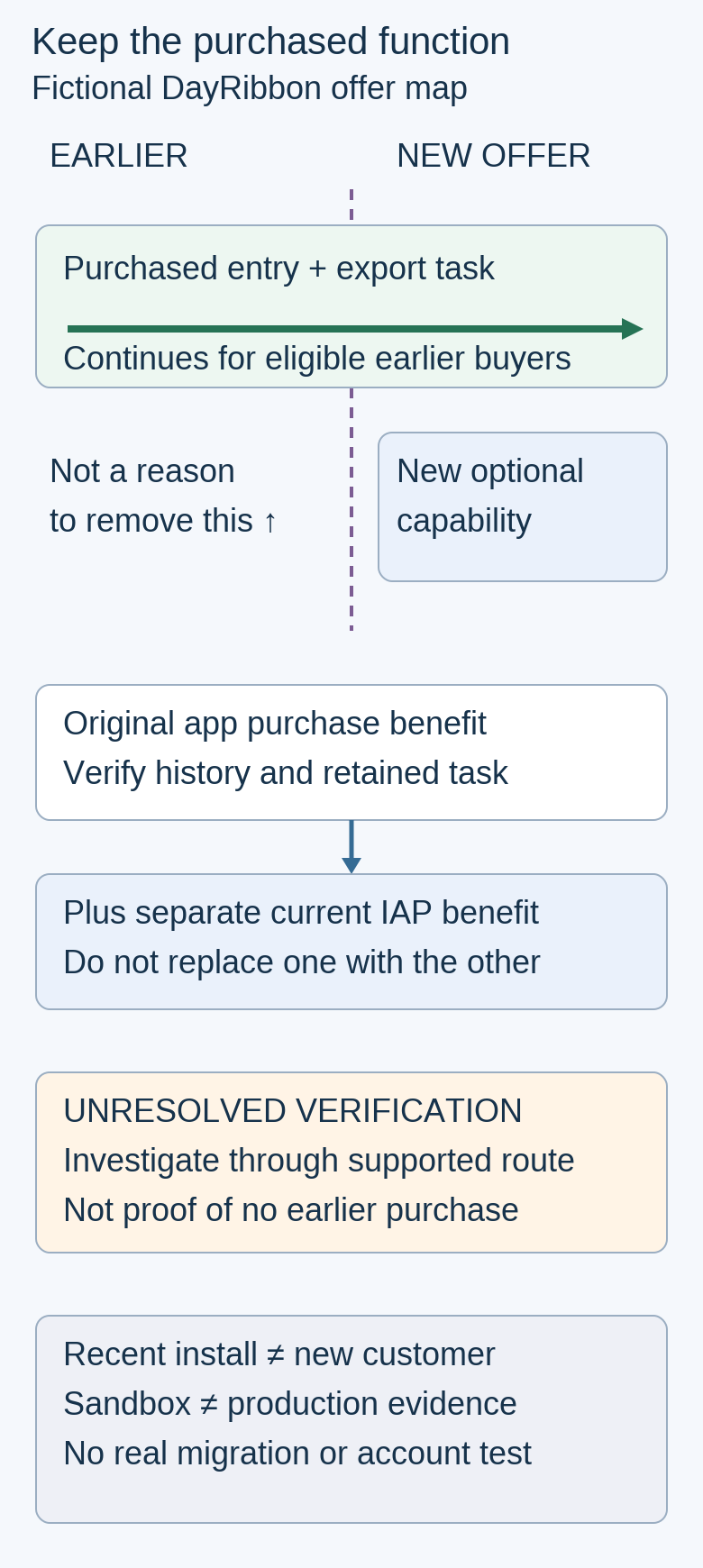
Original fictional benefit map. It does not represent a live migration, verified account or approved offer.
 Superdirector
Make it work for your brand
Find it. Remake it. Post it. Superdirector turns the viral formats in your niche into your brand's carousels, X posts and video scripts, and keeps the calendar full.
Begin with the old product promise
List the tasks the earlier payment enabled. Use the actual offer and product history rather than assuming that an old “premium” label describes everything now in the app. Distinguish the primary functionality previously sold from later optional additions.
Apple’s subscription review guidance says that changing an existing app to a subscription model should not remove primary functionality users have already paid for. It also requires ongoing value for an auto-renewing subscription and a clear description of what the price provides. Those principles do not approve a particular migration or define your app’s complete historical promise.
A longstanding diary-app founder’s question makes the business concern concrete. The author asks about a prospective subscription while preserving earlier purchases, then clarifies that the remaining uncertainty is how customers would feel seeing the new offer. That is not a report that the transition succeeded, nor proof that a particular payment model creates trust.
The first decision is therefore not “which paywall converts best?” It is “what would this customer lose if we applied the new offer to them?” Resolve that before choosing promotional language.

Original AI-generated editorial illustration. Earlier-bought diary functionality needs a continuity plan separate from any new optional offer. This is not a product capture, customer scene or completed test.
Keep three benefit questions separate
An earlier app purchase can establish a historical benefit. A current in-app purchase can establish a different present benefit. The offer shown to a prospective new customer is a third question. Treating all three as one paid-or-free flag can hide important distinctions.
Apple’s business-model-change documentation describes using the original app transaction to identify features included before a model change, while checking current in-app-purchase entitlements separately. This is the mechanism to investigate with the implementation owner, not permission to paste an example into production without reviewing the product’s actual version history and purchase types.
Write down which evidence supports each benefit. Do not assume that an active subscription is the only way someone may legitimately access an older paid function. Conversely, an earlier app purchase does not automatically establish every optional capability sold later.
Worked example: the diary function continues
Consider the fictional diary app DayRibbon. Its earlier paid offer included writing entries and exporting them. A proposed new recurring service adds a distinct capability that the founder must still define and substantiate. The example does not assert that storage, synchronization or any other particular feature is automatically a suitable subscription.
The continuity plan keeps the previously purchased entry and export tasks available to eligible earlier purchasers. The new offer is explained separately. A customer should not have to accept a new recurring payment merely to perform the primary task already bought.
Prepare a review case using a synthetic diary and appropriately authorized purchase evidence. After the candidate update, can the historical purchaser create an entry and export it through the intended route? Record the actual result when a test is authorized. A correctly drawn paywall is not enough if the underlying task becomes inaccessible.
The proposed customer explanation should identify what stays available and what the optional new offer adds. Do not promise that customers will welcome the change, or describe continuity as a special favor while obscuring the earlier purchase. No announcement is drafted for sending here.
A recent installation does not establish a new customer
Apple documents originalAppVersion as the version originally purchased or downloaded, remaining unchanged through upgrades. For iOS, the relevant version field corresponds to the original build value, not simply the marketing version shown in a release announcement. The documented sandbox value is always 1.0.
The separately documented originalPurchaseDate remains the same through deletion and reinstallation. Its sandbox date is fixed. Neither a recent install nor a convenient sandbox value can substitute for verified historical purchase evidence.
These are Apple-specific data meanings, not a universal customer identity system. Have the engineering owner review the actual history and verification path. This article intentionally supplies no cutoff date, version-comparison algorithm or account mutation instructions. An incorrectly interpreted boundary could charge an earlier purchaser again or grant an unrelated benefit.
Worked example: original access and an add-on coexist
Imagine a second fictional app, PocketMeasure. An earlier app purchase included its primary measurement utility. A later optional in-app purchase added a distinct supported export format. The team must not replace both questions with “does this person have the newest subscription?”
The review record asks first what the verified historical purchase includes, then whether a separate current purchase supports the additional capability. It checks the actual task for each benefit. An earlier purchaser without that optional add-on is not the same case as a purchaser whose original access cannot be verified.
Keep unresolved evidence visibly separate. A network error, unavailable transaction or failed verification does not by itself establish that the person never purchased the app. Route the uncertainty into the product’s authorized recovery and investigation process rather than automatically telling the person to pay again. This is an editorial and product-review requirement, not a specification to grant all features on every error.
Do not request credentials or public receipt uploads to fill the worksheet. Use existing authorized private test records and synthetic content where appropriate.
Read migration examples critically
A developer migration walkthrough is useful because it exposes implementation and testing decisions. It is not a canonical recipe for every app. Its example maps unverified or error cases into a negative eligibility result; that fallback is not adopted here. Its release-order discussion also explicitly acknowledges uncertainty.
Use such a reference to ask sharper questions of the actual implementation. Do not borrow its conversion claims, assume its local caching choices fit another app, or turn its unverified reinstall discussion into a rule that overrides Apple's documented original purchase-date behavior.
A separate free-first founder discussion concerns preserving access for early free users. That is adjacent evidence about changing an offer, not a second exact example of preserving a paid-upfront purchase. The author describes an intention and later asks about retained features; no completed transition is established. Retrieved dates conflict, and neither thread measures demand volume.
Review continuity before a release decision
Use the blank continuity worksheet to connect the earlier promise, applicable purchase evidence, retained task, additional current benefits and unresolved cases. Keep a proposed new-customer offer distinct from a historical-purchaser case and an unknown-verification case.
Later authorized validation should cover the actual candidate build and applicable purchase environments, including the historical situations the product needs to support. Simulated cases can test logic, but sandbox success alone does not prove production continuity. No such purchase or device test has been performed here.
After an authorized change, distinguish retained-task completion, support confusion, new-customer payments, mature renewals and repeated useful work. An increase in new subscriptions cannot excuse a broken earlier purchase, and fewer complaints do not establish that everyone understood the change.
The next small action is to name one primary task an earlier customer bought and trace how it remains available under the proposed offer. If that trace ends in an unresolved entitlement or a demand to buy the same function again, hold the transition for correction rather than polishing the launch message.