How-To Guide
Choose what new users can try before your app’s paywall
It is not a benchmark-driven instruction to lock everything or give everything away.
Before choosing “hard paywall” or “freemium,” decide what a new person needs to experience to judge your app, which additional capability genuinely belongs in the paid offer, and what the proposed free scope costs to serve. A paywall label does not answer those product questions.
For an early language app, the useful output is an access-boundary plan: one complete evaluable task, a transparent paid difference, and an explicit cost boundary. It is not a benchmark-driven instruction to lock everything or give everything away. Keep the decision limited to prospective new users. Existing access, subscription entitlements and prices remain unchanged.
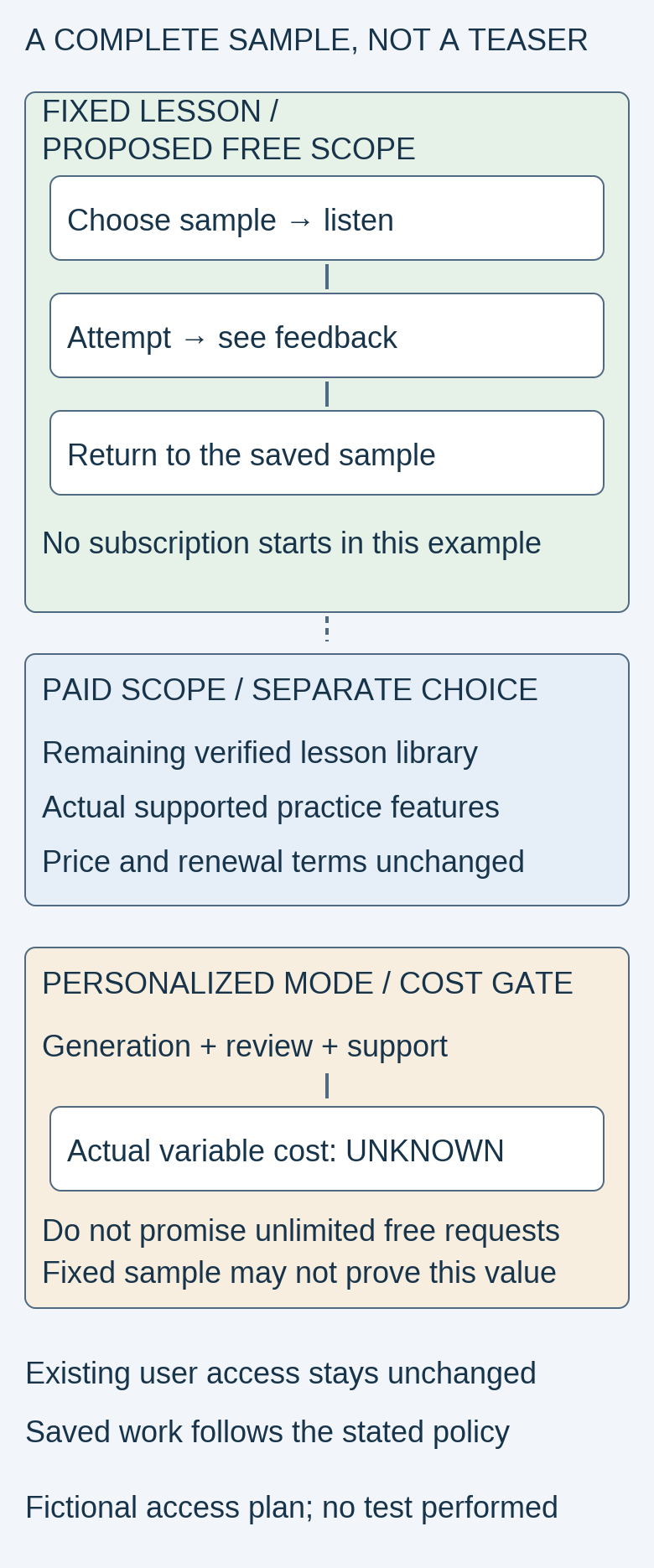
Original fictional access plan, not an implemented paywall, learning result or conversion experiment.
 Superdirector
Make it work for your brand
Find it. Remake it. Post it. Superdirector turns the viral formats in your niche into your brand's carousels, X posts and video scripts, and keeps the calendar full.
Name the experience, not just the gate
Four arrangements are easy to confuse. An upfront gate requires accepting the relevant purchase or subscription offer before the covered product experience. A free tier leaves specified capabilities available without subscribing. Metered access permits a defined amount of use before the boundary. A subscription free trial is an offer within a subscription relationship, not merely a free sample.
Apple's subscription guidance describes freemium and metered approaches, while emphasizing clear subscription content, duration and renewal pricing. These are available design patterns, not proof that one will outperform another for your audience. Use precise wording about whether the sample starts a subscription and what happens when its stated limit is reached.
The distinction matters in actual founder questions. A Japanese-learning app developer asks what to keep free when an upfront subscription prevents people from experiencing the product. That is a question about the usable experience, not merely where to place a button. The discussion's conversion claims and screenshot have not been independently validated and are not used as benchmarks here.
Define a whole task someone can evaluate
Consider the fictional app LoopPhrase. It provides rights-cleared short listening lessons. Its proposed sample lets a new learner select one lesson, listen to its clip, attempt the exercise, see feedback, and return to that saved sample. Those are illustrative product requirements, not a claim that a real app implements them.
If the sample stops immediately before feedback, the person has not experienced the proposed learning interaction. If saving is part of the advertised experience but the saved result is inaccessible, the sample may also give a misleading impression. A teaser can explain an offer, but do not call it a complete product trial when the central task remains unavailable.
Write the task boundary in observable terms. “One introductory listening lesson, including its feedback and saved sample” is more reviewable than “a little free content.” The quantity is an editorial scenario, not an optimized allowance. A different app may need a different unit to communicate its value honestly. If this task is the acquisition video's promise, rehearse the first useful result on a fresh account before calling it a complete sample.
Make the paid difference understandable
For LoopPhrase's first planning example, the paid difference is access to the remaining verified lesson library and any actual supported practice features. It is not a promise of fluency, better grades or a particular learning speed. A customer should be able to explain what remains free and what the payment adds without guessing from a locked icon.
Keep the sample free without initiating a subscription in this example. Do not call it an auto-renewing trial or imply that trying the lesson enrolls someone. Keep the existing price and renewal terms fixed while considering this access question. Changing price, trial duration and free scope together would make both the offer and the learning question harder to understand.
A transparent upfront paid experience can remain an option. If it is the current model, describe it before asking a person to invest substantial setup effort. Do not advertise an unrestricted free experience and reveal the payment requirement only after collecting their work. Conversely, a free sample does not oblige the business to promise unlimited unpaid service.
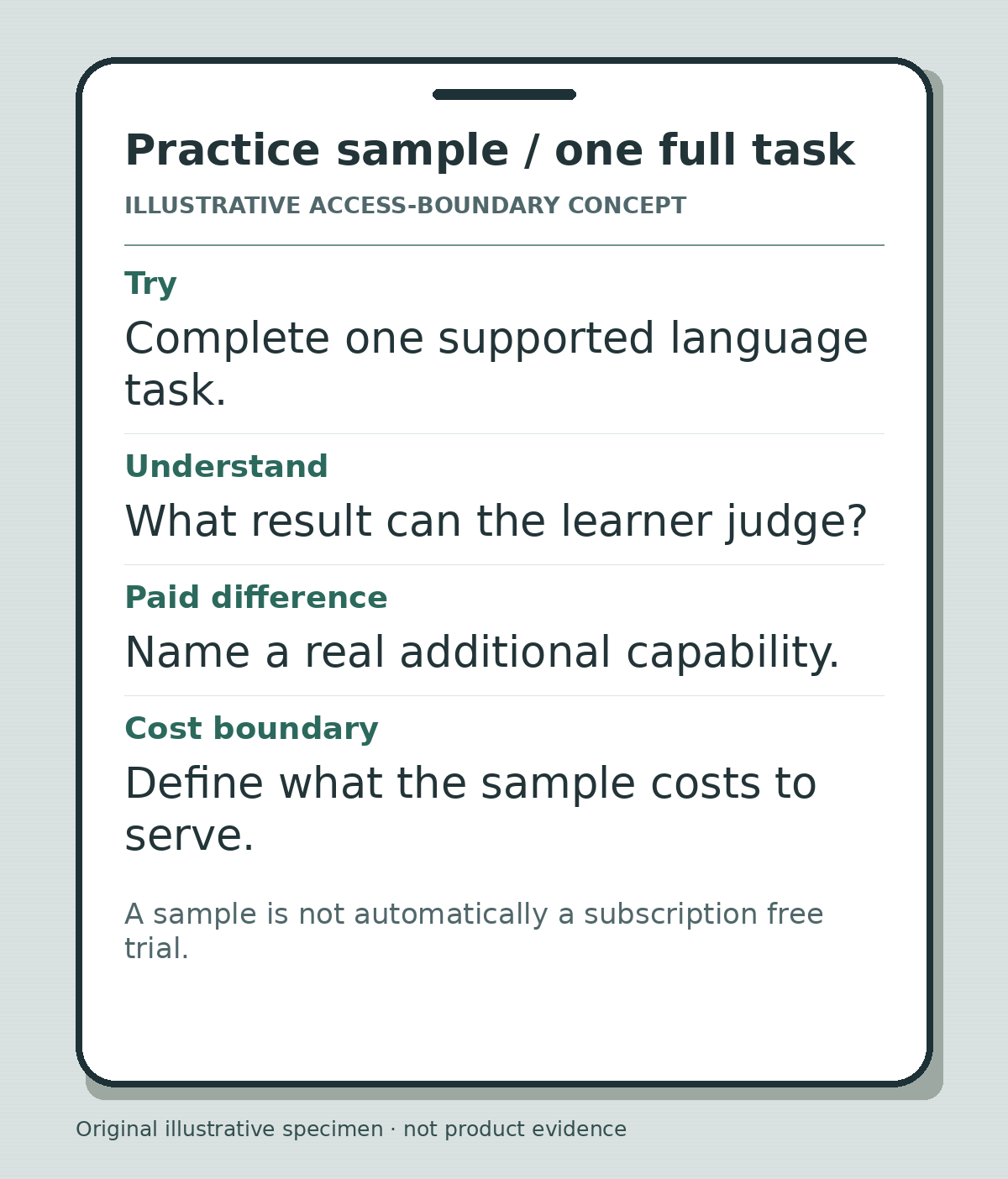
Original language-practice access concept. The scope is illustrative and must match the actual product; it is not a purchase screen, a free-trial offer or an experiment result.
Let real serving costs constrain the sample
Now consider a second fictional LoopPhrase mode: personalized lesson generation with variable processing and review costs. The founder cannot assume that unlimited non-paying requests are affordable. Neither can this article invent a cost per user to justify a preferred gate.
Separate a fixed, rights-cleared sample from personalized requests. Record the costs that actually vary with delivery, generation, storage or support, alongside the scope of any content rights. Mark missing inputs unknown. The cost of making the initial sample and the cost of serving another user are different fields, even when both matter to the business.
If a fixed lesson can demonstrate the essential interaction, prepare that narrower access hypothesis rather than making unlimited generation the default. If personalization itself is the central value, a fixed lesson may be insufficient; keep that limitation visible and resolve the cost and evaluation question before expanding the free scope.
Do not manufacture urgency by unexpectedly removing results someone was promised they could keep. State what happens to the sample and saved work at the boundary. A decision to preserve the current transparent paid arrangement while costs remain unknown is an honest hold, not a failed experiment.
Use outside evidence to challenge the plan, not choose it
A second developer discussion explicitly describes too few users for a useful comparison. The author later questions whether additional trial starts translate into paid subscriptions and considers moving the offer after an initial useful experience. Those are evolving intentions, not verified outcomes or universal advice.
RevenueCat's 2026 report compares access models in an observational sample of RevenueCat-integrated apps with active subscription revenue and minimum inclusion criteria. Its target period is principally 2025, with older cohorts for some calculations. Cross-app differences do not establish what would happen if this app changed its gate. Do not take a large headline ratio as permission to remove existing users' access or promise a conversion lift.
The practical lesson is to examine your own task and offer. Outside evidence can expose a weak assumption, such as equating trial starts with payers. It cannot supply an unobserved customer response to your new policy.
Prepare a small observation plan without pretending to run a test
First review whether a prospective user can complete the proposed sample and accurately describe the paid difference. Record actual difficulties when authorized observation occurs. Product understanding is not willingness to pay, and willingness is not a completed payment.
If an experiment is later authorized and implemented, preserve the defined new-user population and distinguish exposure, complete sample use, trial starts, first payments, refunds and later useful work. RevenueCat's result definitions illustrate why these must stay separate: trial conversions mature later, and enrollment is not the same as a recorded paywall view. This is not an instruction to install its tools or purchase an experiment plan.
Sparse evidence may remain inconclusive. Do not invent a sufficient sample size or switch the success measure after seeing a few results. The immediate decision can still be a well-reasoned access hypothesis with clear limits, rather than a claimed statistical winner.
Complete the access-boundary sheet
Use the blank worksheet to specify the complete sample, supported paid scope, cost unknowns, treatment of saved work and prospective-user-only boundary. Then choose: prepare the bounded sample, retain transparent paid access, or hold until a named product or cost question is resolved.
Both worked examples are fictional planning alternatives. The operator discussions supply questions, not evidence that a particular access model will win. A finished plan makes the product decision understandable without pretending that it has already earned a commercial result.