How-To Guide
Define what strict mode stops before promoting an app blocker
Separate a blocker’s session rules from platform authorization and explain the observed limits before promoting a stricter paid mode.
A creator tapping a blocked app proves that one attempt met a restriction. It does not prove the restriction cannot be ended, that every route to the content is covered, or that buying a premium tier will change the person's habits.
For a consumer focus-app founder, the useful campaign question is specific: what does the advertised mode prevent during the promised session, under which setup, and what choices remain? Answer that before using “strict,” “locked” or “impossible to bypass” as the reason to install or pay.
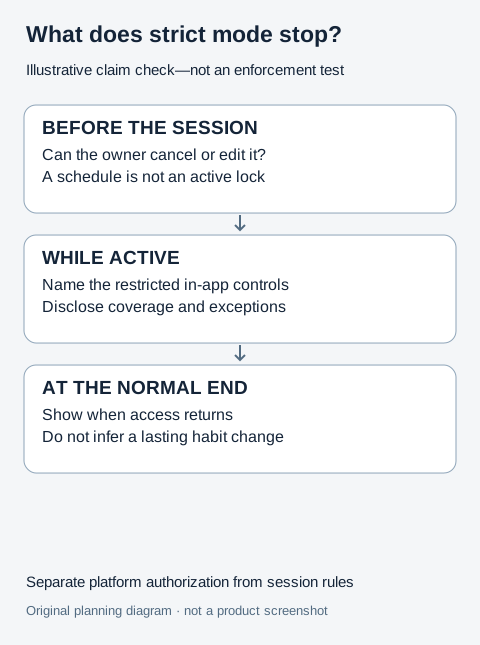
A strict-mode promise needs a named control and a normal end condition. Illustration, not a verified product result.
 Superdirector
Make it work for your brand
Find it. Remake it. Post it. Superdirector turns the viral formats in your niche into your brand's carousels, X posts and video scripts, and keeps the calendar full.
Buyers distinguish a reminder from a commitment
In one digital-minimalism discussion, the author says they habitually ignore limits and later reports buying a premium blocker but cancelling a session before it began. That is a question about the commitment mechanism, not simply the presence of a blocking screen. Replies mix platforms and personal recommendations; they do not verify another product's enforcement.
A separate iOS user question asks for stronger restrictions after describing ways they could stop previous blockers. Later vendor replies discuss changed platform behavior. Treat the original as a historical task observation, not a current test of every iOS release. Do not convert a user's description or a vendor's reply into a universal bypass instruction or a claim that all blockers fail.
Together, these independently authored questions support a qualitative buyer concern: does paying for stricter mode actually change the choices available at the moment of temptation? They do not establish demand size, clinical benefit or which app is best.
Write a commitment contract in ordinary language
Consider QuietWindow, a fictional app offering a scheduled focus session. The following questions are a proposed brief, not facts about an existing product:
| Boundary | Question the creative must answer | Why the answer changes the promise |
|---|---|---|
| Before the start | Can the owner cancel or edit a scheduled session? | A scheduled commitment may differ from an active one |
| During the session | Which in-app pause, edit or early-end options exist? | “Strict” must name the controls it actually restricts |
| Platform authorization | What account mode and permissions does the tested setup use? | An in-app lock is not a guarantee about system authorization |
| Coverage and exceptions | Which selected apps or sites are covered, and what remains accessible? | One blocked app is not proof of complete content coverage |
| Normal finish | When and how does access return? | A buyer needs the end condition as well as the lock screen |
Have the product owner fill the answers from the released build and documentation. Leave an unknown visibly unknown. A premium badge or an animation of a padlock is not evidence for any row.
Keep this a voluntary self-management demonstration. Do not configure another person's device without their permission, ask a creator to surrender account credentials, or turn a marketing test into advice to lock someone out of essential communication. Use a test setup and harmless sample targets. Confirm documented access and recovery arrangements before an authorized test; this article does not prescribe a passcode-sharing scheme.
Film the boundary that justifies the paid claim
For an Instagram Reel or YouTube Short, show the mode selection, the relevant session state and one ordinary attempt to use the selected target. If the purchase promise concerns early ending, explain the actual early-end rule rather than spending the entire clip on the blocked screen. Show the normal finish, using a short disclosed test session where the product supports one. Do not fake elapsed time or imply a staged session lasted a full workday.
A conditional caption for fictional QuietWindow could say: “During an active session, this mode removes the in-app pause option shown in our standard mode. See supported setup, exceptions and session-end rules before choosing it.” That wording is usable only if those facts are verified. It is narrower and more informative than “you can never open distracting apps again.”
For X, publish an illustrated before-start / active / ended comparison with the same limits. Keep platform authorization as a separate note, not a fourth session state. The artifact should help a buyer decide whether the mechanism fits them, including deciding not to purchase.
Do not claim that blocking treats addiction, ADHD or another health condition. Do not infer lasting behavior change from a successful restriction test. The demonstration concerns product controls, not a person's discipline or worth.
Hold the creative when strictness is undefined
Stop the campaign review if the team cannot explain whether its strongest statement refers to an in-app control, a platform setting, a particular account mode or an observed test. Narrow the promise to the verified behavior instead of adding an absolute claim in the hook and retracting it in small print.
After an authorized release, separate setup completion, active-session starts, documented early endings, normal completions and reports of unexpected access. Interpret these alongside the actual configuration; do not call every early exit a defect or every completed timer a wellbeing improvement. Retest the affected boundary after app or OS changes and preserve the previous claim with its date so stale creator assets can be corrected.