How-To Guide
Choose a useful return occasion before adding another app reminder
A quiet day in your analytics is not automatically a failed habit. Some products help with a task people choose to do every day.
A quiet day in your analytics is not automatically a failed habit. Some products help with a task people choose to do every day. Others become useful when a particular occasion occurs. Before adding a streak, a reminder or another reason to open the app, identify the next occasion when the original task would actually matter.
The decision is not whether retention matters. It is whether your proposed change helps someone repeat useful work, or merely produces more openings. This guide builds an opportunity-aware return plan for an early consumer app. It does not supply a universal usage frequency, a clinical recommendation or a notification campaign.
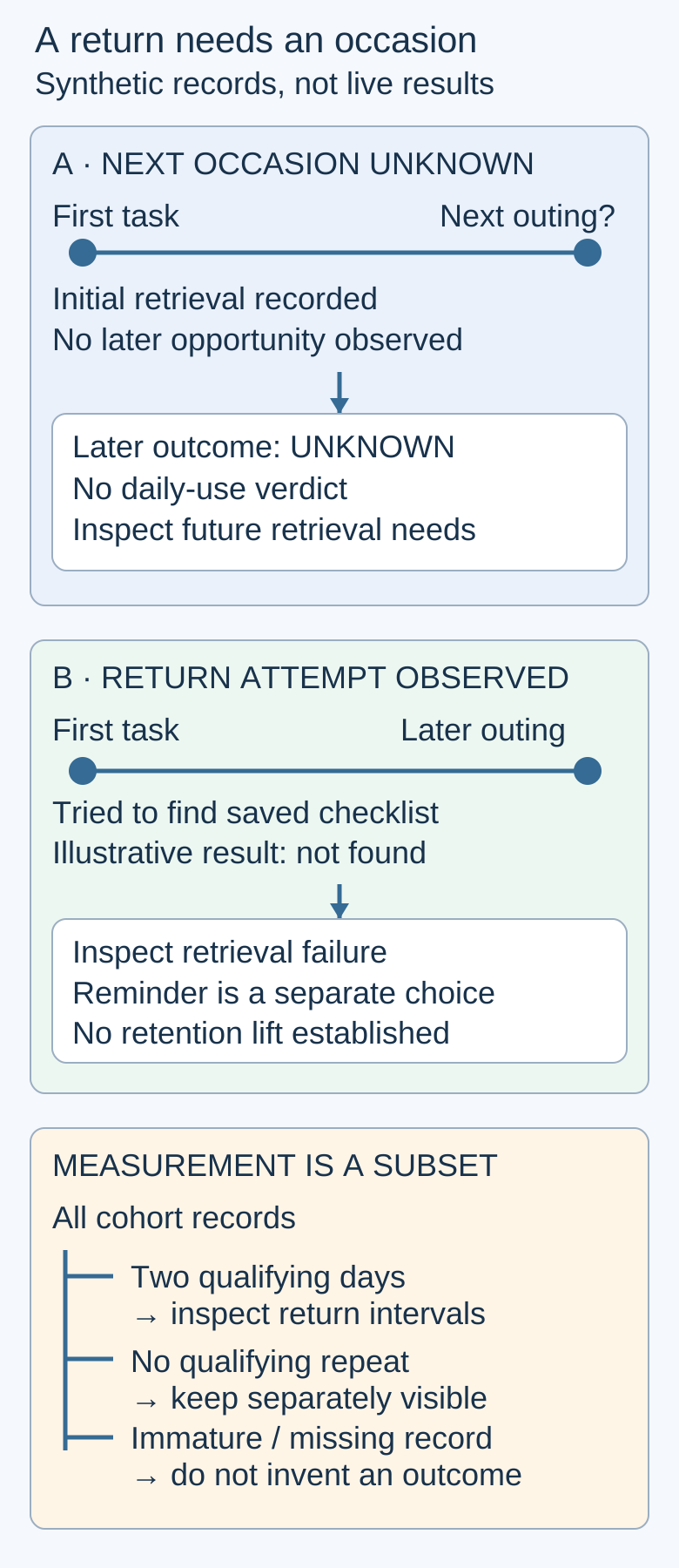
Original decision diagram. All records are illustrative, not customer observations or measured outcomes.
 Superdirector
Make it work for your brand
Find it. Remake it. Post it. Superdirector turns the viral formats in your niche into your brand's carousels, X posts and video scripts, and keeps the calendar full.
Start with the occasion rather than the dashboard
Describe the useful task in ordinary language. For the fictional reference app FieldNote, a person retrieves an equipment checklist before a hobby outing. The app does not create the outing. Its usefulness depends partly on an occasion outside the software.
“Open FieldNote tomorrow” is an engagement instruction. “Find the checklist when preparing the next outing” identifies a possible job. The second description tells a founder what retrieval needs to support and what evidence might be missing. It does not establish how often the occasion occurs for any real user.
Write down what you actually know about that occasion. Was it mentioned in authorized feedback? Observed during a permitted product test? Assumed because the app category seems familiar? Keep an assumption visible. Do not infer a person's schedule, circumstances or needs from an absence of events.
A daily product can still have a genuine daily task. The point is not to make every product occasional. It is to avoid selecting a cadence simply because the analytics dashboard makes that interval convenient.

Original AI-generated editorial illustration. The next hobby outing creates an occasion to retrieve a checklist; another app opening is not the occasion itself. This is not a product capture, customer scene or completed test.
Two founder questions reveal different uncertainties
A calm-app founder asks how to make the product worth returning to without streak pressure or excessive reminders. In a later reply, the author says they hope people learn skills they can eventually use without the phone. That is a product aspiration, not proof of a beneficial outcome. It does show why more app opens cannot be assumed to represent the whole intended value.
A separate boxing-timer operator describes low daily use as a retention problem while also saying there are too few users to evaluate additional features. The post does not provide the actual workout schedule, a complete cohort definition or verified repeat-task records. It therefore cannot establish whether the problem is frequency, usefulness, discovery or something else.
These are independently authored questions, not measured demand for this article. The calm-app thread has a reported search-versus-rendered date conflict. The boxing-app search date has not been independently verified; its rounded relative date is not inherently contradictory. Their metrics are self-reported. Do not borrow a diagnosis from either thread. Use the questions to expose what your own decision would require.
Worked example: the next opportunity is unknown
Consider a synthetic FieldNote record. A tester found a checklist during an initial walkthrough. Several days later, no new app event is recorded. The team does not know whether another outing occurred.
The correct worksheet entry is not “retained” and not “lost because we forgot to send a reminder.” It is “next opportunity unknown; no later completed task observed.” The record does not establish success outside the app either.
A useful next product question is whether the checklist will be recognizable and reachable when the occasion does arise. That can be examined with safe test data without pretending that the real person's next outing happened. If the founder needs further user research, it requires an appropriate authorized process rather than guesses about private behavior.
Do not add a daily streak solely to make this record look active. A streak would introduce a new task: maintaining the streak. Whether that task belongs in the product is a separate product decision, not an automatic repair for missing observations.
Worked example: an opportunity happened and retrieval failed
In a second fictional record, an authorized tester reports trying to reopen a saved checklist before another outing and being unable to find it. The example supplies an occasion and a specific attempted task. It still does not establish the cause of every other person's absence.
Here the next internal action is to inspect the actual retrieval path. Check the relevant build and supported saved state using synthetic material. Can the person recognize the checklist and get to it without reconstructing the first session? If the team prepares a change, repeat that exact task against the changed candidate.
Increasing reminder frequency would not prove the checklist became easier to retrieve. A notification might bring someone to the same problem more often. Keep the product repair and any future reminder hypothesis separate.
Neither example predicts a commercial outcome. A verified retrieval improvement is useful product evidence, but it is not proof of a paid renewal or an increase in retention.
Inspect the interval without hiding non-repeaters
Amplitude's usage-interval documentation explains a view based on users who triggered selected events on at least two different days. It describes median gaps between events and notes that products can have different natural frequencies. That is useful methodological context, not a default schedule for FieldNote.
The inclusion rule matters. A view of repeaters cannot, by itself, tell you what happened to everyone who entered the product. Keep people with no qualifying repeat, people whose observation window is still immature and people with missing event coverage visible in a separate cohort record. Do not silently drop them and describe the remaining interval as overall retention.
Choose the event with care. A notification open, a foreground event and a completed checklist retrieval answer different questions. A task can also occur without producing the particular event you expected. Confirm the measurement against actual behavior before drawing a strong interpretation.
With sparse evidence, retain a provisional task window rather than reporting a precise natural cadence. The interval may vary by task or segment. Do not import the documentation's example numbers, declare a universal benchmark or treat a change in observed timing as proof that a reminder caused it.
Treat a reminder as a separate, optional hypothesis
Apple's notification guidance requires consent and discourages repeated notifications for the same thing. It also describes useful actions that can avoid opening the app. An app-open target can therefore miss some useful interactions even at the interface-design level.
Before considering a reminder, identify the specific information it would provide, whether the person chose it and what useful action is actually supported. A generic demand to return does not establish any of those things. Avoid private or sensitive information in a visible notification.
This is not an instruction to send, enable or redesign notifications. No reminder is necessary to complete the worksheet. The available decisions include investigating a failed task, improving the explanation of a useful occasion, collecting missing evidence through an approved process, or leaving the cadence unchanged.
Keep the business outcomes separate
Use the blank return-occasion worksheet. Record the task, source of the occasion claim, observation dates, whether another opportunity is known, the attempted action and the result. Then record measurement coverage and the next internal decision.
App use, useful repeated work, payment and a mature renewal are separate observations. Absence must not be relabeled as success to protect a preferred product story. Conversely, a completed task should not be dismissed merely because the person did not open the app on an arbitrary day.
The next small action is to inspect one real, permitted return record and identify what is known versus assumed. If the next occasion is unknown, preserve that uncertainty. If a return attempt failed, investigate the task. If the record is incomplete, improve the evidence before adding pressure to the product. No live analysis, practitioner test, notification or retention improvement is claimed here.