How-To Guide
Test the first useful result promised by your acquisition video
A person can sign up successfully and still get none of the value shown in your video.
A person can sign up successfully and still get none of the value shown in your video. Before increasing acquisition, test what happens after the visitor arrives: can a fresh user produce the promised result, and can you verify that result independently of the success screen?
This guide starts after landing and signup, and it is not a deep-link checklist. It produces one task-specific acceptance record that ties a single creative promise to a single usable output. It assumes no customer outcome or conversion improvement.
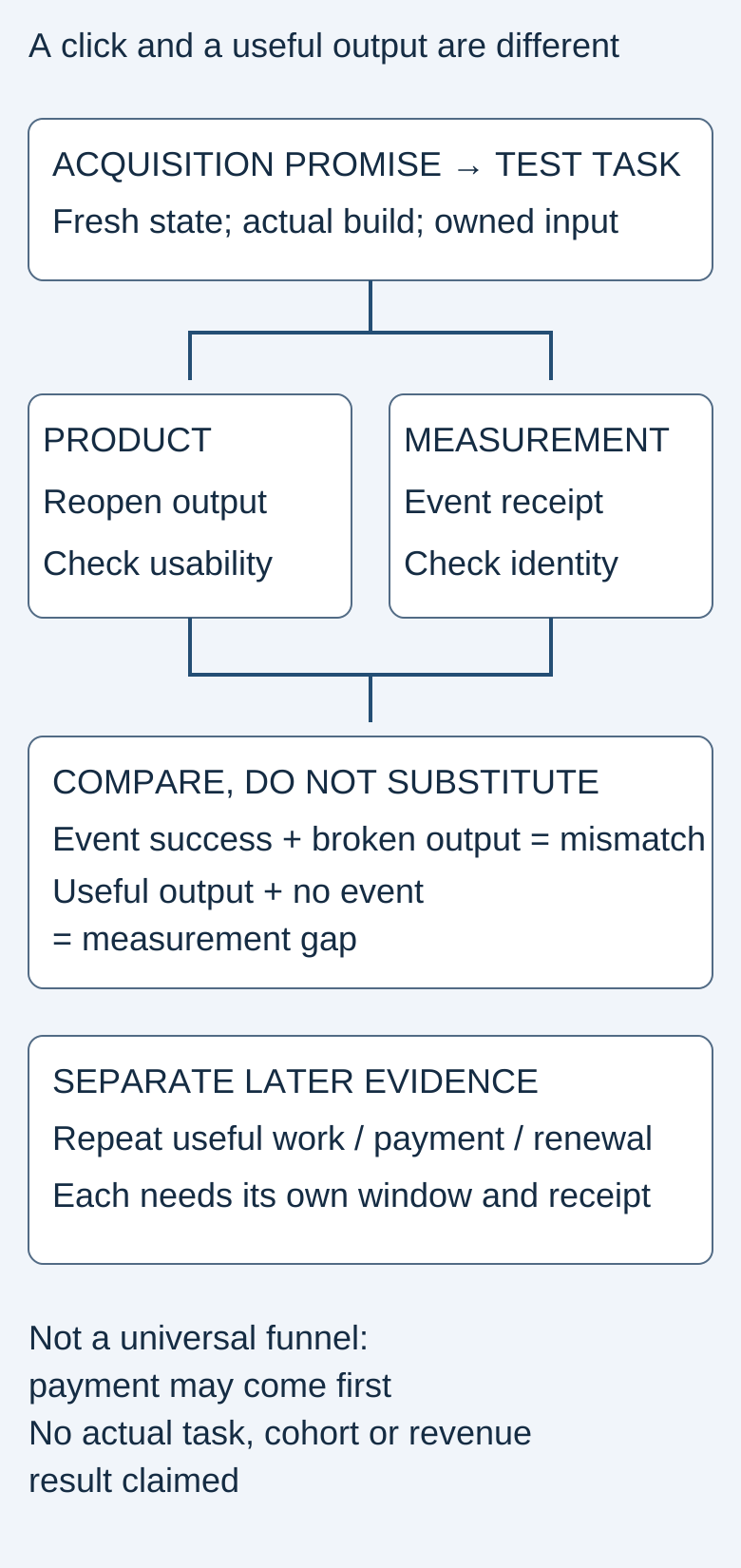
Each step needs its own receipt. The diagram contains no conversion percentages or claimed user results.
 Superdirector
Make it work for your brand
Find it. Remake it. Post it. Superdirector turns the viral formats in your niche into your brand's carousels, X posts and video scripts, and keeps the calendar full.
Translate the promise into something inspectable
Choose one acquisition video and write down the observable outcome it promises. Avoid “experience the magic” or “finish onboarding.” Those phrases give a reviewer nothing to check.
Take an illustrative photo app whose promise is a resized image ready to share. The test reopens the exported file, checks the dimensions against the intended ones and confirms the image is usable. Reaching the editor or tapping Export is only a step along the way. Use a synthetic or owned source image, and take the expected dimensions from the real use case. Do not invent a platform requirement.
For an illustrative habit app, scheduling a reminder is a different outcome from receiving it. A reminder-created event does not prove delivery, and delivery does not prove the person returned the next day. Keep the promise narrow enough to verify.
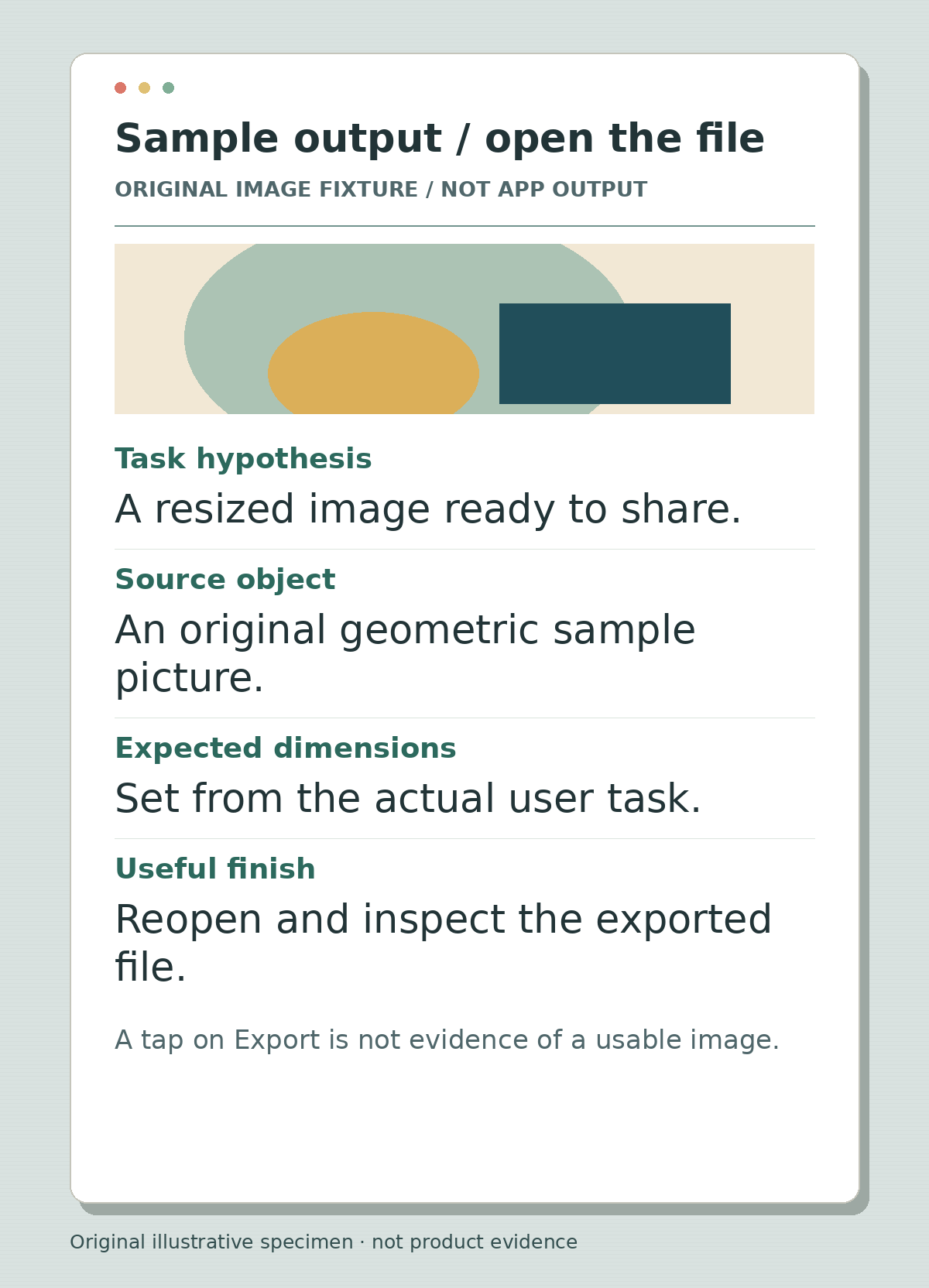
Original geometric image fixture in an illustrative file-inspection view. It is not output from the target app, and no dimensions, activation result or product test are claimed.
Keep first value as a hypothesis about activation
PostHog's account of finding its activation metric compares candidate actions with later retention. Its example concerns companies using its own product. Do not transplant that company's event thresholds or cohort definition into a consumer app.
For a new product, label the first useful result an activation hypothesis until later usage supports it. It can still be a worthwhile release checkpoint, since a product should deliver what its creative demonstrates. Passing it does not show that completing the task causes retention or payment.
Rehearse with a genuinely fresh state
Record the candidate build, device, entry creative, account state and permitted feature tier. Use a clean authorized test account or a supported fresh-state mechanism; never reset a personal account destructively. If a new visitor will not have an editor's prefilled project, saved permissions or paid entitlement, the test must not depend on them either.
Start from the first post-signup screen and do the task. Note each point where the user must make sense of a choice, provide input, wait, grant a permission or meet a payment requirement. If the advertised export needs a paid tier, say so in both the creative and the test record. A blocked output is not a success just because the account exists.
Keep the walkthrough continuous enough that the real sequence shows. If you use an illustrative prototype instead of the live candidate, label it as a prototype and leave product acceptance open.
Compare product evidence with the event receipt
Save two kinds of evidence. One shows what the user sees: the reopened file, saved object or observed service action. The other is the relevant event or backend receipt, if authorized analytics are available. Link the two by test identifier and time, and avoid storing private content you do not need.
If the event says completed but the exported file is missing or unusable, the result is a failure. If the task succeeds but no event arrives, product behavior and measurement have different statuses. Fix the instrumentation before treating the funnel as a reliable count of useful results.
PostHog's onboarding investigation guide combines an ordered funnel with qualitative investigation and advises early-stage teams to lean on qualitative evidence when samples are sparse. That is methodological guidance, not a universal sample-size rule or proof that every drop-off is caused by friction.
Investigate the first mismatch, not the most convenient story
Two distinct operator conversations supply adjacent context. One SaaS founder describes signups that do not reach the core experience. Another creator-tool founder reports an unexpected payment redirect before onboarding. These are self-reports, not verified defects, repaired deployments or benchmarks for your product.
Use that context to ask one concrete question: where does this test diverge from the promise? It might be an unclear instruction, a missing feature, a legitimate access requirement, an error or a measurement problem. Record what you observed first. Do not blame the creative, remove a payment step or add reminder emails until you know where the break actually is.
Pick a small fix for the mismatch you saw. Then rerun the same acceptance test on the exact changed candidate. A mocked event test alone cannot show that the exported artifact or the user journey now works.
Separate first success from a retained buyer
Keep at least these outcomes distinct: signup, task attempted, useful result verified, repeated useful work, payment, and renewal among cohorts old enough to renew. Their order may differ by product, and payment can precede useful work. Do not force them into a universal funnel simply because a diagram has arrows.
Count repeated useful work as another meaningful task in a suitable later window; a second pageview does not qualify. Set renewal eligibility from the actual billing interval and the cohort's age. A cohort too young to renew has not failed to renew, and a first-task success is neither a full-price buyer nor a mature renewal.
Use the blank first-result worksheet to record the promise, acceptance criteria, artifact, measurement receipt, failures and retest. Ask a practitioner to try the task without step-by-step coaching, and note where the explanation breaks down. This is a proposed validation step; no practitioner session is reported.
After an authorized release, test the activation hypothesis with dated cohorts, stable identities, explicit denominators and the observation window you chose. Compare the relevant groups, but do not take correlation or a small before-and-after change as causal proof. Qualified visits, verified output and revenue stay separate measures.
Evidence and limits
The method references describe one analytics vendor's approach, and the operator discussions concern SaaS and creator tools. Applying their questions to a consumer-app video is a proposed test design. It is not evidence of the app's activation, retention or revenue.