How-To Guide
YouTube Shorts for a beginner crochet-pattern shop: teach something useful without giving away the whole pattern
Plan six YouTube Shorts for a beginner crochet pattern shop, with complete free lessons, product previews and a checklist for the buying path.
How can my Etsy crochet-pattern shop attract beginner crocheters on YouTube Shorts without teaching the entire paid pattern for free?
Teach a complete small skill that helps a beginner decide whether your project suits them, then show how the paid pattern organises those skills into the finished item. Do not cut off a promised tutorial halfway through. Put the boundary between a useful standalone lesson and the full project's instructions, not between a question and its withheld answer.
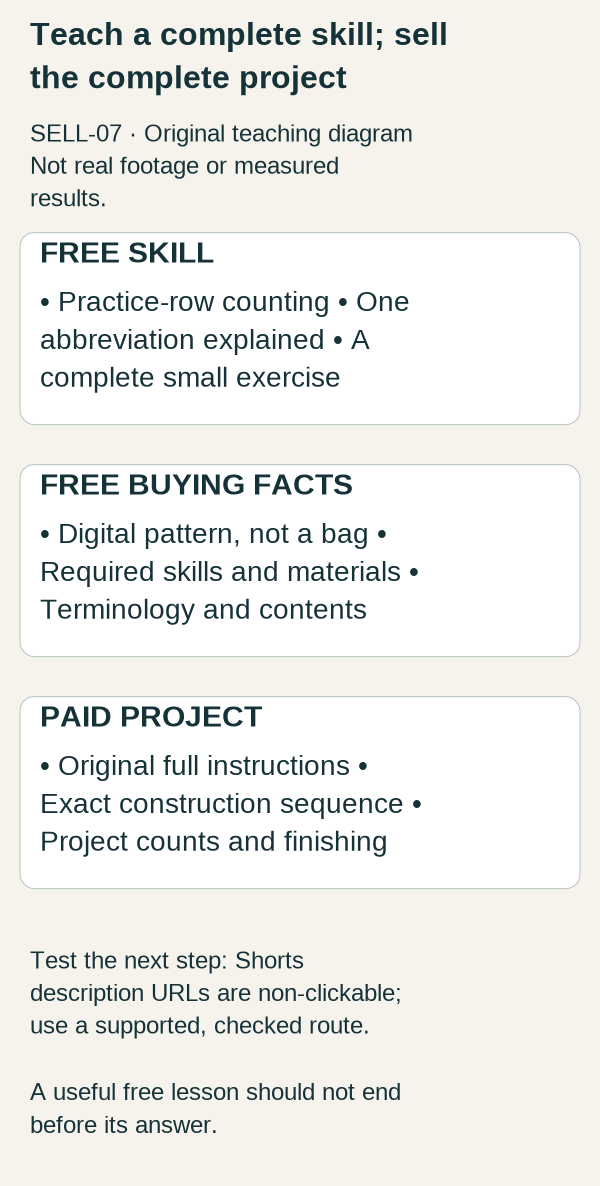
Original illustrative teaching diagram. Separate a complete useful free crochet exercise, free buying facts and the paid full-project sequence; check the actual Shorts destination. This is planning guidance, not product footage, customer evidence or measured results.
Teach a complete small skill that helps a beginner decide whether your project suits them, then show how the paid pattern organises those skills into the finished item. Do not cut off a promised tutorial halfway through. Put the boundary between a useful standalone lesson and the full project's instructions, not between a question and its withheld answer.
This original example uses a fictional mini-tote pattern sold on Etsy. The seller owns the design and footage. Each sample Short teaches a prerequisite skill or helps with a buying decision. The paid pattern contains the complete construction, counts, sizing and finishing sequence that the product actually offers.
 Superdirector
Make it work for your brand
Find it. Remake it. Post it. Superdirector turns the viral formats in your niche into your brand's carousels, X posts and video scripts, and keeps the calendar full.
Write the free-versus-paid boundary first
Divide a page into three sections.
Free educational content: reading a stitch abbreviation, recognising the top of a stitch, counting a practice row, checking tension on a swatch, weaving a practice tail, and understanding the project's required skills.
Free product information: finished dimensions, materials, terminology convention, skill requirements, what the download contains, and whether support is available.
Paid project content: the full original instructions, exact project counts, sequence, construction details, and any diagrams or photographs included in the purchased pattern.
Do not withhold facts needed to decide whether to buy. “You must purchase to find out whether this is a digital pattern” is not a sensible boundary. Equally, a short skill lesson does not need to expose the complete pattern page in the background.
Prepare a filming setup beginners can follow
Use a small practice swatch in a plain, contrasting yarn. Place the camera where fingers do not hide the hook entry point. Record slowly enough to show the action, then edit the pauses, and do not speed the entire demonstration up beyond comprehension.
Name the stitch terminology convention on screen. UK and US crochet terms can differ, so keep one convention for the same abbreviation across your videos. Before publishing, have a knowledgeable reviewer check the final lesson, including captions and mirrored footage.
You can use a swatch unrelated to the paid tote's exact stitch counts. That keeps the lesson complete while protecting the project's full construction sequence. Keep the finished tote available for one brief context shot.
Six Shorts with clear boundaries
1. “Before your first tote: find the stitch you are counting”
Begin on the swatch and use a pointer to indicate the visible stitch tops. Demonstrate the counting method your pattern uses, slowly and accurately. Finish by showing the row total for that practice swatch, not an unexplained jump to the finished project.
Closing line: “Practise counting on a swatch first. My mini-tote listing explains the skills and terminology used in the full pattern.”
The free lesson ends with a learned skill. The paid product is a relevant next project, not the missing final step.
2. “What a stitch marker is doing here”
Show a marker placed where it belongs for the demonstrated exercise. Explain what it does and show what happens when the next row or round begins. Use a separate practice sample so the clip does not expose all of the tote's construction.
Closing line: “This is one way to keep your place while practising. Check your own pattern's instructions for where markers belong.”
Avoid presenting one method as the rule for every crochet project.
3. “Your swatch and the finished size”
Show a ruler laid correctly across a flat sample and explain why checking the pattern's gauge information matters for the intended dimensions. Do not promise that matching a short clip guarantees a correctly sized tote.
Closing line: “The listing gives the finished dimensions and materials; the pattern explains its own gauge and construction requirements.”
Use the actual product's instructions when making the final lesson. If the paid pattern lacks information a beginner needs, improve the pattern before promoting it as beginner-friendly.
4. “Read one abbreviation before buying a pattern”
Place one abbreviation and its fully written term on screen, labelled with the terminology convention, and demonstrate the action on the practice swatch. Cover one term well. Do not show a dense glossary for two seconds.
Closing line: “The product details say which terminology the pattern uses. Check that before you start.”
Keep the printed paid pages out of frame. A clean teaching card is easier to read anyway.
5. “What is inside the pattern download?”
Use an original diagram or a deliberately prepared sample page that shows section labels, not the full project instructions. Explain what the download really contains: written steps, photographs, diagrams, a materials list, or other included elements. Do not advertise a video tutorial if none is provided.
Closing line: “This is a digital pattern for making the tote, not a finished bag. Read the listing for the exact contents.”
This Short answers purchase confusion; it does not teach technique.
6. “Is this a good next project for you?”
Show the finished tote from front, side, and inside. Put the actual skills needed and any assembly steps on screen. Explain whether a complete beginner should practise something first.
Closing line: “If those skills feel comfortable, see the full project details. If not, start with the free practice clips and come back when you are ready.”
Do not replace a realistic skill requirement with “anyone can do it in an evening.” Completion time varies, especially for beginners.
Give viewers a route that actually works
A pasted Etsy URL in a Short's description or comments is not a clickable buying path, so do not rely on it. YouTube's current help page lists those URLs as non-clickable and lists channel-profile links and related-video links as clickable. Check the route on the surface your viewers actually use before you tell them where to go. YouTube link guidance.
A straightforward route is “See the pattern details through the link on my channel profile,” provided that profile link is configured and tested. If you use a related explanatory video, make sure it adds value and that any onward external link works for your account. Do not build a maze of unnecessary steps merely to conceal the price until the end.
A finished filming card and review sheet
Worked card:
“Lesson: count the practice row. Viewer: beginner who loses track. Free result: can identify what is being counted. Footage: contrast swatch, slow pointer pass, final count. Paid connection: skills needed for mini tote. Excluded: full tote stitch counts. CTA: check terminology and materials through the channel-profile link.”
Reusable card:
“Skill: __. Complete outcome taught: __. Terminology: __. Demonstration sample: __. What remains in the full project: __. Honest prerequisite: __. Tested next step: __.”
After publishing, record the questions beginners ask. If several cannot see the hook entry, improve the filming. Do not add another sales pitch. If people mistake the download for a finished bag, make the product-information Short clearer and correct the listing imagery.
Start with one prerequisite skill and one product-information clip. Together, they let a beginner learn something useful and decide whether the paid pattern is the right next step.