How-To Guide
Test English and French Instagram content for an Etsy meal planner without making everything twice
Compare English and French posts for an Etsy meal planner using six shared demos, a four-week schedule and matched seven-day snapshots.
How can I test English versus French Instagram content for my Etsy printable meal planner without doubling my workload?
Create six visual demonstrations once, then make matched English and French versions of their text and captions. Keep the product, offer, and demonstrated task consistent. Treat the organic results as directional evidence about your current audience and buying path, not a controlled proof that one language sells better everywhere.
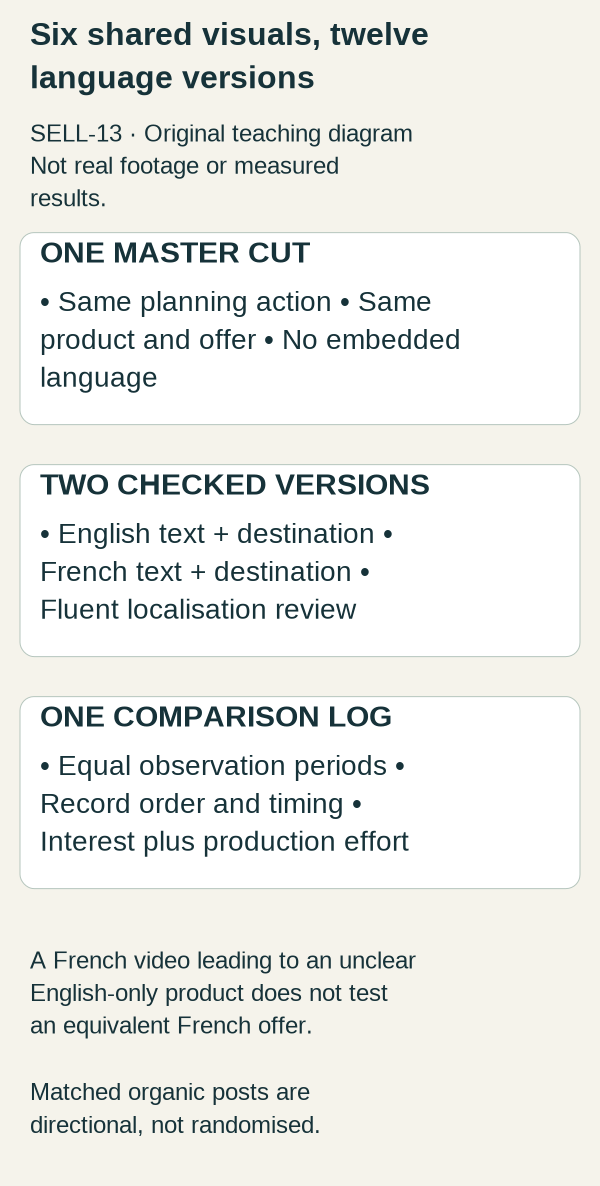
Original illustrative teaching diagram. Use one language-free master cut, two checked English/French versions and matched observation logs without claiming a randomized language experiment. This is planning guidance, not product footage, customer evidence or measured results.
Create six visual demonstrations once, then make matched English and French versions of their text and captions. Keep the product, offer, and demonstrated task consistent. Treat the organic results as directional evidence about your current audience and buying path, not a controlled proof that one language sells better everywhere.
This original worked experiment is for a fictional Etsy printable meal-planner shop. It assumes that an equivalent, checked product exists in both languages. If the planner itself is only in English, the French content tests interest in an English-language product, a different question that must be stated clearly.
 Superdirector
Make it work for your brand
Find it. Remake it. Post it. Superdirector turns the viral formats in your niche into your brand's carousels, X posts and video scripts, and keeps the calendar full.
Make the buying experience equivalent first
Before editing videos, compare the product files and listing information. Are paper sizes, date conventions, week layout, currency display, download instructions, and editable fields appropriate for each intended customer? Does “printable” mean a PDF, an editable template, or both? Are the included files and price equivalent?
French-language demand is not identical to demand in France. A French-speaking buyer might be elsewhere, with different paper, terminology, and shopping expectations. Define the audience you actually intend to serve rather than using language as a shortcut for geography.
Create a short glossary for a fluent reviewer: weekly meal plan, shopping list, leftovers, pantry, printable PDF, and blank template. Ask them to approve natural buyer-facing language and the product instructions, not merely whether the translation is grammatically possible.
Choose the question and the stopping decision
Write this hypothesis before posting: “For people currently reached by this account, does French-language creative produce enough relevant interest in the French planner to justify continued production?”
The decision is operational. You are deciding whether to keep a second language in a small content routine, not establishing a universal conversion benchmark. Preselect a review date after all six pairs have had the same observation period, with a note that sales reporting may need additional time to settle.
ViewInsta's testing guide recommends recording hypotheses and changing one variable. Its general recording discipline is useful, but posts published on different days are exposed to different conditions. Calling this a matched organic comparison is more accurate than claiming randomised A/B testing.
Film these six pairs from one planner session
Use fictional household details and grocery items. Do not expose a real customer's information. Film blank pages and hand movements so text overlays can change without reshooting.
Pair 1: Plan the next three dinners. Show a blank meal section and add three example meals. English hook: “Start with three dinners, not a perfect week.” French working hook: “Commencez par trois dîners, pas par une semaine parfaite.” Both lead to the same simple planning action.
Pair 2: Check the cupboard first. Show a short fictional pantry list beside the planner. English: “Plan around what you already have.” French working version: “Préparez vos menus avec ce que vous avez déjà.” Avoid turning the example into an unsupported savings promise.
Pair 3: Move ingredients to the shopping list. Highlight two meals, then transfer their ingredients. English: “Turn two meals into one shopping list.” French working version: “Deux repas, une liste de courses.” Show the same groceries and number of steps.
Pair 4: Leave room for a change. Cross out one example dinner and replace it. English: “A meal plan can change on Wednesday.” French working version: “Votre menu peut changer en cours de semaine.” Preserve the meaning rather than forcing a literal weekday if it sounds awkward.
Pair 5: Print and use the page. Show the real file printing at the intended size, then writing on it. English: “What you print, and what you fill in.” French working version: “Ce que vous imprimez, ce que vous remplissez.” State any actual printer requirements in the listing.
Pair 6: Show what the download includes. Lay out the included page types, using an accurate product diagram. English: “Check the pages before you download.” French working version: “Découvrez les pages avant de télécharger.” Distinguish a digital file from a shipped physical planner.
These French lines are draft localisation examples, not approved publication copy. Have the fluent reviewer approve the final copy, including the CTA and product terminology, before use. If no fluent reviewer is available, publish only the English versions and postpone the language comparison. Do not count machine-translated copy or an unchecked French product as a valid French test.
Keep a common edit and change the language layer
Save a master cut for each pair without embedded language. Duplicate it, replace text overlays and captions, and adjust text display time only when reading length requires it. Record that adjustment rather than pretending the videos are mechanically identical.
Name files consistently: P01-EN and P01-FR through P06-EN and P06-FR. Keep a text sheet with opening, overlay, caption, CTA, reviewer, and approval date. This makes a later wording correction much cheaper than searching through finished videos.
A four-week schedule at three posts a week
Use Monday, Wednesday, and Friday slots at the same chosen local time. Twelve versions require four weeks, not a two-week sprint:
- Week 1: P01-EN, P01-FR, P02-FR.
- Week 2: P02-EN, P03-EN, P03-FR.
- Week 3: P04-FR, P04-EN, P05-EN.
- Week 4: P05-FR, P06-FR, P06-EN.
Capture a seven-day snapshot for each post at the same elapsed age. The final snapshot is due on Friday of week 5, seven days after P06-EN. Compare those snapshots rather than letting the first posts accumulate four extra weeks of exposure. Record actual dates and unusual events or promotions. Alternating the first language reduces a systematic ordering habit but does not eliminate audience, timing, or distribution confounds. Treat later sales reporting separately from the seven-day interest comparison.
Separate a language result from a destination failure
Test both routes as a buyer. A French video that leads to an unclear English-only listing does not fairly test demand for a French planner. Similarly, a broken destination can look like weak creative when the video was doing its job.
Use distinguishable destinations or tracking labels only where your actual tools support them. A shared profile link used by many posts may not identify which Reel caused a visit. If you cannot separate clicks by version, record language-tagged inquiries and aggregate visits without assigning them to individual Reels.
A useful tracking row is:
“Pair: __. Language: __. Published at: __. Observation end: __. Available reach: __. Identifiable destination visits: __. Qualified questions: __. Purchases reported by a supported tool: __. Tracking limit: __. Production minutes: __.”
Define a qualified question in advance: product language, paper size, file format, contents, or a buying question. General praise is still welcome, but it is not the same signal.
Read a small result honestly
Imagine a fictional pair where English receives more views, while French receives two questions about A4 printing. Do not announce that French “converts better.” First check whether the French product page makes printing requirements clear. Then look across the other five pairs to see whether the same type of interest recurs.
If one language receives little exposure, its low click count is inconclusive. If both attract questions but neither attracts measurable visits, inspect the buying path. If French requires substantial correction each week, include that production burden in the decision even if interest is promising.
The next step is to prepare Pair 1 and verify the two product destinations. Six shared visual ideas are enough to begin; you do not need two separate content calendars or a new automation subscription to learn whether bilingual production is worth maintaining.