How-To Guide
Launch a UK solid dish-soap brand on Instagram with £500 and no sustainability certifications
Plan a 30-day Instagram launch for UK solid dish soap with a £500 budget, scripts showing use and storage, and a checklist for supported claims.
How do I launch a Shopify solid dish-soap brand on Instagram in the UK with £500 and no sustainability certifications?
Build the launch around how the product is actually used: loading a brush, washing a dish, rinsing, and storing the bar between uses. Without sustainability certifications, do not fill the gap with vague green promises. Explain the verified ingredients, packaging, dimensions and care precisely, and keep some of the £500 free for product readiness and customer problems instead of spending all of it on content.
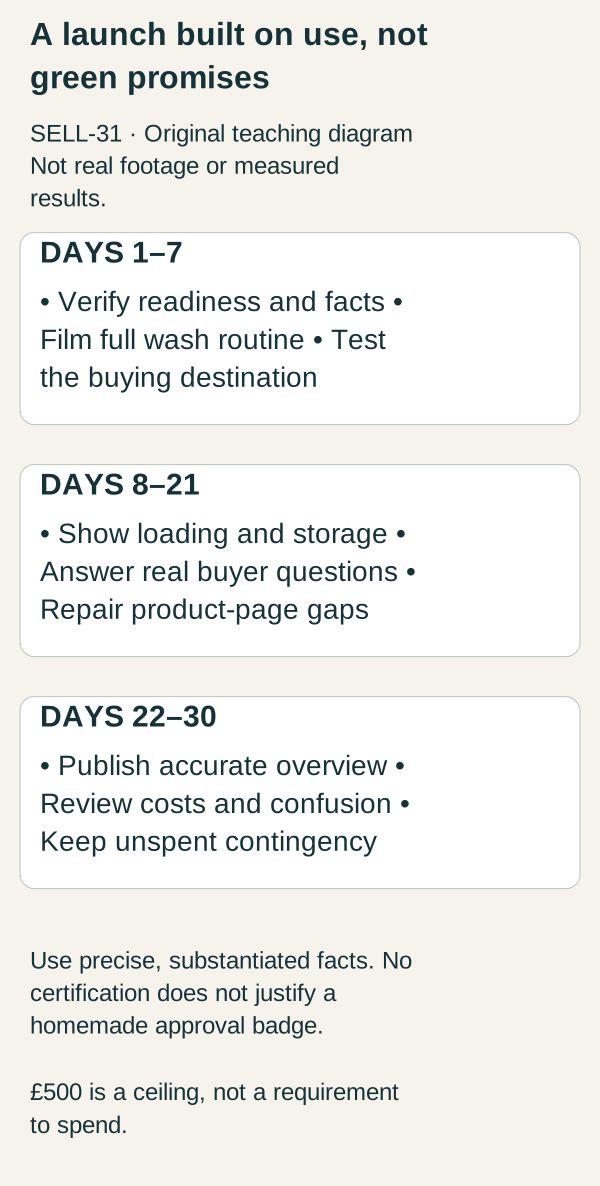
Original illustrative teaching diagram. Use the £500 ceiling across readiness, real dish-soap demonstrations, buyer questions and review without inventing green certifications. This is planning guidance, not product footage, customer evidence or measured results.
Build the launch around how the product is actually used: loading a brush, washing a dish, rinsing, and storing the bar between uses. Without sustainability certifications, do not fill the gap with vague green promises. Explain the verified ingredients, packaging, dimensions and care precisely, and keep some of the £500 free for product readiness and customer problems instead of spending all of it on content.
This original thirty-day plan assumes a fictional UK brand with a Shopify store and a £500 launch-marketing ceiling. It does not assume that the formula, labelling, safety, or product compliance is already ready. Those are prerequisites, not tasks that an attractive Reel can replace.
 Superdirector
Make it work for your brand
Find it. Remake it. Post it. Superdirector turns the viral formats in your niche into your brand's carousels, X posts and video scripts, and keeps the calendar full.
First decide what you can truthfully say
Make a fact sheet with the product's weight, ingredients, intended use, instructions, warnings, packaging components, included items, price, and fulfilment arrangements. Record where each fact comes from and who approved it. A supplier's attractive phrase is not sufficient evidence for a broad environmental claim.
The CMA's Green Claims Code checklist asks whether a claim is accurate and clear, backed by up-to-date, credible evidence, and free of hidden or omitted information. For general claims such as “sustainable”, it says the claim should reflect the whole life cycle, so one favourable packaging detail does not carry it. CMA Green Claims Code checklist.
Certification is not the only possible form of evidence, but having none does not justify inventing an equivalent badge. Avoid leaf-shaped seals or “planet approved” graphics that imply independent verification. If you can substantiate a specific packaging statement, describe that component and its limitations; do not imply that the whole product has no environmental impact.
A practical £500 allocation
Use these as spending caps, not expected market prices:
- £100 for launch samples, packing trials, and fulfilment checks.
- £50 for essential filming consumables or a missing basic support, only if needed.
- £150 reserved for quoted creative assistance or product photography after reviewing your own footage.
- £100 reserved for a small later distribution test only if the buying path works.
- £100 contingency for corrections, replacements, or unexpected launch costs.
You do not need to spend every category. If product compliance or safety work is unfinished, pause launch spending and finish that work first. Paying to promote an unclear or unready offer is not progress.
Keep the budget sheet simple: category, approved ceiling, quotation, committed amount, paid amount and remaining balance. When you total your spending, count samples at what they cost you, not at retail price.
Days 1–7: make the routine understandable
Days 1–2: Finish the fact sheet and the product-page basics. The page should show what is included, how to use and store the bar, the current price, delivery information and any relevant cautions. Remove unsubstantiated claims from packaging mockups as well as from text.
Day 3: Film one continuous wash, following the product's instructions. Show the wet brush or sponge, the loading action, an ordinary dish, the rinse and the storage. Keep the master take so later edits cannot hide preparation or extra product.
Day 4: Film close-ups of the bar, its packaging and the actual storage arrangement. A dish or rack is a prop unless it is included, and the video should show that distinction clearly.
Day 5: Publish an introduction that says what the product is and who might consider this format. Do not open with an unverified claim about how many bottles it replaces.
Day 6: On a phone, test the route from Instagram to the exact Shopify product page. Confirm the variant, price, stock, delivery wording and checkout path, without placing a fake order.
Day 7: Review the questions you have received and fix any confusing product details before you make more videos.
Days 8–14: answer use and storage questions
Using the footage you have already captured, publish a loading demonstration, a full rinse sequence and a storage explanation. Leave days between them for replies and fulfilment; the plan does not require daily posting.
In the loading video, show the action and what was used, and do not imply a standard dose without a basis. When you film the rinse, keep lighting and dish position consistent so the edit does not manufacture a result. For storage, follow the product's actual instructions and explain the role of any accessory shown.
Use buyer questions as prompts, but never turn one person's experience into a universal performance statement. If someone asks whether it works with a particular material or appliance, verify that use before replying or filming it.
Ten feature-led openings to use across the month
- “New to solid dish soap? Here is the first step.”
- “This is how I load the brush for the dish shown here.”
- “The wash, rinse, and put-away sequence in one view.”
- “Where this bar sits between washes.”
- “What comes with the bar, and what is a styling prop.”
- “A close look at the packaging components.”
- “Before ordering, check the product size.”
- “Here are the instructions included with this bar.”
- “The product question we needed to explain more clearly.”
- “What to check before choosing a solid format for your sink.”
None of them requires a claim about being zero-waste, chemical-free, non-toxic, antibacterial or better for the planet. A simple demonstration of washing a plate does not stand in for any of those claims.
Days 15–21: improve the page before buying reach
Read the first inquiries and compare them with the product page. If viewers ask whether the storage dish is included, move the answer beside the product image; if they ask how to use the bar, make the relevant demonstration easy to find.
Create a CTA map:
“Loading video → use instructions. Storage video → care and storage. Packaging video → exact included components. Size video → weight and dimensions. Introductory video → main product overview.”
A CTA does not always need to say “buy now.” “Read the use instructions before choosing” can be the more appropriate next step for an unfamiliar format.
Consider the reserved distribution budget only once the destination and claims are ready. Before you commit money, write down the specific objective, maximum spend, creative, audience assumption and review conditions. No budget line obliges you to run ads.
Days 22–30: assess the launch you actually ran
Publish one response to a genuine repeated question, one factual product overview, and an accurate stock or availability update. Use the remaining time to fulfil orders and record any recurring confusion or product issue.
Log content cost, production time, identifiable visits, product questions, checkout or order reporting available in your store, and customer-service themes. A successful launch review can identify a better instruction card even when it cannot prove that one Reel caused a purchase.
Keep environmental substantiation separate from this marketing test. Positive comments and sales do not validate an environmental claim. If you want to make one later, establish the precise claim, collect appropriate evidence, and review the whole impression before publishing it.
Your first usable script
“This is a solid dish-soap bar, shown here with the brush I use at home. The brush and dish are not included unless you choose a package that says they are. Here is the loading step, the dish being washed, and the rinse. After use, I store the bar as the instructions describe. You can read the ingredients, included items, and care information on the product page before deciding whether this format suits your routine.”
Start with that straightforward explanation and the real product facts. A small brand can be clear and appealing without presenting itself as certified, scientifically superior, or impact-free.