How-To Guide
Show why a $35 garlic press is worth considering without untested competitor comparisons
Plan eight garlic-press videos for an Amazon listing, with complete use and cleaning shots, a claim ledger and no untested comparisons.
By the Superdirector editorial team.
At a glance
What social videos can show why my $35 Amazon stainless-steel garlic press is different without making untested competitor comparisons?
Show the complete use sequence: loading, pressing, removing residue, cleaning, drying, and storage. Let shoppers inspect the product's details and decide whether they justify the price. Do not turn a single successful demonstration into a claim that the press is faster, easier, stronger, or better than every alternative.
Show the complete use sequence: loading, pressing, removing residue, cleaning, drying, and storage. Let shoppers inspect the product's details and decide whether they justify the price. Do not turn a single successful demonstration into a claim that the press is faster, easier, stronger, or better than every alternative.
This original filming plan is for a fictional Amazon seller with a $35 stainless-steel garlic press. The price is the scenario's input, not a live offer. Before filming, check the materials, included accessories, care instructions and performance claims against the actual product.
Replace superiority with an observable buying question
A video saying “the best garlic press” asks viewers to trust a conclusion. A video showing the chamber, pressing action, and cleanup gives them information they can inspect.
Begin with a claim ledger:
“Proposed wording: __. What a viewer could reasonably infer: __. Evidence held before filming: __. Limits of that evidence: __. Approved wording: __. Reviewer: __.”
For example, “Here is the chamber after pressing this peeled clove” makes a narrower claim than “Nothing ever gets stuck.” The first describes the recorded demonstration. The second claims consistent performance across conditions you probably have not tested.
The FTC's substantiation policy says advertisers need a reasonable basis for objective claims before they disseminate them, and that covers reasonable implied claims as well as express ones. A dramatic edit can imply a claim as readily as a caption can. FTC advertising-substantiation policy.
Prepare a fair demonstration kit
Use the actual retail product, its supplied instructions, a clean board, ordinary garlic, a bowl, and whatever cleaning tools the instructions permit. Keep included accessories separate from household props. Record whether the clove is peeled and whether any preparation occurred off camera.
Save a continuous master recording of each demonstration. You can make a shorter edit, but the master lets you check that a cut did not remove repeated squeezing, a stuck fragment, or an extra cleaning step. Do not alter the output with beauty filters that make residue disappear.
If you want a measured statement, decide the method first. A ruler can document dimensions. A credible weight measurement can document the sample's weight. Neither proves durability or ease of use.
Eight videos you can film without a competitor
1. Loading the chamber
Opening: “See what fits before you press.”
Show the open chamber and the clove going in. State whether the clove is peeled and whether it was trimmed. If you have to cut a large clove, keep the cut on camera and do not present the step as an effortless whole-clove operation.
Closing: “Check the chamber and preparation steps against how you usually cook.”
The buying question is about preparation and capacity, not whether your press beats another brand.
2. One complete press
Opening: “One clove, shown from loading to opening.”
Film one continuous shot with the hands, handles and output visible. Show any additional squeeze needed, then open the chamber. A close-up of the output can follow, but it should not replace the full sequence.
Closing: “This is the result from the clove shown here.” Avoid turning one take into a general yield percentage.
3. Where the residue remains
Opening: “The part of a garlic-press demo I would want to see.”
Open the chamber after use and show the actual remaining material. Explain the removal step that the instructions recommend. Do not wipe the chamber before the “after” shot.
Closing: “Here is the cleanup step before washing.” Showing the residue honestly is more useful than a misleading promise of zero waste.
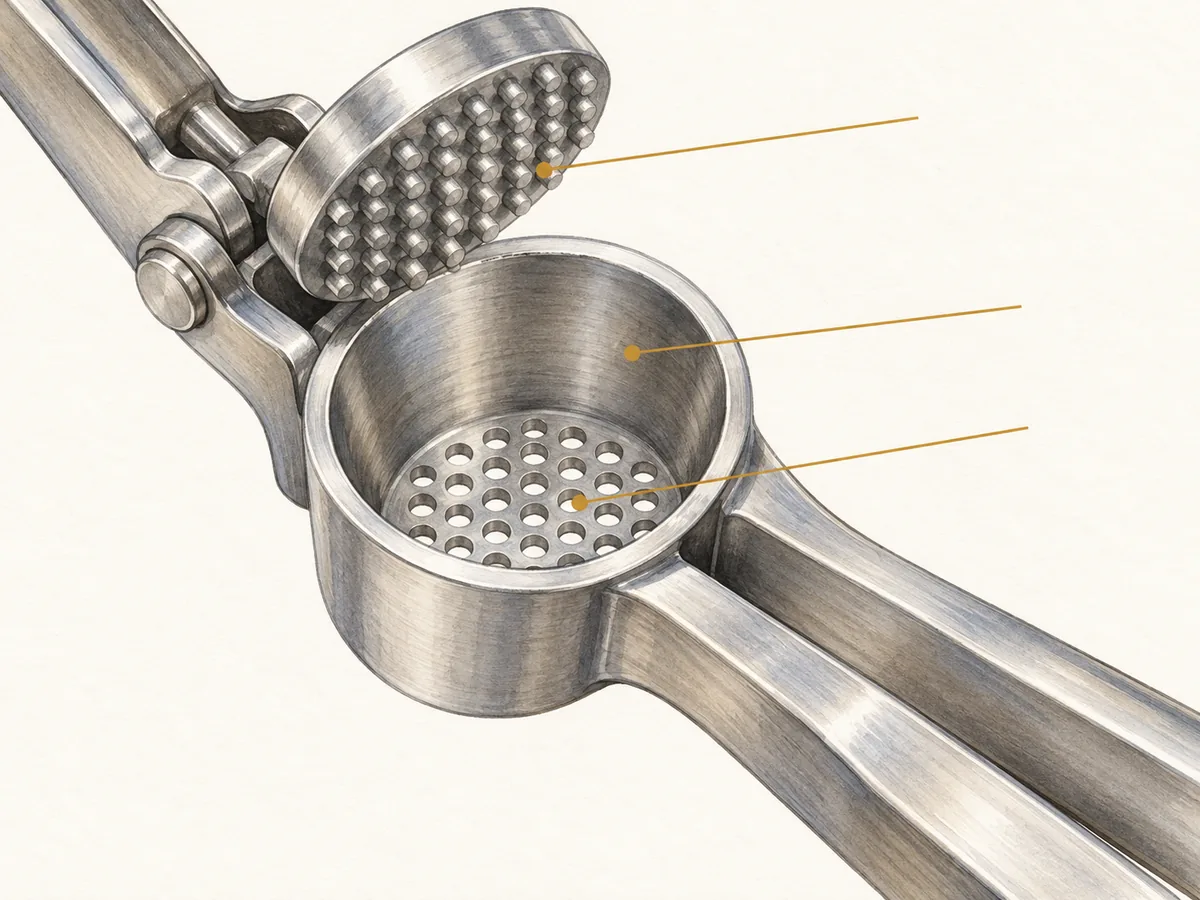
Where to inspect after a real press: the pressing plate (top pointer), chamber wall (middle), and perforated floor (bottom). This original fictional illustration identifies surfaces only; the empty chamber is not an after-use result. Film the actual residue and follow the real product’s cleaning instructions.
AI-generated fictional teaching illustration, not a product capture or observed result.
Original visual by the Superdirector editorial team. Created 2026-10-20.
4. Cleaning access
Opening: “Can you see the surfaces you need to clean?”
Show the press opened as instructed, including any removable part genuinely designed for removal. Demonstrate cleaning with the permitted tools. Avoid taking apart any part that is not meant to come apart.
Closing: “Follow the supplied care instructions for this model.” Do not infer dishwasher safety from the words “stainless steel.”
5. Handle and grip view
Opening: “A closer view of the handles before you choose.”
Show the open span, contact surfaces, and a natural demonstration from two angles. State measurements if verified. A creator can describe their own experience honestly, but should not promise comfort or suitability for every hand.
Closing: “Compare the size and action with what works for you.” Avoid health, pain-relief, or strength-related promises.
6. Drawer fit
Opening: “Here is the space it takes when stored.”
Measure the press in its normal stored position and place it in a drawer with familiar utensils. Keep the view wide enough to assess scale. Do not imply the example drawer is a universal fit.
Closing: “Check the dimensions against your utensil space.”
7. What is included
Opening: “What comes in the box, and what does not.”
Lay out the actual retail contents. If a brush is included, show it. If the bowl, board, or storage tray is a prop, keep it outside the contents layout or label it clearly.
Closing: “The listing describes the exact package for this version.” This is especially useful when old images show accessories no longer supplied.
8. The ordinary dinner sequence
Opening: “From garlic prep to putting the press away.”
Show the product in a realistic cooking task, and keep filming through the cleanup instead of stopping at the attractive food shot. Use a dish you can prepare safely and avoid making food-health claims.
Closing: “Decide whether this routine fits the way you cook.” This video pulls the separate details together and draws no invented laboratory conclusion.
A finished script for the residue video
“Here is the chamber after pressing the peeled clove shown in the previous shot. I have not cleaned it yet. This material remains inside, and this is how I remove it before washing according to the product instructions. The press then opens like this so I can reach the cleaning surfaces. The listing has the dimensions, included items, and care details if you want to compare it with your own kitchen routine.”
Adapt every physical action to the actual product. If the product instructions do not support a demonstrated cleaning technique, change the demonstration and leave the instructions as they are.
Show the price without inventing the reason
You can state the current price and the verified features offered at that price. You cannot infer “professional grade,” “lasts a lifetime,” or “saves money” just because the item costs more than a familiar alternative.
Use a feature-to-evidence card:
“Feature: opens to the shown position. Evidence: uninterrupted view of retail sample. Buyer relevance: access to cleaning surfaces. Not established: faster cleaning than competitors.”
If you later want a comparative claim, treat that as a separate substantiation project with a fair method and appropriate review. Do not improvise it by choosing an unusually poor competitor or changing the garlic between takes.
Choose the next video from real hesitation
Record the purchase questions each demonstration receives: chamber size, cleaning, grip, storage, or contents. Match the next video to the most important unanswered question. Track identifiable visits and supported purchase reporting separately from views, and label unknown attribution honestly.
Start with the continuous press and residue pair. Together they show what the product does and what the shopper must do afterward, which tells a buyer more than another unexplained premium-price claim.