How-To Guide
Why TikTok-attributed purchases and GA4 tagged sales differ
Compare TikTok web Purchase attribution with GA4 purchase reporting by event, source scope, window, timing and data quality before explaining a gap.
By the Superdirector editorial team. Official sources reviewed October 28, 2026.
At a glance
Why might ad-platform attributed sales differ from GA4 tagged-link sales in the same campaign?
TikTok can attribute website Purchase events to eligible ad clicks or views within its campaign settings. GA4 reports observed purchase events under a selected Session source or allocates event-scoped key-event credit under its own model. Pin the event, source scope, attribution window, time basis and collection path before comparing the counts; use the order ledger for actual completed sales.
- A UTM tag labels traffic when collected; it does not prove an order or causal lift.
- TikTok Ads Manager, TikTok Events Manager, GA4 and commerce records answer different questions.
- A remaining gap can be reported as unresolved after verifying definitions and data quality.
Direct answer
Short answer: first check that both reports count a website *purchase*, then name each report's credit rule, source scope, time window and data-collection path. TikTok Ads Manager can credit a web Purchase event to an eligible ad click or view under its configured attribution settings. GA4 can count a purchase event under the session source of a tagged arrival or allocate key-event credit using an event-scoped attribution model. A UTM tag identifies campaign traffic when it is collected; it does not by itself verify an order or prove that the ad caused it. The commerce or payment ledger is the authority for completed and refunded orders. TikTok's attribution metrics, Google's traffic-source scopes, and Google's UTM guidance support these separate readings.
This guide is for a TikTok website-ad campaign, including a creator post used as an ad, whose destination is measured in a GA4 web property. It does not cover TikTok Shop, app installs, offline sales or a creator's organic post without an ad. It explains why two platform numbers may disagree and how to report the disagreement. The served Spark click-to-session guide handles an *earlier* path: destination click, loaded page and GA4 session. The social ROI guide handles *later* return and cost reconciliation. This page sits between them, at the purchase-attribution boundary.
Use the purchase-scope comparison card and its blank CSV ledger while reviewing a real campaign. They contain no account data, purchase count or customer identity.
Start by naming five different numbers
“Sales” is not a sufficiently precise column label. These five rows can legitimately differ before any tracking defect exists:
| Record | What it answers | What it does not establish |
|---|---|---|
| TikTok Ads Manager — attributed web Purchase | How many website Purchase events TikTok attributed to the selected ad account/campaign under its stated click/view settings and report dates. TikTok's attribution glossary separately names CTA Purchase and VTA Purchase. | All orders made by the business; purchases caused *incrementally* by the campaign; a count of people who clicked the tagged link. |
| TikTok Events Manager — received Purchase events | Whether the connected data source received Purchase events, including activity that may not be attributed to an ad. | Ads Manager's attributed purchase count. TikTok distinguishes these reporting sources. |
GA4 — purchase events under Session source/medium or Session campaign | Purchases observed in sessions assigned to that traffic source/campaign under GA4's session scope. Google shows how to filter event counts in Traffic acquisition. | All purchases influenced by a prior TikTok view, all purchases from every later session, or a causal effect. Google explains session-scoped event counts. |
GA4 — purchase key-event credit under event-scoped Source/medium | Credit allocated to a source by the property's reporting attribution model when purchase is a key event. Data-driven attribution can give fractional credit. | A whole-order count for that source or the same thing as GA4 Session source. Google explains event scope and fractional credit. |
| Commerce or payment ledger — completed orders and refunds | The business's reconciled order and net-revenue record under an explicit date and refund rule. | Which ad *caused* an order unless a separate, defensible design establishes that. |
Choose one named TikTok column and one named GA4 column for the comparison. TikTok's generic Conversions metric is the campaign's optimization event; it need not be Purchase. TikTok's Custom Conversions may count a narrower rule, and individual custom-conversion rows can overlap. A screenshot labeled only “conversions” cannot be reconciled to GA4 purchase without that definition. TikTok's current Custom Conversion reporting guide makes the distinction.
When enlarged, scroll horizontally to read the diagram.
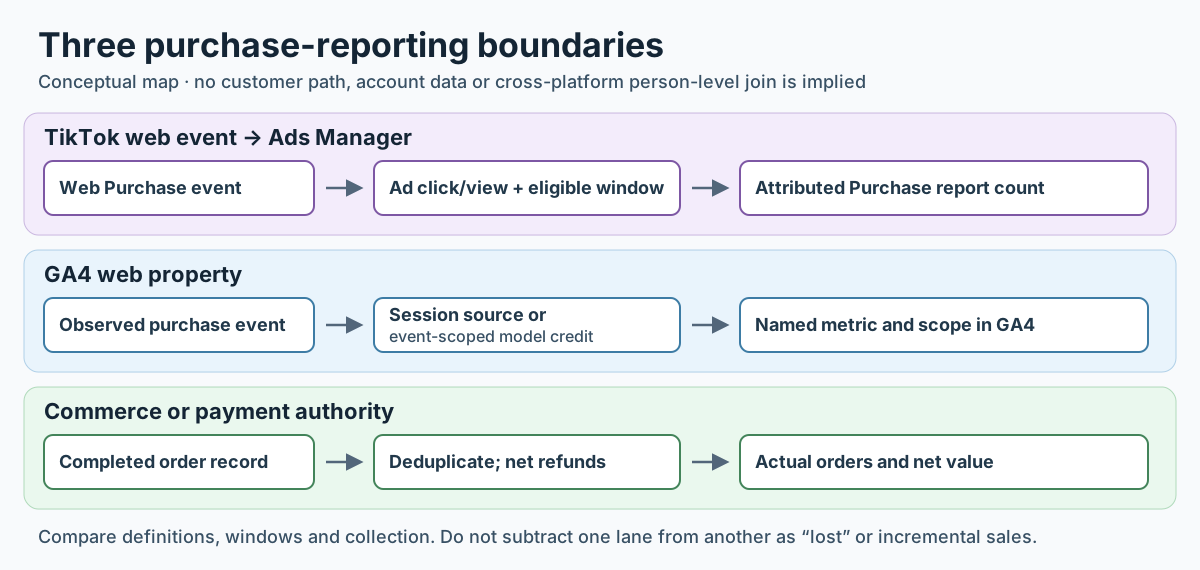
Original conceptual map of three purchase-reporting boundaries. The lanes need not have equal counts.
Original visual by Superdirector editorial team. Created 2026-10-28.
Pin the event and the reporting source
Record the TikTok ad account, campaign/ad group, website data connection, event name, exact metric column, click-through and view-through settings, report level, date range and account time zone. TikTok's standard Purchase event means a website visitor makes a purchase; its standard-event guide treats it separately from initiating checkout or adding payment information. If the campaign optimizes for a different event, do not rename its Conversions column “sales.” If you use a custom conversion such as “new-customer purchase,” record its rule and compare only with a similarly defined GA4/business cohort.
Record the GA4 property and web stream, the purchase event or selected purchase metric, the *exact* report and dimension, date range, property time zone, and any filter. Google's Traffic acquisition documentation says its Session dimensions are session-scoped, while its scope explanation shows that a filtered Event count in that report counts events in sessions assigned to the selected source. A report using First user source answers an acquisition question about a user's original source; it is a different comparison. A report using unprefixed Source for a purchase key event answers an event-credit question and can have fractional values under data-driven attribution. Label the dimension next to the number.
Finally, inspect the reconciled order record for the same site and period. GA4's web purchase event is intended to carry a unique transaction_id; Google says that ID deduplicates repeated web purchases and supports refunds. This is an instrumentation check, not permission to export customer identifiers into a public worksheet. The order or payment system still decides whether an order was completed, cancelled or refunded. Google's transaction-ID guidance and ecommerce event example describe the analytics side.
Verify the tagged route before interpreting the gap
Read the final destination URL actually attached to the ad, follow any redirect, and confirm that the landing URL retains its campaign parameters and the correct GA4 property records the intended campaign label. Google's URL guidance defines utm_source, utm_medium, utm_campaign and utm_id as campaign parameters; it says their values appear in Traffic acquisition when collected. Those parameters label traffic. They do not create a Purchase event, join a later order to a person, or establish causal lift. Google's URL builder guidance.
Record exact UTM spelling and capitalization. A campaign can fragment into several GA4 rows if the same source/campaign name is written differently, and a redirect can strip parameters before GA4 observes them. If the landing route itself is broken, repair that path before debating the sales report; the destination-to-session guide handles the earlier click/landing/session chain. If the website cannot observe the tagged session, mark the GA4 comparison incomplete rather than treating its missing row as zero sales.
TikTok also offers an optional, native comparison page for advertisers who have connected GA4 in Events Manager. Its September 2026 documentation says it compares web purchase data at account or individual-campaign level and includes only campaigns it can match via utm_id; its diagnostic checks utm_source, utm_id, utm_medium and utm_campaign. A missing campaign in that view may mean the utm_id join failed, not that the campaign made no purchases. Use the view if already available and record its filters; the article does not require connecting an account to answer the question. TikTok's reporting-comparison documentation.
Separate ad credit from GA4 source credit
TikTok's attribution glossary distinguishes purchases attributed to ad clicks from those attributed to views. A view-through purchase can be eligible under the campaign's settings even though that ad exposure never produced a tagged landing click. TikTok's Attribution Analytics can compare click- and view-through windows and show assisted versus referred conversions, subject to the reporting surface's availability. Do not copy a platform default window from a general help article; save the setting on the actual ad group and report.
GA4 answers a different question. Session source/medium labels a session's attributed origin, and a purchase event belongs to a session. Event-scoped Source/medium assigns key-event credit under the property's selected model; Google says session and user dimensions are not changed by switching that event reporting model, and event-scoped credit can be fractional. Thus even two GA4 rows labeled “TikTok purchases” can differ if one uses Session source and the other uses Source. Neither should be silently compared with TikTok's whole attributed-event count. Google's scope guide; attribution-model guide.
Hypothetical path, not observed customer data: someone views a TikTok ad but does not click it, later follows an email link to the shop and buys. If TikTok's view-through setting covers that exposure and its website event is eligible, Ads Manager *may* attribute the Purchase to the ad. The purchase-session source in GA4 may be email, and there was no TikTok UTM click in this path. The systems can describe the same business event differently without proving that the ad created the sale. This path illustrates possible credit rules; it is not a person-level join between the platforms or a measured lift result.
Align clocks, then inspect collection quality
Two reports filtered to the same displayed dates may still select different events. TikTok's Performance Comparison help offers ad-impression time and real time (when the event happened), and says ad-impression time is the comparison to Ads Manager. Google's attribution-model report distinguishes ad-interaction time from event time. Record the exact timing choice and both account time zones. Allow the selected attribution window and processing delay to settle before concluding that a recent date is missing purchases. Do not force a one-day TikTok ad-interaction row to equal a one-day GA4 purchase-event row.
Then check the event plumbing separately on each side. TikTok says its Pixel and Events API need the same event_id to deduplicate overlapping copies of one web Purchase. Google says a unique transaction_id lets GA4 deduplicate repeated web purchases; reusing an empty string or one ID for multiple orders can undercount. These are different identifiers with different jobs. The existence of either one does not mean the two vendors share an order-level join. TikTok event deduplication; GA4 transaction-ID guidance.
Check whether a sale was actually observed, cancelled or refunded in the commerce authority, and whether either platform is modeling or omitting events under its own collection conditions. TikTok says web modeled conversions may be reported when conversions cannot be observed directly; this is a conditional reporting possibility, not an assertion about your account. If the report does not expose a way to isolate modeled events, note that limitation instead of equating every attributed count with a verified order. TikTok's modeled-web-conversion documentation supplies that caveat.
Write a client explanation that names the remaining unknown
The purchase-scope comparison card and CSV ledger keep one row per report definition and a separate decision record. A defensible readout uses the labels, not a forced subtraction:
“For [campaign and period], TikTok Ads Manager reported [web Purchase metric and count] attributed under [click/view settings, report level and timing]. GA4 reported [
purchasemetric and count] under [Session source/medium or event-scoped Source/medium, property and timing]. The reconciled order system recorded [completed orders and refunds under its own rule]. We verified [specific configuration or collection differences]; [remaining difference] is unresolved. These platform counts do not establish incremental sales.”
The bracketed fields are placeholders, not campaign results. If the only verified explanation is “the credit scopes differ,” say that. If utm_id is missing, the TikTok comparison view cannot match the campaign; if the actual Purchase event is misconfigured, repair measurement. A platform-attributed count can support ad-reporting analysis; an order ledger can support actual order and net-revenue statements. A numeric ROI claim still needs verified return and campaign costs under the same declared scope, and causal lift needs a credible comparison. The served ROI method covers those later decisions.
Source and scope note
Official TikTok for Business, Google Analytics Help and Google for Developers pages were checked 2026-10-28. This is a definitions-based operator method; it does not use a Superdirector account export, private purchase record, actual ad setting, customer identity, asserted conversion count, or third-party performance statistic. TikTok's older general discrepancy page describes GA4 as simply “single-session” and “last click”; Google's current documentation distinguishes session-scoped and event-scoped credit, so this article uses Google's own scope and attribution documents for GA4 behavior. Recheck the exact provider settings and official pages before a real client report.
Frequently asked questions
Why might ad-platform attributed sales differ from GA4 tagged-link sales in the same campaign?
purchase metric and whether its traffic dimension is Session source/medium or event-scoped Source/medium. Check UTM collection, event deduplication and actual orders before explaining any remaining gap. Do not call the difference missing or incremental sales.Why can TikTok's purchase number be higher than GA4's tagged-session number?
purchase event falling in a GA4 session labeled with that TikTok campaign. Different collection, timing and modeled reporting can also matter. Inspect the actual account settings and event records; the direction of the gap alone does not identify its cause. TikTok attribution metrics; GA4 source scopes.Can GA4 show more TikTok-tagged purchases than TikTok Ads Manager attributes?
Should the numbers match once every ad URL has a UTM tag?
utm_id; they do not make TikTok view-through attribution, GA4 session source, GA4 event credit and an order ledger one metric. Test the tagged route, then compare definitions and preserve the unresolved difference. Google's URL guidance; TikTok's comparison-view conditions.