How-To Guide
Recruit nursing-student testers by showing a terminology study workflow
Create seven terminology-study demos and a nursing-student beta invitation that show recall and review without giving clinical advice.
I built a spaced-repetition app for medical terminology. How can I find my first US nursing-student users on social without giving medical advice?
Show how a student studies a checked term, attempts recall and revisits material. Keep the content about using a study tool, not interpreting symptoms, choosing treatment or making clinical decisions. A disclaimer cannot turn unsafe clinical instruction into harmless marketing, so exclude that instruction from the demonstration itself.
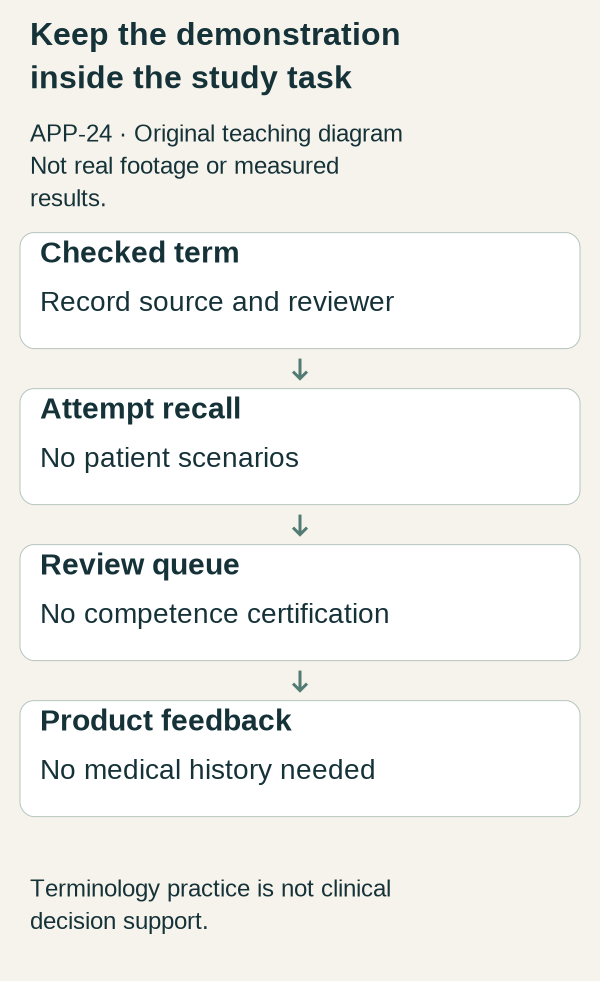
Original illustrative teaching diagram. Keep nursing terminology recruitment inside checked recall and review tasks without patient data or certification. This is planning guidance, not product footage, customer evidence or measured results.
Show how a student studies a checked term, attempts recall and revisits material. Keep the content about using a study tool, not interpreting symptoms, choosing treatment or making clinical decisions. A disclaimer cannot turn unsafe clinical instruction into harmless marketing, so exclude that instruction from the demonstration itself.
For a first group of US nursing-student users, a narrow, transparent beta invitation is more useful than a broad “master nursing” promise. Explain which terminology deck is available, who checked it, what the app does with it and what feedback you want. Do not imply school approval, exam alignment or improved clinical competence without evidence.
 Superdirector
Make it work for your brand
Find it. Remake it. Post it. Superdirector turns the viral formats in your niche into your brand's carousels, X posts and video scripts, and keeps the calendar full.
Build a demonstration deck before a content calendar
In this fictional example, TermLoop supports user-selected terminology cards, revealing a checked definition, marking a card for review and revisiting a review queue. Its timing algorithm has not been clinically or educationally validated. Those are illustrative product facts, not claims about any real app.
Use a small deck of foundational terminology reviewed by a qualified subject reviewer. Record the source, version and reviewer for each entry. Check whether you may reproduce the source wording; facts and definitions still require careful original expression and attribution where appropriate. Do not copy a textbook deck or a professor's course materials because they happen to be available online.
Exclude real patient examples, clinical records, medication instructions and diagnostic recommendations from the capture account. Even a blurred screen can retain private information in a notification, thumbnail or filename. Prepare a clean account rather than relying entirely on post-production masking.
Seven videos that demonstrate the study job
1. Preview the deck's actual scope
Opening: “What is inside this terminology beta?” Show its real deck title, topic list and a sample checked card. Say: “This is a terminology study tool, not a clinical decision tool. This beta contains the topics listed here.” End with the verified beta information destination.
Do not call a general terminology collection “everything for nursing school.” If a requested course area is missing, state that plainly rather than adding its name to the caption for search visibility.
2. Show the attempt before the reveal
Opening: “Try recalling the term before opening its definition.” Show the card, leave a reasonable pause, then reveal the actual definition. The pause is a production choice, not a claim about optimal learning time.
Say: “The app separates the prompt from the answer so you can attempt recall first.” That is a visible interface fact. “You will remember twice as much” is an outcome claim and should not appear without suitable evidence.
3. Keep an uncertain item for later
Opening: “What if you are not sure yet?” Mark an item for review using the real control. Open the review queue and show that it is there. Explain the control's actual meaning: a user-selected review state, not a certification of competence.
If the app uses an algorithmic schedule, explain only behaviour you have verified. Avoid borrowing another product's spaced-repetition terminology when your implementation does not match it.
4. Correct a content error visibly
Opening: “Found wording that seems wrong or unclear?” Demonstrate the real reporting route with a fictional issue. Show where a report goes and what the product currently promises about review.
Do not claim every submission is reviewed by a nurse unless that is genuinely staffed and documented. If your reporting process is simply a founder-monitored email, describe it accurately. A modest real correction process is better than an invented expert panel.
5. Distinguish study notes from patient notes
Opening: “This demo uses invented study material, never patient information.” Show a harmless sample note field only if the feature exists. Explain what users should put there: their own general study reminder, not patient identifiers or clinical records.
Review the product's actual data practices separately. “Do not enter patient information” is not the same claim as “the app is approved for protected health information.” Do not imply such approval.
6. Show the return visit
Opening: “Where do you start when you come back?” Reopen the app and demonstrate finding the review queue. If you join footage from different sessions, label the edit. Explain what is stored and what is not only after checking the implementation.
This video answers a practical adoption question: will a student know what to do next? It does not need exam scores, a transformation story or a testimonial.
7. Give the beta tester one useful assignment
Opening: “Could you find and revisit one study card?” Ask prospective participants to read the beta details, use one available card and report unclear navigation or wording through the stated channel.
Suggested copy: “I am looking for nursing students to test this limited terminology-study workflow. It is not medical advice or a clinical tool. Please do not send patient information or private course records. The beta page explains the available deck and access conditions.”
Find relevant places without turning participation into spam
Look for public student discussions where study tools or terminology workflows are already relevant. Read each community's promotion rules and recent moderation guidance. Ask a moderator through the stated route when permission is needed. Do not scrape a student list or imply a relationship with a school you do not have.
Contribute a useful explanation of the workflow before inviting anyone to try it. The question is not “How can I post everywhere?” It is “Where would this limited study task be useful and permitted?” Keep a record of the community, relevant discussion, permission status and the exact invitation used.
For this worked example, assume a $150 ceiling. It does not require buying creator coverage. If you need content review, investigate that cost before promotion. Do not advertise expert-reviewed content until the review has actually occurred and its scope is clear.
A complete reusable test record
Worked record: fictional TermLoop beta; checked terminology deck; user opens one card, attempts recall, reveals its definition and adds it to review; feedback asks whether the next action was understandable; no patient data requested; content questions go to the verified correction route; claim limited to demonstrated study functionality.
Blank record: deck/source/version ___; reviewer/scope/date ___; current build ___; exact study action ___; sample-data check ___; excluded clinical claims ___; invitation destination ___; feedback question ___; correction owner ___; next content revision ___.
Track invitation responses, access granted, completed workflow attempts and reported problems separately. A signup is not evidence of learning. If testers repeatedly interpret the app as clinical guidance, change the positioning and onboarding before recruiting more people.
Next action and supporting reference
Record the reveal-and-review flow with one fully checked card. Have the subject reviewer inspect both the definition and the surrounding marketing language. That small review catches a different class of error than checking whether the app runs.
Rawcut's existing-footage guide, inspected in the supplied source research, informed the separation of on-screen instructions from spoken narration. It is not a nursing-education or clinical source. This article deliberately supplies no clinical teaching, treatment advice or learning-effectiveness estimate; those cannot be inferred from a production guide.