How-To Guide
Is it legal to copy a viral video format, hook or trend for your brand?
US copyright does not protect ideas, formats or hooks; it does protect footage, scripts, music and visuals. What a brand may reuse and what it must make.
By the Superdirector editorial team. Statutes, Copyright Office pages and platform policies read November 6, 2026. Not legal advice.
At a glance
Is it legal to copy a viral video format, hook or trend for your brand?
In the US, copying the idea of a viral video is generally allowed: copyright law does not protect ideas, methods or short phrases, and a format is usually treated as one of those, so a simple hook pattern, a list structure or a trend concept is generally free to use. Copying the video itself is not: the footage, the script's wording, the music, the images and the edit belong to whoever made them. A brand can reuse the format and must make every piece of content itself, with licensed music. Platforms add stricter originality rules on top. This is general information, not legal advice.
- Free to reuse: the idea, format, structure, pacing and a short hook phrase.
- Make yourself or license: footage, script wording, voiceover, music, photos, graphics, characters.
- Never use: their logo or brand name in a way that suggests a link, or a re-upload of their post.
The short answer: the format is free, the content is not
One line in US copyright law answers most of this question. Section 102(b) of the Copyright Act says protection never extends to "any idea, procedure, process, system, method of operation, concept, principle, or discovery", however it is described or shown. The Copyright Office's FAQ says the same in plainer words: ideas, concepts, systems and methods are outside copyright, and so are names, titles, slogans and short phrases.
A simple video format is an idea and a method: "a question on the first slide, five answers, a punchline on the last" or "film the problem, cut to the fix". A hook line such as "Nobody tells you this about..." is a short phrase. Those are free to use. What the creator owns is the expression: the footage they shot, the words of their script, their voiceover, their music, their images, their edit. Copyright attaches to those as soon as they are recorded, and only the owner may prepare a new version of them.
This page explains what US law and the rules of TikTok, YouTube and Instagram say, as read on November 6, 2026. It is general information, not legal advice; for a campaign with real money or a named creator involved, ask a lawyer.
Separate the format from the content
Before you make anything, split the post you want to follow into two lists. The left column is what you may reuse; the middle is what you must make yourself; the right is what you should never take.
| Reuse freely (format) | Make your own (content) | Never take without permission |
|---|---|---|
| The idea or premise | Footage and photos | Their video file, stitched or re-uploaded |
| The structure: slide count, order, before and after | The script and captions, in your words | Their original sound or voiceover |
| A short hook pattern or phrase | On-screen text and graphics | Their logo or brand name used to suggest a link |
| Pacing: cut every two or three seconds | Your presenter and voice | A distinctive character or artwork they created |
| The topic or trend concept | Music from a licensed library | A recognizable person filmed by them |
The middle column is the work. If you can describe the post in one sentence without mentioning anything they filmed, wrote or recorded, you have the format. The keep-change checklist has these rows as a sheet you can fill in for each post.
When enlarged, scroll horizontally to read the diagram.
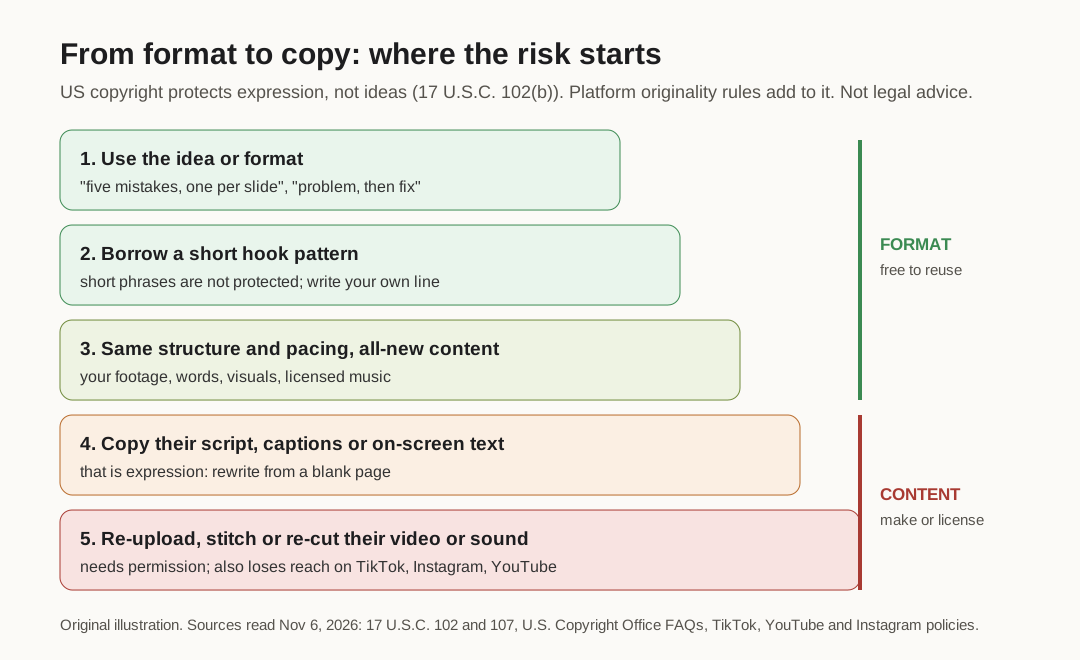
Original illustration based on 17 U.S.C. 102(b), Copyright Office FAQs and platform rules read November 6, 2026. Not legal advice.
Original visual by Superdirector editorial team. Creation date not recorded.
Make every piece of content yourself
No fixed amount of someone else's video is safe to borrow. The Copyright Office's fair use FAQ rules out any fixed allowance, whether counted in words, notes or a share of the work, and adds that no amount of change lets you claim another person's work without the owner's consent. Fair use exists, but its four factors include whether the use is commercial and its effect on the original's market, two factors that tend to count against a brand ad built on another creator's clip, although each case is decided on its own facts.
In practice: shoot your own footage, even on a phone; write your script from a blank page after noting only the structure; put your own product, your own customer questions and your own examples in it. Two places people slip are on-screen text copied word for word from the original, and a voiceover that follows their script line by line. Both are the expression, not the format.
Choreography is a separate case. Section 102(a) lists choreographic works as protectable, so a distinctive dance routine can belong to someone. Where a simple trend move ends and a protected routine begins is a judgment this page cannot make for you, so for a dance trend in a brand post, ask a lawyer before you copy the moves step for step.
License the music
Music needs its own check. TikTok's business help page says the general music library is not for commercial use by businesses, which should use the Commercial Music Library, about 1 million pre-cleared songs that are free for businesses, for organic posts (including duets and stitches), video ads and branded content. If you want to use another user's original sound, TikTok tells businesses to check with their legal team that they hold a proper license.
So when a viral post rides a trending song, keep the format and pick a track from the commercial library, or use your own audio. The song is part of the content, not the format.
Check the platform's originality rules
Copyright is the floor. Each platform adds an originality rule that bites even when no one would sue:
- TikTok: "You should only post content you created or have the right to share." Reused material with nothing new added is kept out of the For You feed, and TikTok bans repeat copyright infringers in appropriate circumstances (Community Guidelines, IP policy).
- YouTube: its reused content rule says taking someone else's content, making minimal changes and calling it your own violates the monetization guideline, even with permission; reused material is allowed when viewers can see a meaningful difference.
- Instagram: its ranking explainer says it makes reels that were already posted on Instagram less visible.
The practical upshot matches the law: a new post in a known format is fine, a re-cut of someone else's post is not, and on TikTok and Instagram it is also likely to reach fewer people. Trademark law is a separate line again. The USPTO describes a trademark as a word, phrase, symbol or design that identifies goods or services, so a rival's brand name or logo in your post can suggest a connection that does not exist.
Run the checklist before you post
- Could you describe the original in one sentence without naming anything they filmed, wrote or recorded? That sentence is the format you are using.
- Is every frame of footage and every photo yours, licensed or from a source that allows commercial use?
- Is the script in your own words, with your product and examples, and no line lifted from theirs?
- Is the music from a commercial library or your own, with no trending sound from the general library?
- Is no other brand's name or logo used in a way that suggests a partnership?
- Is everyone recognizable in the video someone who agreed to be in it?
- Would a viewer who saw both posts see a meaningful difference beyond the format?
Any no means change the post, or ask a lawyer before it goes out. The remake method walks through a full example, and the weekly routine for spotting outliers covers where the formats come from.
Superdirector, our product, works on the format side of this line. When a post takes off in your niche, it keeps the hook and structure and writes fresh carousels and X posts in your brand; it rebuilds the format rather than reposting anyone's footage or audio. You stay the publisher of what goes out, add AI labels where a platform asks for them, and keep each account separate.