How-To Guide
Can you measure which Instagram Reel sends sales to Amazon?
Measure traffic from Instagram to Amazon with an Attribution access check, a route checklist and a fallback log for clicks and buyer questions.
By the Superdirector editorial team.
At a glance
Can I measure which Instagram Reel sends sales to my Amazon listing, and what should I track if my account cannot use Amazon Attribution?
Sometimes you can report purchases associated with a Reel-specific Amazon Attribution link, provided your account is eligible and viewers actually use that distinct route. Without purchase-level attribution, you can still measure identifiable outbound clicks and buying questions. You cannot honestly turn a shared profile-link click or a same-day sales increase into proof that a particular Reel caused a sale.
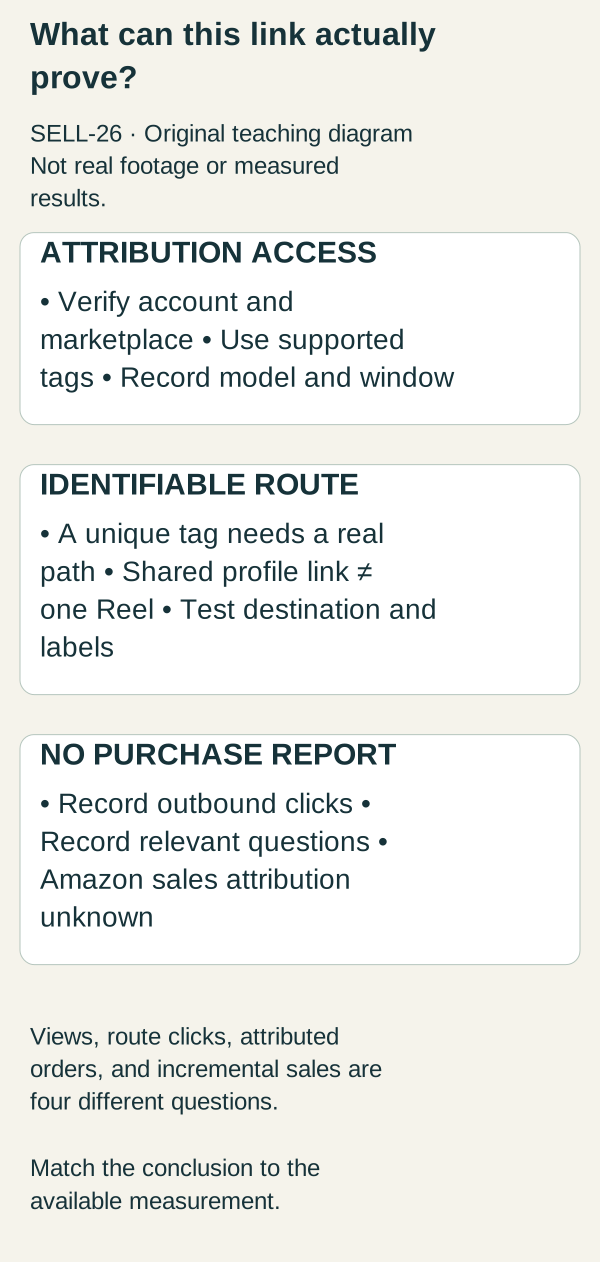
Original illustrative teaching diagram. Separate attribution availability, identifiable link routes and unknown Amazon purchase reports; clicks are not incremental sales. This is planning guidance, not product footage, customer evidence or measured results.
Original visual by Superdirector editorial team. Created 2026-10-20.
Sometimes you can report purchases associated with a Reel-specific Amazon Attribution link, provided your account is eligible and viewers actually use that distinct route. Without purchase-level attribution, you can still measure identifiable outbound clicks and buying questions. You cannot honestly turn a shared profile-link click or a same-day sales increase into proof that a particular Reel caused a sale.
The practical task is to choose the strongest measurement your account and link path support, then label the result at that level. This original worksheet works for a small Amazon seller testing several Instagram product demonstrations.
Three different questions are often mixed together
“Did people watch?” is an exposure question. “Did people follow a link toward the listing?” is a traffic question. “Did the campaign receive credit for a purchase?” is an attribution question. “Would that purchase have happened without the Reel?” is a causal question.
Each question needs different evidence. A traffic tool can answer the second without answering the third, and an attribution report can assign credit under its own rules without answering the fourth. Decide which question matters before you choose a dashboard.
First branch: check your actual Amazon access
Amazon's current product page describes Attribution as a free measurement solution for marketing outside Amazon. Its FAQ lists professional sellers enrolled in Brand Registry, vendors, KDP authors, and agencies serving sellers as eligible, and says separate tags let you view metrics by marketing tactic. Availability depends on the account and marketplace, so verify access and do not assume every seller has the tool. Amazon Attribution overview.
Sign in through your normal trusted Amazon route and confirm that you can create a measurement setup for the exact product and marketplace. Record the access date and any unresolved eligibility question. If the interface or eligibility differs from a guide, rely on your current account information and Amazon's official support. Do not invent a workaround.
You do not need to open a second account, buy an unrelated subscription, or share credentials with a link vendor simply to begin a click log.
If Attribution is available, make the route identifiable
Give each creative a stable identifier, for example R01-cleaning, R02-size, and R03-storage. Create separate measurement tags for the distinct tactics your account supports, and keep a record that maps each creative ID to its tag, destination, placement, and dates used.
Amazon's documentation lists clicks, detail page views, and purchases among the reported metrics, and its product page states a fourteen-day attribution window. Check the current definitions and date settings in your report before you compare results. Amazon's reporting FAQ.
The main limitation is routing. If all three Reels tell viewers to use the same profile link, a single tag can identify that profile route without necessarily identifying the Reel that prompted the visit. Naming the link after a creative does not make the source uniquely identifiable.
A distinct labelled destination choice can help where your actual tools support it, but the extra step may change behaviour. Record that trade-off. Do not pretend a viewer who chooses “cleaning demo” has been experimentally assigned to that creative.
A completed fictional measurement plan
Suppose the seller is testing three garlic-press Reels and cannot access Amazon Attribution.
Purpose: decide which buying question deserves another demonstration.
Available route: one existing product-information page, followed by an Amazon button.
Creative labels: R01-cleaning, R02-chamber, R03-storage.
Directly measurable: aggregate page visits and outbound Amazon clicks during the test, using the existing page analytics.
Manually observable: questions mentioning cleaning, chamber capacity, or drawer fit.
Not available: verified Reel-level Amazon purchases.
Decision rule: improve the clearest repeated buying question and repair any broken destination before expanding production. Do not rank Reels by invented sales totals.
If the seller can later create genuinely distinct, tested routes, the measurement plan can become more granular. Keep the old results at their original level and do not retroactively upgrade them.
The log to copy
For each creative or route, record:
- Creative ID and descriptive title.
- Actual publishing account and placement.
- Publication time and observation period.
- Destination and tracking label, if any.
- Whether the route uniquely identifies the creative.
- Available exposure metric and its definition.
- Recorded clicks and the tool's counting method.
- Reported purchases, attribution model, and window, if available.
- Relevant buying questions.
- Price, stock, promotion, or listing changes during the period.
- Conclusion and what remains unknown.
Keep a separate “unavailable” value. Zero purchases in a functioning report and no purchase reporting at all are different observations.
QA the full path before comparing anything
Open the route on a phone as a shopper would. Confirm the correct Amazon marketplace, product, variation, and availability. Check any redirect or intermediate page. Make sure the label maps to the intended creative and that your analytics can recognise a test visit after the expected reporting delay.
Do not create fake orders to test sales reporting. Use legitimate tool diagnostics or approved test procedures where provided. A working click route is worth verifying even when purchase reporting is unavailable.
Also note whether a shared link was changed during the test. If R01 and R02 remain visible while the profile link changes from one tag to another, later clicks cannot cleanly be assigned to the latest post.
Make a decision at the level of your evidence
If one route receives more clicks, say that. If a supported report assigns more purchases to one tag, state the report, window, and conditions. If total sales rise while other promotions run, do not allocate the increase to Instagram by subtraction.
The next useful action may be to improve a landing page, make the buying step clearer, or repeat a demonstration with a new opening. Better measurement has value, but it should not become a reason to delay every useful product explanation.
Start by writing one sentence: “For this test, I can reliably measure __, but not __.” That sentence is the guardrail for every chart and spending decision that follows.