How-To Guide
How do you write an X (Twitter) thread that people read to the end?
Write an X thread people finish: a first post that works alone, one idea per post, one ask at the end. With a copyable template and X's own ranking notes.
By the Superdirector editorial team. X's repository, X developer docs and the guides cited were read November 6, 2026.
At a glance
How do you write an X (Twitter) thread that people read to the end?
Decide the one thing the thread proves, then write the first post as a complete promise: the payoff, a reason to believe it and the shape of what follows. Give each later post one idea or number that leads to the next, end with the payoff and one request, and cut every post that repeats. The code X publishes now estimates time spent and trains retrieval to surface posts people read to the end, so, on our reading, a short thread people finish should do better than a long one they abandon.
- The opener often travels alone: X's For You merges the side branches of a single conversation.
- In X's weights file a reply or quote scores 5.0 and a copied-link share 20.0; a like scores 0.708.
- Emojis count as 2 characters and links as 23 toward the 280-character limit.
What gets a thread read to the end
To write an X thread people finish, decide the single thing it proves, make the first post a complete promise that works on its own, give each later post one idea that leads to the next, and end with the payoff plus one request. Cut every post that does not move the reader closer to that payoff. Five to eight posts is enough for most ideas; length is only worth it if each post earns the next tap.
The ranking code X publishes points the same way. Its For You README logs two recent changes: on October 8, 2026 the ranking model got much better at estimating how long you spend on a post, and on October 13 retrieval was also taught to favour posts that readers finish. In the weights file, which X mirrors from its feature-switch defaults (last synced November 5, 2026), a reply and a quote score 5.0 each and sharing a post by copying its link scores 20.0, while a like is worth 0.708. X warns that these weights scale predicted probabilities, not counts, so read them as which reactions to aim for. They are not an exchange rate between likes and shares.
One more detail from the README shapes how you write the opening. For You runs a filter that merges the side branches of a single conversation, and Buffer's guide points out that most readers scrolling past will see only a thread's opening post. Our reading: a stranger meets your thread through one post, so the opener must earn the tap by itself.
Decide the one thing the thread proves
Most threads that lose readers halfway were three ideas pretending to be one. Before writing, finish this sentence: "By the last post, the reader will know ___ and can ___." If you cannot finish it, you have a topic, not a thread. If the whole idea fits in 280 characters, post a single post; a thread is for something that needs steps, evidence or a sequence.
| Thread type | What it proves | Good length |
|---|---|---|
| How-to | A reader can do a task by the end | 5 to 8 posts, one step each |
| Teardown | Why something worked, with the evidence | 6 to 10 posts, one finding each |
| Story | What happened and what you learned | 5 to 7 posts, ending on the lesson |
| List | The few options worth knowing | One post per item, plus the opener and close |
| Data | One number and what it means | 4 to 6 posts, chart in the second post |
These lengths are our working ranges, not X rules. Wordtune's 2023 guide said X allowed 20 posts in one thread; X's help center would not load when we checked, so look in your own composer for the current cap.
Write the first post as the whole promise
Onlypult calls the first post the headline, and it is more than that on X: it is often the only post a stranger reads before deciding. A good opener does three jobs in one post. It states the payoff, it gives a reason to believe you (a number, a result, a credential that matters to this topic), and it tells the reader what follows.
- Payoff first: for example (an invented one), "How we cut our onboarding drop-off from 61% to 38% in four changes." The reader knows what they get.
- Specific over clever: a real number or named situation beats a teaser like "This changed everything." A teaser that never pays off is the fastest route to a not-interested tap, which carries a weight of -53.07 in X's weights file.
- Say the shape: "4 changes, with screenshots" or "A thread" tells people it continues; Buffer's guide also suggests numbering posts (1/, 2/) so a reader who lands mid-thread can follow.
- Write ten, keep one: XPatla suggests writing 10 hooks before the thread; pick the most specific, not the loudest.
Keep the opener inside the limit without tricks. X's character rules count every emoji as 2 characters and every link as 23, so emoji-heavy hooks lose room fast. More openers are collected in how to write hooks that stop the scroll.
Give every middle post one idea and a reason to keep going
Each middle post should carry one idea, one example or number, and an ending that makes the next post feel necessary. XPatla's rule is one idea per tweet, which also helps anyone who meets a single post out of context. Write each post so that, quoted alone, it still says something true and useful.
- Lead with the point, then the support, as in this invented example: "Change 1: we replaced the password step with a magic link. Step-three completion rose from 41% to 55%."
- Put proof where the claim is: a screenshot, a chart, a quote with its source. An image in the second or third post breaks up the text.
- End on the bridge: the next question the reader now has ("But that broke something else.")
- Delete any post that only restates the previous one. A thread that drags is the opposite of time well spent.
Two ideas in one post? Split it. One idea spread over two posts? Merge them.
When enlarged, scroll horizontally to read the diagram.
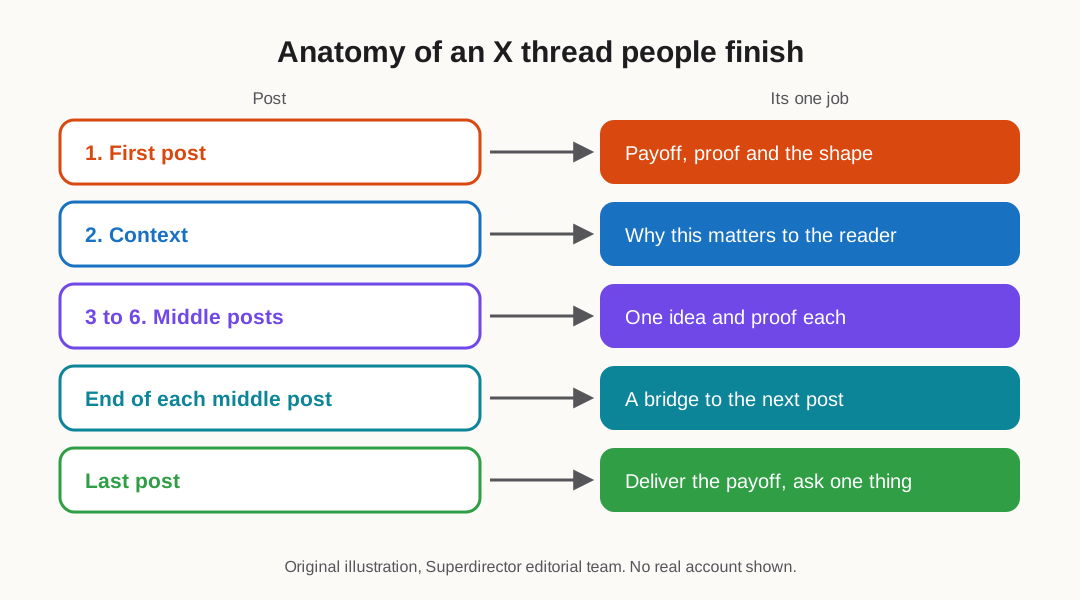
Original diagram of the thread structure in this guide; it shows no real account or result.
Original visual by Superdirector editorial team. Creation date not recorded.
End with a payoff and one ask
The last post pays off the first. Restate the result in one line, then make one request. Onlypult's structure ends with a summary and a call to action; XPatla's advice is to choose a single goal for the ask. In our experience, asking for a reply, a follow and a click in one post splits the reader's attention three ways.
| If your goal is | End with | Why it fits X's weights |
|---|---|---|
| Conversation | One real question your readers disagree on | A reply scores 5.0; a like scores 0.708 |
| Followers | What you post next and how often | Following the author carries 4.0 |
| Sharing | "Send this to the person who runs your onboarding" | Copying the link to share scores 20.0 |
| Traffic | The link, in the last post or a reply | Opening a link carries 0.2; test where it goes on your account |
Post it in X's composer or schedule it
In X's composer, write the first post, then use the + button to add the next post to the same thread; Buffer's guide describes the same button. Publish all posts together so nobody's reply lands between parts.
- Character budget: 280 per post for Latin text; emojis and Chinese, Japanese or Korean characters count as 2, links as 23.
- Draft somewhere else first: write the full thread in a note, read it aloud, then paste post by post. Typefully, per SocialPilot's comparison, can paste long text and split it into posts automatically; check every split by hand.
- Scheduling: Buffer's guide says Buffer schedules threads, and Onlypult's page says it can schedule a thread of ten posts at most. Not every tool can: Blaze's help page says its X integration cannot post threads automatically, so you paste them in yourself.
- Timing: the For You README filters out posts older than 48 hours before scoring, so a thread has a short window. Our advice: post when you can answer replies for the first hour or two.
A thread template you can copy
This is the structure above as a fill-in sheet: each post's job, its character budget and a worked example for an imaginary app founder. The example is illustrative, not a real account. The same rows are in the thread template CSV.
| Post | Job | Budget | Example (illustrative) |
|---|---|---|---|
| 1 | Promise: payoff, proof, shape | Under 250 characters | We cut onboarding drop-off from 61% to 38% with 4 changes. Screenshots of each: |
| 2 | Context: why it mattered | 1 idea | Most people quit at step three, the password screen. That was where we started. |
| 3 | Change 1, with proof | 1 idea + image | Change 1: magic link sign-in. Step-three completion went from 41% to 55%. |
| 4 | Change 2, with proof | 1 idea | Change 2: we asked for the workspace name after sign-up, not before. |
| 5 | Change 3 and the setback | 1 idea + bridge | Change 3 backfired at first. Here is what we missed: |
| 6 | Change 4 and the fix | 1 idea + image | Change 4: a 20-second sample project. Our biggest single gain. |
| 7 | Payoff and one ask | 1 request | 61% to 38% in six weeks. Which onboarding step loses your users? |
Turn a carousel into a thread, and back
A carousel and a thread are the same skeleton in two formats: a cover that promises, one idea per slide or post, and a closing slide that pays off. If a carousel did well on Instagram, it is a tested outline for a thread, and a thread with a strong finish rate is a ready outline for a carousel.
| Carousel | Thread | What changes |
|---|---|---|
| Cover slide | First post | The thread opener needs the proof in words; a slide can lean on the visual |
| One idea per slide | One idea per post | Posts can hold a sentence of context that a slide cannot |
| Chart or screenshot slide | Image in the post | Keep one image per few posts, not one per post |
| Closing slide with the ask | Last post with one ask | On X, ask for a reply or a share; on Instagram, a save or send |
When you remake a thread that worked for someone else, keep the structure and write every word yourself: your example, your numbers, your product. Quote the original post when you are building on it directly.
Read the results and rewrite the first post
Judge each thread against your own account. At 48 hours, note the first post's impressions, the replies across the thread and the profile visits, then set them against the median of the last ten posts you published. A thread with a strong first post and weak later engagement lost people in the middle; one with weak impressions but good replies needs a new opener. X publishes no thresholds for this; the comparison is ours.
Rewrite the opener of a thread that underperformed and post the improved version a few weeks later; most of your followers will not have seen the first one. Keep a log of openers and results, and the patterns appear within a month. For a broader weekly routine, see how to plan a week of content.
Where Superdirector helps with threads
We build Superdirector, so read this part with that in mind. You name the X accounts, rivals and search terms worth watching; it picks the posts and formats taking off and writes X post and thread drafts on the same skeleton, in your brand's voice. On the $199 Growth plan it can publish Instagram carousels and single X text posts to your own accounts, after your first approval or through a standing Auto-post you turn on. Threads are not among the posts it publishes; you paste those in yourself. The home page headline reads "Autonomous social media growth.*" and the asterisk says "AI video and full autopilot are coming soon." You stay the publisher of every post.