How-To Guide
How many views does a video need to count as viral?
No platform sets a viral number. Measured data puts the top 1% near 1M views on TikTok and Reels; for your account, 10x your median at day 7 is the test.
By the Superdirector editorial team. Platform help pages and the studies cited were read November 6, 2026.
At a glance
How many views does a video need to count as viral?
No platform publishes a viral number, so there are two honest answers. Across everyone posting, roughly a million views is top-1% territory for TikTok and Instagram Reels, and a YouTube Short gets there from about 95,000, in one tracker's sample of 3.3 million videos. For your own account, a good working rule is to call a video viral once it has about ten times your typical (median) views a week after posting. That second test is the one to act on.
- Your viral bar: the median of your recent 20 to 30 posts, multiplied by 10. Three times it is a strong post.
- Judge a TikTok at day 7, not day 1: breakout TikToks had collected only about 7% of their first month's views by the end of day one.
- Platforms count views differently, so compare a post with its own platform and its own account.
There is no official viral number
TikTok, Instagram and YouTube do not publish a view count that makes a video viral. The numbers you see quoted, such as "1 million views in 24 to 72 hours", come from people watching accounts, and the better guides say so: Fourthwall's breakdown calls its thresholds "informal, observed patterns", and Learning Revolution says its table is not official either.
So the question has two useful answers. The first is how rare a number is across everyone posting. The second is how far a post travelled compared with what your own account normally gets. A brand needs the second, because it tells you which of your posts, or a competitor's, did something worth repeating.
The rarity figures below are from viral.app's study, which counted 3.3 million short videos from accounts tracked in viral.app, posted from October 2025 through August 2026. That is one vendor's sample, not platform data, but it was the largest dated sample we found and it explains its method.
How rare each view count is on each platform
| Platform (viral.app sample) | Top 1% from | Top 10% from | Middle video | Odds of reaching 1M |
|---|---|---|---|---|
| TikTok | 807k | 18.2k | about 870 | 1 in 120 |
| Instagram Reels | 1.06M | 35.9k | about 1.5k | 1 in 95 |
| YouTube Shorts | 95k | 5.7k | about 1k | 1 in 370 |
| Facebook video | 695k | 40.1k | about 670 | 1 in 140 |
Read the table as "how unusual is this number for anyone". On TikTok and Reels the top 1% begins close to a million, so "a million views" is a reasonable shorthand there. Shorts break out less often: around 100,000 already lands a Short in its top 1%. Every count was taken at least 30 days after the video went up.
Account size moves all of this. Million-view TikToks from accounts below 1,000 followers were roughly one in 1,600 in the same data. A separate, smaller dataset from Reelyze (9,770 Reels from 222 accounts) found that just 38.7% of Reels got as many views as the account had followers, and 7.7% got ten times that. That is why a single absolute number misleads a small brand.
Work out your own viral bar
The test that fits your account is a multiple of your own median. The pattern held on each platform viral.app measured: roughly one video in seven beat its account's median by three times, one in twenty by ten times, one in a hundred by a hundred times. Use it like this:
- Pull your most recent 20 to 30 posts on one platform, each at least seven days old. Leave out anything you boosted with ads, because paid views inflate the count.
- Rank them by views and pick the one in the middle. That is your median. Skip the average: a single hit inflates it and hides your usual result.
- Multiply the median by 10; anything over that line is viral for your account. Three times the median marks a strong post worth studying.
- Divide each post's views by your follower count as a second check. A post with more views than you have followers has very likely reached people who do not follow you.
Here is the same arithmetic for two invented accounts, so you can see why one number does not fit both. The figures are an illustration, not customer data.
| Small account | Large account | |
|---|---|---|
| Followers | 2,000 | 200,000 |
| Median Reel, last 24 posts | 900 views | 40,000 views |
| Strong bar (3x median) | 2,700 | 120,000 |
| Viral bar (10x median) | 9,000 | 400,000 |
| A Reel with 12,000 views is | 13x the median, 6x followers: viral | 0.3x the median: a weak post |
| A Reel with 120,000 views is | 133x the median: a breakout | 3x the median: strong, not viral |
The 120,000-view Reel is the same number in both columns and means opposite things. The viral bar worksheet has these formulas set up for your own posts.
When enlarged, scroll horizontally to read the diagram.
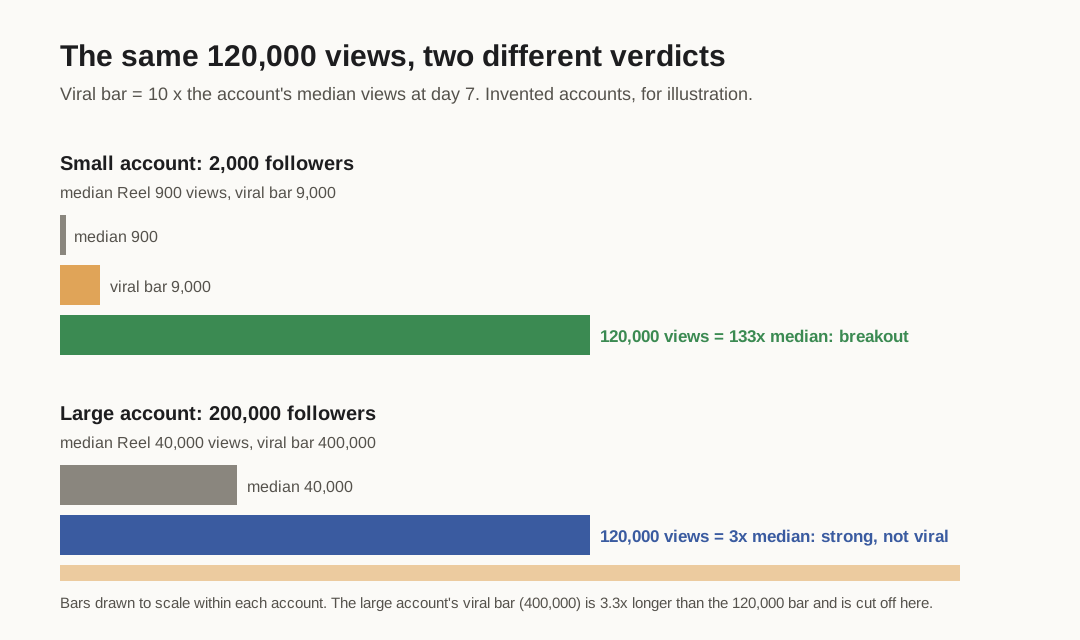
Original illustration with invented accounts. The bar is 10 times each account's median views at day 7.
Original visual by Superdirector editorial team. Creation date not recorded.
Wait a week before you judge
Plenty of guides say a viral video does its work within one to three days. viral.app's timing data says that is true of ordinary videos and false for breakouts. The typical TikTok that finished above a million had about 7% of its first-month views after day one, about a fifth after day two and just under two thirds after day seven. TikToks that never passed 10,000, by contrast, collected nearly nine tenths of their views on day one.
Reels front-load more: million-view Reels in the same sample had close to a third of their month's views after day one. In practice, look at day two for the early sign (a post that keeps growing after day one is unusual) and record the number at day seven before you compare it with your bar. YouTube adds its own delay: it says verified metrics can take several days to update fully.
Check how the platform counted the views
A view is not the same event on every app, so compare a post only with posts on the same platform.
- YouTube: since August 24, 2026, YouTube's help page says a view counts as soon as playback begins, for Shorts, long videos and live streams alike. YouTube can also pause or adjust a count, and throw out low-quality plays, while it verifies them; its Realtime numbers are estimates.
- YouTube Shorts: square or vertical uploads up to three minutes, posted on or after October 15, 2024, are classed as Shorts, so a two-minute vertical video now sits in the Shorts numbers.
- TikTok: its newsroom explainer says follower count and past hits are not direct factors in For You recommendations, while an account with more followers is still likely to get more views. Finishing a longer video is weighted as a strong signal.
- Instagram: Instagram says the bulk of the Reels a viewer gets are from accounts that viewer does not follow, and it ranks them mainly on the odds of a reshare, a full watch, a like and a visit to the audio page.
Two consequences for the test. Most Reels people see come from accounts they do not follow, so a Reel can travel well beyond your followers, and the follower ratio is a useful second check there. And YouTube changed what counts as a view in August 2026, so a median built from older videos may not match how newer ones were counted; keep the median window recent.
Turn an outlier into your next post
Finding the outlier is half the job. The other half is working out what made it travel and doing that again in your own brand. For each post that cleared ten times its account's usual views, write down three things: the hook in the first line or first two seconds, the structure (a five-slide list, a question and answer, a before and after), and the payoff at the end. Then make your own version with your product, your words and your footage.
Do not repost the original: Instagram says it aims to make reels that have already been posted on Instagram less visible, and TikTok says it does not recommend duplicated content. The weekly outlier routine covers where to look, and the remake method covers what to keep and what to change.
If you would rather not do this by hand, Superdirector (the product behind this site) watches the accounts, competitors, keywords and hashtags you choose on Instagram, TikTok, YouTube and X, picks the posts and formats that are taking off, and remakes them as carousels and X posts in your brand. On the Growth plan it can post Instagram carousels and X text posts for you, after you approve the first one or switch on Auto-post. Finished AI video is coming soon; until then a video idea comes back as a script and storyboard for you to shoot.