How-To Guide
Make evergreen Reels for a UK road-trip budget app
Write five UK road-trip budget Reels using labeled inputs, a worked fuel estimate and clear limits instead of stale pump-price headlines.
I made a road-trip budget app for UK drivers. How do I create useful launch Reels without quoting fuel prices that will go stale?
Demonstrate the calculation with clearly labelled example inputs, not a headline fuel price that will become stale. Show viewers where to enter their own distance, fuel consumption and price, then explain what the result includes and excludes. Your durable promise is a transparent planning method, not today's cheapest trip.
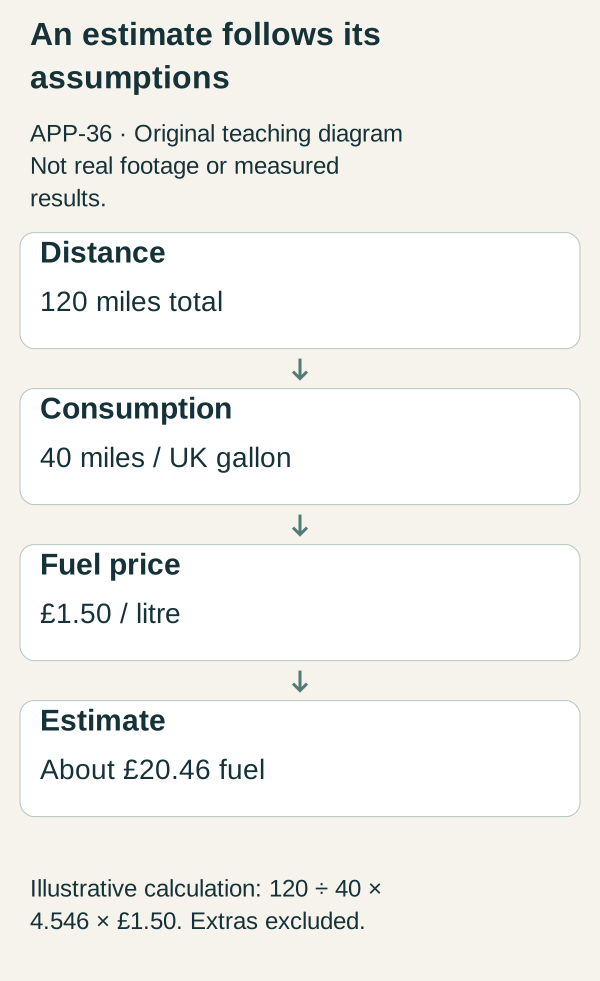
Original illustrative teaching diagram. Show an illustrative UK fuel estimate: 120 miles divided by 40 mpg times 4.546 litres per gallon times £1.50 = about £20.46, extras excluded. This is planning guidance, not product footage, customer evidence or measured results.
Demonstrate the calculation with clearly labelled example inputs, not a headline fuel price that will become stale. Show viewers where to enter their own distance, fuel consumption and price, then explain what the result includes and excludes. Your durable promise is a transparent planning method, not today's cheapest trip.
A useful Reel can say, “Change these assumptions and see how the estimate changes.” It should not say, “This route costs £24,” unless that statement is supported for the stated vehicle, route, date and assumptions. Even then, a historical example must remain visibly historical.
 Superdirector
Make it work for your brand
Find it. Remake it. Post it. Superdirector turns the viral formats in your niche into your brand's carousels, X posts and video scripts, and keeps the calendar full.
Decide what your app actually calculates
Our fictional app, MileBudget, accepts distance in miles, consumption in miles per UK imperial gallon and fuel price in pounds per litre. It estimates fuel cost from those inputs and lets users add other costs manually. It does not fetch live prices, predict traffic or estimate every vehicle type automatically.
Check your implementation before filming. UK imperial gallons and US gallons are different units. A conversion error can make a polished demonstration misleading. The calculation below uses the conventional approximation of 4.546 litres per imperial gallon; the UK statutory definition is 4.54609 cubic decimetres (litres). Your product should document its own precision and rounding.
The example inputs are invented: 120 miles, 40 miles per imperial gallon and £1.50 per litre. They are not current prices or a claim about a particular car. The fuel estimate is 120 ÷ 40 × 4.546 × £1.50, approximately £20.46. Round only at the displayed result, and state the rounding convention if it affects the explanation.
Five complete demonstration scripts
1. Enter your own fuel price
First frame: “This is an example price, not today's pump price.” Show £1.50 being entered with an “illustrative input” label beside it. Keep that label visible when the result appears.
Narration: “The app calculates from the price you enter. Replace this example with the price relevant to your own plan.” Show the field changing, then the recalculated estimate. Do not add a live-looking timestamp or “updated now” badge when no price feed exists.
Close with: “Plan using your own checked inputs.” This is a complete product explanation without requiring a fuel-price news cycle.
2. One-way versus return distance
First frame: “Did you enter the whole journey?” Use an invented 60-mile outward leg and a 60-mile return leg. Show whether the app expects total distance or has a return-trip control.
Narration: “In this example, the total is 120 miles. Entering only the outward leg would estimate only that distance.” Do not assume the return route is always identical; the equal legs are a teaching example.
The final frame shows the actual input rule, not merely the output number. It answers a common calculation ambiguity without relying on current prices.
3. Compare consumption assumptions
First frame: “Same distance and price, different consumption input.” Change only the consumption field. Explain whether a larger number means more miles per gallon or more litres per 100 kilometres; those conventions run in opposite directions.
Narration: “This is a sensitivity check, not a prediction of how your car will perform.” Avoid presenting an idealised consumption value as guaranteed real-world efficiency. If your app supports only one unit system, do not show a second unit selector that does not exist.
4. Fuel is not the entire trip budget
First frame: “The fuel estimate is only one line.” Show separate manually entered examples for parking, tolls or accommodation only where relevant to the user's plan. Label every invented amount as illustrative.
Narration: “These extras are entered separately. The app does not confirm that a charge applies or that a room is available.” If the app cannot add extras, demonstrate a companion worksheet rather than fabricating the feature.
This clip prevents the number on the main screen from being mistaken for the total cost of travelling.
5. Split an estimate without pretending to collect money
First frame: “Planning a contribution is not collecting a payment.” If the app has a split calculation, show the estimated total divided among fictional travellers. If it does not, omit this video or show a clearly external worksheet.
Narration: “This divides the planning amount. It does not transfer money or settle what each person actually paid.” The distinction remains important even when the interface uses a friendly button such as “share.” Show its real behaviour.
Make the example durable in the edit
Place assumptions near the number they qualify. A disclaimer hidden at the end does not help a viewer who pauses on the result screen or sees a cropped repost. Burn in a readable “Example inputs” label and retain it in the cover where the amount appears.
Avoid a hook such as “Birmingham for £20” when the example does not establish that journey's real cost. Prefer “See how distance and fuel price change your estimate.” The latter describes the actual demonstration rather than an implied travel deal.
Record with a clean sample account and no home address in route fields. Use your own graphics, and do not imply sponsorship by a fuel retailer or mapping provider. Test captions with sound muted and at phone size; a mathematically accurate formula is not useful if the input units are unreadable.
A reusable calculation and capture sheet
Worked record: total distance 120 miles; consumption 40 miles per imperial gallon; fuel price £1.50 per litre; estimated fuel £20.46; all values illustrative; parking and other costs excluded; no live data; result rounded to two decimal places; source footage captured from the actual calculation build.
Blank record: distance ___; distance definition ___; consumption ___; consumption unit ___; price ___; price unit ___; conversion factor ___; formula ___; rounding ___; included costs ___; excluded costs ___; live/manual data status ___; sample label location ___.
Have another person recompute the example independently. If the screen and the worksheet disagree, fix the implementation or explanation before filming more variations. Do not solve an arithmetic problem with a prettier animation.
Spend and measurement decisions
For this worked example, assume a £100 ceiling and begin with the existing phone and a readable recording. Pay for an asset or tool only if it resolves a known production problem and the actual price fits. An expensive road scene is unnecessary when the buyer's question concerns inputs and estimates.
Ask viewers what they think the displayed price represents. If they say “the current total cost of this real trip,” your labels are insufficient. If they understand the estimate but cannot find the input units, the interface or framing needs work.
Your next action is to capture the same calculation twice, changing one input. That creates a useful demonstration and a simple accuracy test at the same time.
Supporting reference and scope
Rawcut's existing-footage guide, inspected in the supplied study, informed the readable-overlay production approach. The calculation and scripts above are original worked examples, not fuel-price reporting or financial advice. Check any current platform specifications and every real travel input separately before publication.