How-To Guide
Etsy's unedited-photo requirement: a two-track image workflow for made-to-order sellers
Keep Etsy-required unedited product photos distinct from edited listing and social assets, with product-type exceptions and traceable source files.
An accurate product photograph and an untouched camera file are not always the same thing. That distinction matters when your usual workflow corrects a bead's color, crops a distracting edge, and adds your shop mark before saving the final image. It also matters when those finished images become Instagram posts: the social export may no longer be the file you need for a different destination.
This guide proposes a small asset-management experiment, not a legal opinion, a promise of Etsy approval, or a reason to remake an entire catalog overnight. Start with one real listing and preserve what you already have.
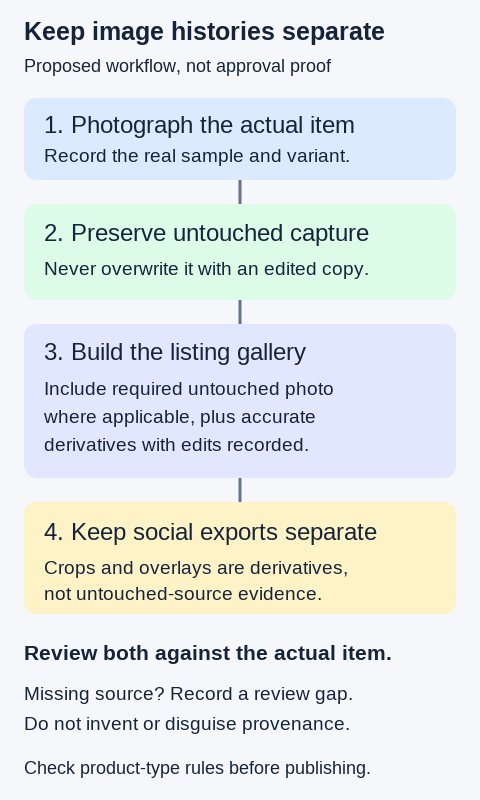
Figure: Keep an untouched capture separate from listing and social derivatives; compare each public-facing asset with the actual product. This original diagram describes a proposed workflow, not Etsy's internal review process.
 Superdirector
Make it work for your brand
Find it. Remake it. Post it. Superdirector turns the viral formats in your niche into your brand's carousels, X posts and video scripts, and keeps the calendar full.
What the current guidance actually distinguishes
The Canadian English Listing Image Requirements page, marked updated October 22, 2026 and checked October 26, requires an unedited photograph of the actual item against a real background for most products. It separately permits truthful editing of other images. It does not say that every photograph must be untouched. Product-type exceptions matter: customized items use real finished examples; some authorized production-partner mockups are permitted for print-on-demand items.
Etsy's English help explanation says the required photograph must not be changed. Other images may be cropped or adjusted without misrepresenting the product. Its first-image advice emphasizes a clear, realistic representation; this is not an explicit instruction that the unedited photograph must occupy the first slot.
Check the guidance served for your shop before acting. We encountered differently worded cached localized policy results; that does not establish a different rule by country. This article does not settle automatic phone-camera processing, upload transformations, or watermark edge cases. Preserve an untouched source and seek authoritative clarification rather than treating another seller's interpretation as an exemption.
First, separate three jobs that one image used to do
Your archive records what was captured. Your listing helps a buyer judge the item. Your Instagram or YouTube creative earns attention and explains a useful detail. A single exported JPEG need not perform all three jobs.
For one listing, create a small ledger with these columns:
| Field | What to record |
|---|---|
| Item identity | Listing ID, real sample identity, variant and date photographed |
| Source | Original file location and whether any post-capture changes are known |
| Product facts | Material, color description, dimensions and included components |
| Listing derivatives | Each edit made, destination, and reviewer |
| Social derivatives | Crop, overlays, captions and destination; do not relabel as untouched |
| Unresolved issue | Missing original, inaccurate capture, uncertain rule or wrong sample |
Keep the original outside the editing application's export folder. A name such as BR-07_capture_2026-10-26.jpg is useful only if it describes the real file history. Renaming a corrected image does not turn it into a camera original. Do not fabricate capture metadata or remove an edit history to imply authenticity.
A fictional beadwork-shop example
Imagine a shop selling made-to-order woven bracelets. The owner has a finished blue-and-copper sample, three corrected listing photographs, and a vertical Instagram image with a text overlay. The camera original survives in a dated folder.
The owner first checks that the source actually shows that sample, rather than a similar bracelet with a different clasp. They compare the product in hand with the image under consistent viewing conditions and record uncertainty instead of declaring perfect color fidelity. The original is retained without overwrite. Corrections and social text are made only in separate working copies.
Keeping the file privately is not the same as including it in the listing: where the requirement applies, the proposed gallery needs the required untouched photograph as well as any accurate edited copies. The listing review now asks two different questions: is there a suitable untouched source for the applicable requirement, and do the presented photographs accurately describe what customers can order? Passing one does not automatically pass the other. If the untouched capture is confusing or seriously inaccurate, adding it mechanically is not a complete solution. Try a small new capture with the existing sample and improved lighting before purchasing equipment or scheduling a catalog-wide reshoot.
For Instagram, the owner makes a close-up explaining the clasp and labels the shown variant accurately. A YouTube tutorial can show the same real sample while explaining selection and care; it should not imply that every customization has been physically photographed. Those channel assets remain derivatives, with their own source references. This is an editorial workflow proposal, not a claim that Etsy's image rule directly governs every social post.
When the original is missing
Do not begin with a blanket 'reshoot everything' task. Inventory the gap first. Separate an original that exists but is misplaced from a file whose history is unknown, an unavailable sample, and a product-type exception that needs checking. These are different problems.
For a small pilot, choose one accessible finished sample. Record capture time and review effort. If that pilot produces clearer evidence, estimate remaining work from actual item categories rather than multiplying a best-case minute count across every listing. Do not generate a substitute photograph and call it evidence of a real past item.
A made-to-order seller may have a valid finished example without possessing every variant. Match the example and its description honestly. The unresolved applicability of a particular image should remain a named review question, not an invented compliance score.
Review the result before expanding
Have another person identify the material, variant and included product from the candidate gallery, then compare those answers with the listing. Check desktop and mobile presentation; tiny overlays may be unreadable even when the underlying photograph is good. Record misunderstandings and revise the derivatives without overwriting the source.
Measure a modest first outcome: how many pilot listings have traceable sources, accurate derivatives and resolved review questions? Later customer questions can show whether the explanation helped. A cleaner archive alone does not establish better conversion, indexing, AI citations or protection from enforcement.
If the physical product itself changes, use a separate SKU image-revision check. That task tracks which product version a buyer sees; this workflow tracks whether the image is an untouched capture or an edited derivative.
Your next step
Choose one listing with an accessible finished sample. Preserve its original, identify every derivative, and check the proposed gallery against Etsy’s current product-type guidance. Stop at unresolved interpretation rather than making a compliance promise.
For the broader content-planning workflow, see how Superdirector works. This guide does not claim that Superdirector verifies Etsy compliance, restores missing originals or approves listing photographs.