How-To Guide
Help enamel-pin buyers choose a backing they can remove where they plan to wear it
Compare enamel-pin backing options by placement access, removal routine and required tools without promising that a locking back prevents every loss.
“Locking back” is not a complete buying specification. A backing that uses a small wrench and a backing released by lifting its top ask the owner to do different things. That difference matters when the pin moves between jackets, stays on a bag or sits where the back is difficult to reach.
For an enamel-pin seller, build the comparison around the buyer's placement and removal routine. Do not rank every backing on an invented stronger-to-weaker scale or imply that a locking mechanism makes a pin impossible to lose.
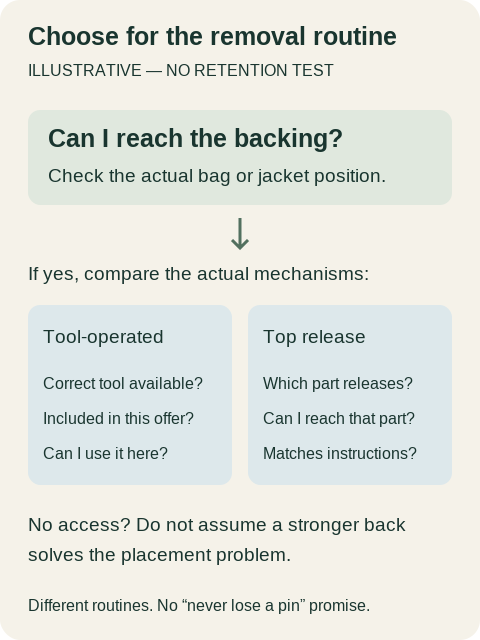
Illustrative decision card. It does not depict a tested product, retention measurement or safe-use certification.
 Superdirector
Make it work for your brand
Find it. Remake it. Post it. Superdirector turns the viral formats in your niche into your brand's carousels, X posts and video scripts, and keeps the calendar full.
The purchase question is about carrying and removing the pin
In a public locking-back question, a new collector described pins coming off a backpack after a snag despite an earlier hand check. They were considering a screw-operated alternative. In a separate bag-display discussion, an owner wanted to avoid losing another favorite; a commenter described needing a tutorial to remove a locking back and separately reported a pin breaking while its backing remained attached.
These are two independent discussion clusters, not controlled tests. They do not prove which backing is strongest or why a particular item failed. They do reveal two buying needs that a front-only product photo misses: understanding the release action and deciding whether the complete arrangement suits the intended placement.
Keep the distinction in the campaign. “Which backing can I use and remove in this location?” is a useful question. “Which one guarantees I never lose a pin?” asks for a promise this comparison does not establish.
Ask three questions before choosing the creative angle
First, where will the pin sit? The front may be visible while the backing is inside a bag pocket or behind a lining. Establish whether the owner can reach the back normally; do not assume that a close-up filmed on a loose fabric swatch represents the finished bag.
Second, how often will the owner move it? A person changing jackets regularly has a different routine from someone who intends to leave the pin in one display position. Neither preference proves one mechanism more secure. It changes how consequential the removal action and any separate tool become.
Third, what will the owner have available when removing it? For an actual tool-operated option, the required tool is part of the buying explanation. State whether it is included in the particular offer and how the buyer can identify the correct replacement through the supplier. Do not imply that any small wrench will fit.
Build a placement-and-release comparison
A useful comparison card can look like this:
| Buyer situation | Decision to show | Information the offer must supply |
|---|---|---|
| Pin moves between jackets | Is the documented release routine convenient for this owner? | Exact release action and any required tool |
| Pin stays on a bag | Can the owner reach the backing for removal and any instructed checks? | Actual placement view, not just the outside decoration |
| Backing sits behind a lining | Is there a supported way to access and operate it? | Known access limits; do not assume the lining can be pierced or cut |
| Buyer wants a tool-operated option | Will the right tool be available when needed? | Tool identity and actual package contents |
| Buyer is concerned about losing a favorite | What risk remains outside the demonstrated operation? | No blanket loss-prevention or whole-pin durability promise |
The matrix is a proposed decision aid, not a result from tested bags or a recommendation to modify clothing. The actual pin, post, backing and placement must suit the manufacturer's instructions. Do not turn the comparison into a universal compatibility chart.
Work through two fictional buyers without choosing for them
Imagine a buyer who moves one pin among three jackets. The seller's comparison should let them see whether the actual backing requires a separate tool and whether they can perform its release routine. The useful outcome is a preference informed by that routine—not an assertion that everyone who changes jackets needs the same back.
A second fictional buyer wants a pin on an everyday bag. Their first question is whether the chosen location leaves the back accessible. If it does not, a more emphatic “locking” label does not solve the access problem. The seller can explain the limitation and let the buyer choose another supported location or decide not to use that configuration.
Neither scenario establishes retention under a snag. A quick pull, a loaded-bag shake or a dramatic tug would not justify a general loss guarantee. Do not invent a destructive demonstration or repeat forum suggestions involving glue, heat or improvised repairs merely to make the comparison more exciting.
Check whether the comparison changes a real decision
Ask a reviewer which option needs a tool, where its release must be reached and whether the shown placement matches their intended use. If they can only repeat “locking is better,” the asset has not explained the choice.
See the planning workflow to organize the option names, placement views and approved release descriptions before filming. The objective is a buyer who understands the configuration they are selecting, not an invented retention ranking or a promise of fewer lost pins.