How-To Guide
Get first users for an East London event app without inflating its coverage
Plan six honest East London event-app posts, a listing-check record and a local permission request without inflating coverage.
Our local-event app only has listings in East London. How do we get first users without making the city look busier in the app than it is?
Lead with the area and listings you actually cover. Show a real, recently checked event record, explain what the app knows and send people to the relevant listing or coverage page. A small useful service is easier to explain honestly than a supposedly citywide app that becomes empty as soon as someone opens it.
Lead with the area and listings you actually cover. Show a real, recently checked event record, explain what the app knows and send people to the relevant listing or coverage page. A small useful service is easier to explain honestly than a supposedly citywide app that becomes empty as soon as someone opens it.
Sparse inventory is not a reason to manufacture pins, imply that every event is available or recycle expired listings into a busy-looking demo. Your launch content should help a viewer decide whether the current coverage is useful for their next outing.
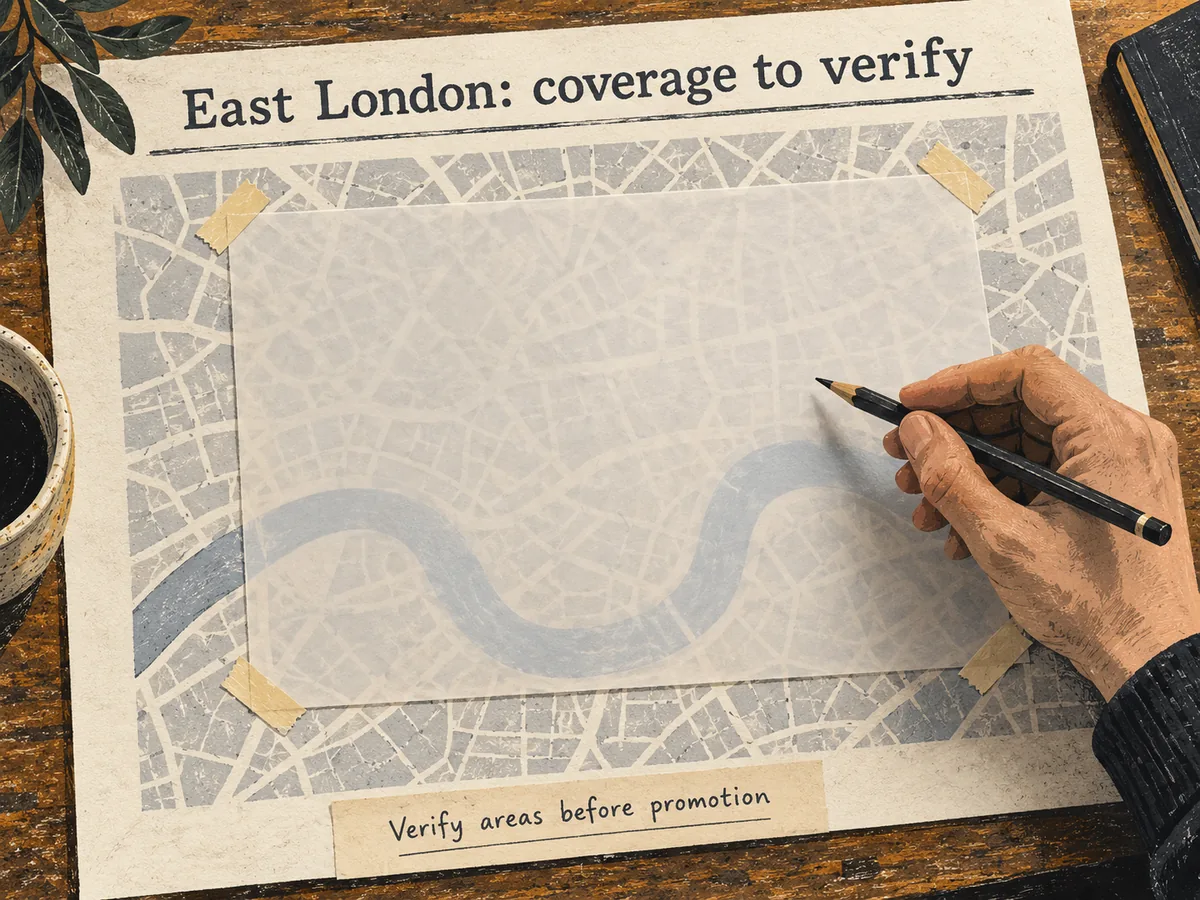
Original planning illustration, not a live service map: leave the coverage overlay blank until the areas are checked. The background is schematic, not navigational, and shows no actual operating boundary.
 Superdirector
Make it work for your brand
Find it. Remake it. Post it. Superdirector turns the viral formats in your niche into your brand's carousels, X posts and video scripts, and keeps the calendar full.
Define coverage as an operational fact
For our fictional example, Eastbound currently lists selected public events in two named East London neighbourhoods. It does not cover all of East London, sell tickets or verify real-time capacity. The exact neighbourhoods, listings and checks must be supplied from a real product before using this example publicly.
Write three separate statements: where listings exist, how listings are selected and what the app can confirm. “East London events” is a category. “Selected listings in these two areas, checked on this date” is a more precise product boundary. Neither should be confused with a guarantee that an event will run or admit someone.
Assign an owner to each record's verification and expiry. If nobody can maintain a listing after promotion, sending more visitors to it may amplify a stale-information problem rather than solve acquisition.
Build a coverage-transparent launch sequence
Post 1: The area you cover now
First frame: “A small event guide for these areas, not all of London.” Show an original schematic coverage diagram with a clear legend. Use shapes and labels rather than fake event pins. The diagram should not pretend to be a navigational map.
Script: “We currently include selected events in [verified areas]. Other areas are not covered yet. Check the current coverage before deciding whether the app is useful for you.”
Destination: the current coverage page. Do not lead with a London skyline while placing the limitation only in a tiny caption.
Post 2: One listing, fully explained
Choose a genuine current event you are permitted to feature. Show its title, date, broad location, source and last-checked information. Explain whether users buy tickets elsewhere and who handles event changes.
Script: “This is a listing, not a booking confirmation. Open the organiser's current details before making plans.” Do not use this script with a fabricated event screenshot unless the whole asset is prominently labelled a fictional demonstration.
The post's usefulness comes from explaining the record and its next step, not from implying an endorsement by the organiser.
Post 3: What a quiet result looks like
Show a real empty or limited result state using the current build. Say: “There are no listed matches for these filters right now. That does not mean there are no events in the area.”
This distinction matters. Your database is a partial collection, not a census of everything happening locally. Offer a supported next action: change filters, inspect the coverage page or submit a public listing through a real moderated route. Do not invent a notification feature to make the screen feel more complete.
Post 4: How a listing is checked
Explain your actual workflow in plain language. For example: “We compare these fields with the organiser's public page before adding the listing.” Only say that if it happens consistently.
Show a clean internal checklist with no personal contact details. Avoid “verified event” as a blanket badge if your check covers only the date and source link. State which fields were checked and when, and preserve uncertainty about capacity or last-minute changes.
Post 5: The first-user invitation
Invite a relevant task rather than a vague download: “If you are looking for an event in our current areas, try finding one listing and checking its organiser page. Tell us if the next step is unclear.”
The invitation should not ask for home addresses or public location histories. Broad area interest is enough for this content exercise. If you later need location permissions, explain that separately in the actual product flow.
Post 6: A real status update
Report material changes such as added coverage or a revised listing process only after they exist. Do not claim expansion because you have a spreadsheet of possible future neighbourhoods.
If little changed, make a useful correction or explain the service's ongoing limit. “Our current coverage is still these areas” is more honest than manufacturing a growth milestone. Remove expired promotional links or clearly mark their status.
A complete listing-promotion worksheet
Worked example, entirely fictional: selected community workshop; area within current coverage; date and venue fields need checking against the organiser's current page before promotion; the app stores a listing only; ticket purchase happens elsewhere; post shows the listing flow and clearly states that booking is separate. Until those checks are completed, the record stays “not ready to promote.”
Blank record: listing ID ___; organiser/source URL ___; event date ___; covered area ___; fields checked ___; checked by/date ___; unresolved availability facts ___; image/text rights ___; destination tested ___; expiry or recheck date ___; correction owner ___.
Notice that the worksheet allows a hold decision. A content calendar is not a requirement to publish whichever listing happens to be available that day.
Use an illustrative £250 ceiling to fix the real constraint
For this worked example, assume a £250 budget; it is an editorial planning input, not a price quote.
Do not assume a paid campaign is the first purchase. If coverage data is unreliable, spend effort on verification. If the product boundary is confusing, revise the page and video. If event imagery lacks permission, use your own interface capture or original diagram instead of paying to distribute an unauthorised asset.
Any expenditure needs a real quote and purpose. The ceiling does not prove a particular creator, photographer or campaign can be bought for that amount. Keep an explicit no-spend option when the inventory is not ready.
Reach people within the coverage you can maintain
Research public community pages, local organizers and venues whose recent activity concerns your actual covered areas. Inspect their current participation and promotion rules, not just a location in the profile. Record a verified page, evidence of local relevance, the permitted submission route and permission status. A venue appearing in your listings does not mean it endorses the app or permits you to promote through its audience.
A complete permission-request draft is: “Hi [verified organizer name], I am building a small event-listing app covering [actual areas]. It contains selected listings, not every local event, and does not sell tickets or confirm capacity. Would a clearly labeled explanation and optional link to our current coverage page be appropriate for your community? Readers can inspect one maintained listing and follow its organizer’s current details. I will follow your rules and will not contact members individually. If this is not relevant, I will not post.” Replace placeholders, verify the destination and use only an appropriate public contact route. This is a draft, not an existing partnership.
If permission is granted, use the agreed placement and one current, rights-cleared listing or the coverage explanation. State the listing’s checked date and organizer handoff; do not imply a reservation. Record the placement, date, destination, observed visits and whether visitors could find a relevant listing where feedback or instrumentation supports that. Leave missing attribution unknown. A small permitted batch is a learning step, not a conversion forecast. Stop or correct promotion when the featured record expires, the destination fails or questions reveal that people expect citywide coverage.
Judge acquisition by useful visits
Separate general video interest from visits by people seeking your covered areas. Ask whether they found a relevant listing, understood the organiser handoff and encountered outdated information. Avoid collecting precise whereabouts merely to make your analytics look sophisticated.
An empty search is a useful signal but not an automatic instruction to expand everywhere. Examine whether the query was outside coverage, overly filtered or a genuine gap inside your promised scope. Fix the promise before widening the territory.
Your next action is to audit one promoted listing and its complete destination path. If you cannot maintain that one path accurately, pause additional promotion until you can.
Supporting reference and scope
LaunchList's first-signups guide, inspected in the supplied source study, separates warm outreach and staged acquisition tasks. The workflow here adapts that broad sequencing principle to original local-inventory decisions. Its growth figures and referral assumptions are not adopted. No real event, organiser endorsement or current coverage claim is asserted in this fictional example.