How-To Guide
Competitor SWOT Analysis: Strengths, Gaps and What to Copy
A competitor SWOT analysis works only when every box cites evidence. Learn what belongs in each quadrant and how to turn a weakness into a gap you can take.
How do you run a competitor SWOT analysis?
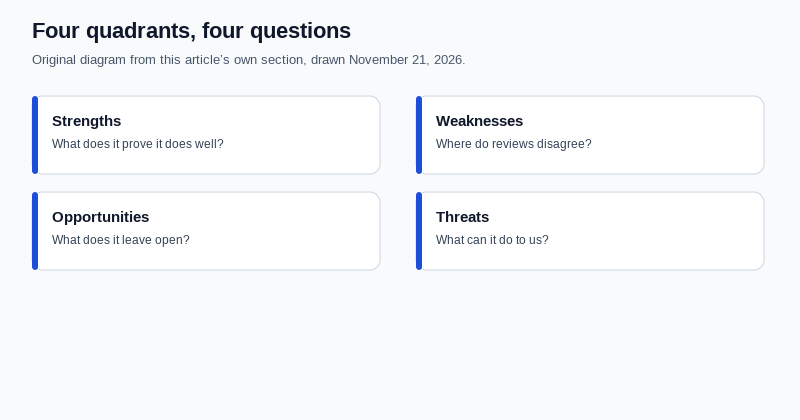
Fill four boxes from evidence. Strengths are what a rival’s pages, prices and customers prove. Weaknesses are where reviews or gaps contradict its claims. Opportunities are openings it leaves; threats are moves it can make against you. Turn each weakness into a gap you can take and each strength into a format you must match.
- Put only sourced facts in the boxes; label an inference as an inference.
- Read two- to four-star reviews for weaknesses instead of guessing.
- End each box with one action, not a longer list.
Four boxes, each with evidence and an action
A competitor SWOT analysis is only as good as its evidence rule. Strengths are what a rival’s own pages, prices and customers prove. Weaknesses are where reviews or buyer questions contradict its claims. Opportunities are openings it leaves; threats are moves it can make against you. Each box ends with one action, so the board reads as a plan, not a description.
Scope the board before the evidence. One board per rival, for one decision, with a named owner and a review date. A board that covers the whole category for an unnamed audience collapses into a list of observations, because each entry is judged against a different question. If the decision is a launch, the board asks what the rival can do to the launch; if the decision is pricing, it asks where the rival’s packaging leaves room. The same facts can appear in both boards with different actions, which is why the decision belongs in the title.
Two or three rivals is the working maximum, and one is often enough for a first pass. The point of the board is to choose an action, not to rank the category, so a longer list spreads the same evidence thin. Add a rival only when it changes an action you would otherwise take, and write that change beside the name, so the shortlist explains itself to the next reader.
| Quadrant | Question | Evidence to use | Example entry |
|---|---|---|---|
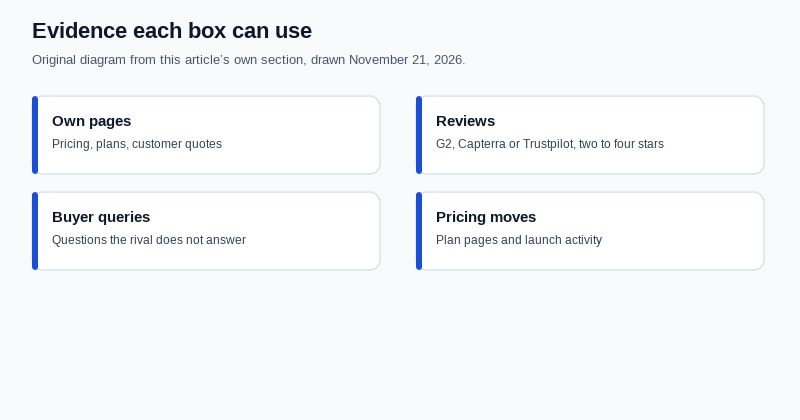
| Strengths | What does it prove it does well? | Own pages, prices, customer quotes | Answers 9 of 20 buyer queries |
| Weaknesses | Where do reviews disagree? | Two- to four-star reviews, unanswered queries | No comparison page for its top rival |
| Opportunities | What does it leave open? | Buyer questions, format gaps | No short video for its best offer |
| Threats | What can it do to us? | Pricing, launches, distribution | Could bundle the feature we sell alone |
Label each entry as fact or inference. “Offers a free tier” is a fact from its pricing page. “Cannot support enterprise” is an inference unless a review or document supports it. That label is what stops a plausible story from hardening into strategy.
Fix the definition of each box before you fill it, or the same fact lands in three places. A common split that works: strengths and weaknesses describe what the rival is today, while opportunities and threats describe what changes next. Today’s fact and next quarter’s possibility need different evidence, so writing them in the same tense is the first sign a box has drifted.
Original diagram from this article’s own direct-answer section, drawn November 21, 2026.
 Superdirector
Have your AI do this for your brand.
7 days free, then $29 a month.
How three competitor-analysis guides treat strengths and weaknesses
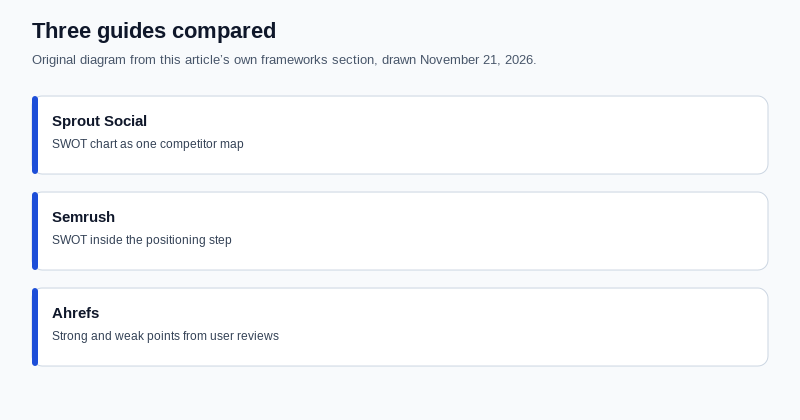
Sprout discusses the 4 Ps (Product, Price, Place, Promotion) in its own right and treats a SWOT chart as an example of a competitor map. Semrush places a SWOT analysis inside its positioning step, after product, marketing, sales, feedback and AI-visibility findings. Ahrefs derives strengths and weaknesses from G2, Capterra or Trustpilot reviews rated two to four, and labels the result “strong and weak points based on user reviews”; it does not frame that read as a SWOT. All three were read on November 22, 2026.
| Source | Where SWOT sits | Inputs it uses | Output |
|---|---|---|---|
| Sprout Social | Reporting step, as a competitor map | Findings from the earlier five steps | Report and response roadmap |
| Semrush | Inside the positioning step | Findings from product, marketing, sales, feedback, AI visibility | Positioning |
| Ahrefs | Strengths and weaknesses only | Two- to four-star reviews | “Strong and weak points based on user reviews” |
The differences matter less than the shared rule: evidence first, action last. A board filled from memory records impressions, not evidence.
Date every piece of evidence. A price read six months ago may already be wrong, and a review theme from an old window may describe a product the rival no longer sells. Two dates are enough in practice: the date the source was published or last updated, and the date you read it. When the two are far apart, note the gap, because a plan page that has not changed in a year is itself a signal about how the rival manages its offer. Freshness is part of the evidence, not a footnote.
The 4 Ps are worth using as a scan even if you use none of Sprout’s other steps. Product, price, place and promotion give you four angles to check, and when a box refuses to accept a fact, they usually show which angle the fact belongs to. Map each entry to the decision rather than to a P, because Sprout’s page treats the two separately; when a fact fits none of the four angles, it probably is not decision-relevant.
Original diagram from this article’s own frameworks section, drawn November 21, 2026.
What this guide adds
- Ahrefs labels its review-based strengths and weaknesses “strong and weak points based on user reviews” and does not call them a SWOT, which exposes the format’s weak point: a real SWOT needs internal facts (cost, margin, capacity) that no competitor page supplies. A rival’s cost, margin and capacity rarely appear on the pages it publishes, so keep the competitor boxes to external evidence and add a fifth “our internal context” column for your own firm’s cost, margin and capacity.
- Sprout discusses the 4 Ps as a checklist for what to look at, and separately treats a SWOT chart as one kind of competitor map. Borrow the 4 Ps to scan product, price, place and promotion, but map each SWOT entry to the decision, not to a P.
- The fastest field to verify is price. Ahrefs builds a public feature-comparison table that marks a 1 where a brand offers each feature and records the cheapest paid plan, so a pricing change is visible without a review cycle. Check prices first; they date the fastest and are the least arguable entry in any box.
Original diagram from this article’s own original-points section, drawn November 21, 2026.
A worked board, marked as hypothetical
The board below is invented to show the evidence labels, not a real competitor’s position. It describes a different invented rival from the four-box table above, so an entry in one does not contradict the other.
| Box | Entry | Label | Action |
|---|---|---|---|
| Strength | Publishes a comparison page for every rival | Fact, own site | Match with two honest comparison pages |
| Weakness | Reviews mention slow support replies | Fact, review themes | Publish response-time proof |
| Opportunity | No short video for its best-selling plan | Fact, feed check | Ship three short videos for that offer |
| Threat | Could bundle the feature we sell alone | Inference, pricing history | Watch its plan page monthly |
Add one more column beside the four boxes, headed “Our internal context”, for the facts only your firm can see, cost, margin and capacity, so the rival’s public strengths sit beside your private constraints in the same row.
Note that the threat is labeled inference. If the rival has never bundled the feature, the entry is a watch item, not a prediction. The action is to watch, not to rebuild the roadmap around a guess.
Review the board in a short meeting with the person who owns each action. Read one box at a time, confirm the evidence label, and change the action instead of adding a second one. If two people read the same entry differently, the entry is too vague; rewrite it until both agree on the evidence and the move. A box that accumulates three actions is usually hiding a disagreement about the decision, and the meeting is the place to settle it. Close by naming the next review date and the evidence that would move an entry between boxes, so the board has a reason to change, not a calendar it follows by habit.
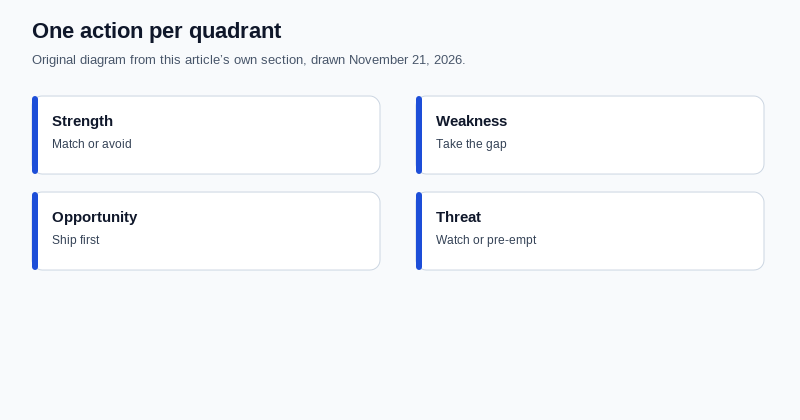
| Quadrant | Action type | Example |
|---|---|---|
| Strength | Match or avoid | Match its comparison pages |
| Weakness | Take the gap | Publish response-time proof |
| Opportunity | Ship first | Short video for its best offer |
| Threat | Watch or pre-empt | Check its plan page monthly |
Run the board past one person who talks to buyers. Reviews and queries show what customers say in public; a sales or support conversation shows what they ask in private. Adding two such notes per box usually changes at least one action, and it is the cheapest way to test whether an entry is evidence or a comfortable assumption.
Original diagram from this article’s own worked-example section, drawn November 21, 2026.
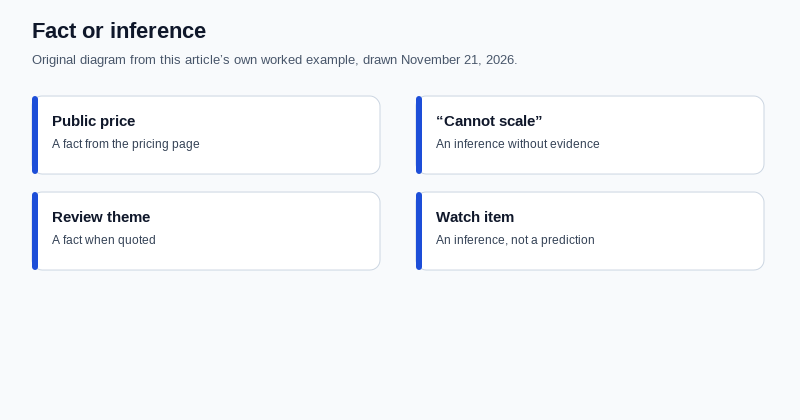
Original diagram from this article’s own worked example, drawn November 21, 2026.
Where Superdirector fits
Pick the accounts and keywords; Superdirector returns the posts and formats your SWOT can cite, so each entry carries a date instead of a memory. Where an entry calls for a short video, both plans let a saved script start one. The judgment in each box stays yours.
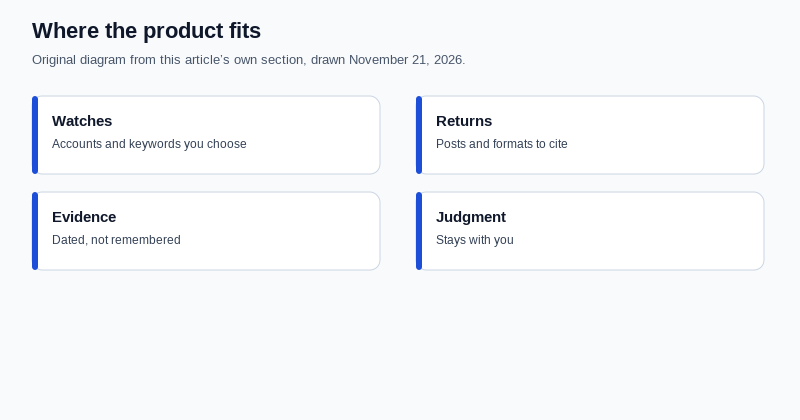
Original diagram from this article’s own superdirector section, drawn November 21, 2026.
Frequently asked questions
What is a competitor SWOT analysis?
How is SWOT different from competitive analysis?
Where should the evidence come from?
How many competitors belong in a SWOT?
What is the difference between opportunities and threats?
Is a SWOT template enough?
SuperdirectorHave your AI do this for your brand.
7 days free, then $29 a month.