How-To Guide
Ten Hinglish hooks and launch-video briefs for a small-city dating-app test
Use ten Hinglish hooks and filming briefs to explain a small-city dating-app test, its real interface language and its current status.
How can I launch a dating app for Hindi-speaking singles in smaller Indian cities using Hinglish Reels rather than English startup content?
Use Hinglish to explain the real dating-app experience, not to decorate an English startup pitch. Start with one intended local audience, show actual product decisions and give viewers a private, accurate next step. Smaller Indian cities are not one uniform culture. A useful launch test needs local language review and honest availability, not assumptions about what everyone finds funny or how people date.
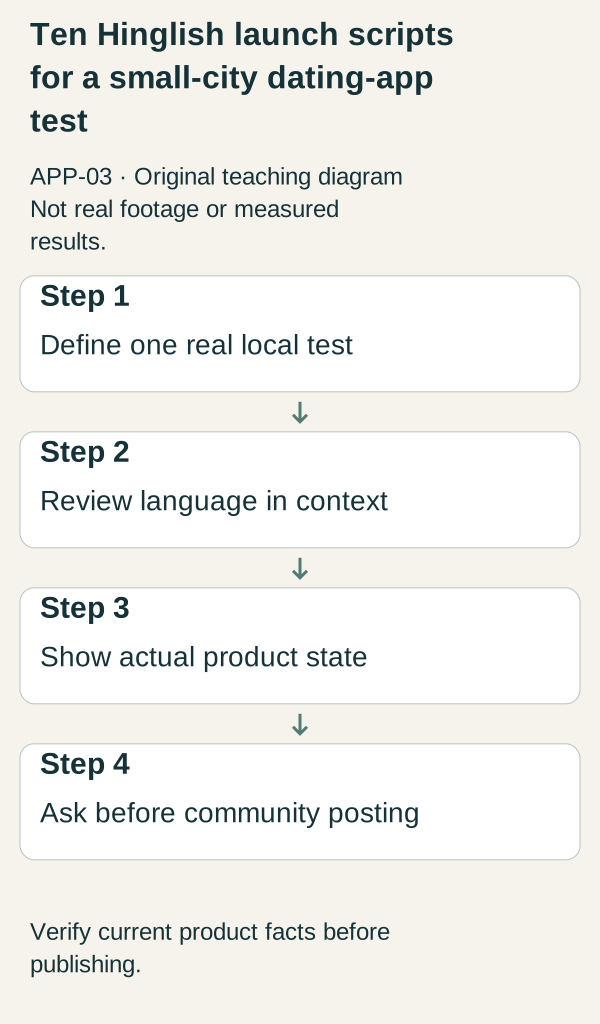
Original illustrative teaching diagram. Connect a real local dating-app test with context-reviewed Hinglish and permission for community posting. This is planning guidance, not product footage, customer evidence or measured results.
Use Hinglish to explain the real dating-app experience, not to decorate an English startup pitch. Start with one intended local audience, show actual product decisions and give viewers a private, accurate next step. Smaller Indian cities are not one uniform culture. A useful launch test needs local language review and honest availability, not assumptions about what everyone finds funny or how people date.
 Superdirector
Make it work for your brand
Find it. Remake it. Post it. Superdirector turns the viral formats in your niche into your brand's carousels, X posts and video scripts, and keeps the calendar full.
Set the local scope before filming
Choose a city only when you have a real launch reason and an operational plan there. Do not create separate country or city pages that repeat the same advice with the place name changed. For this teaching example, the city remains “[launch city]” because no actual community, venue or user base has been researched.
Write down the product state: concept, prototype, waitlist or live service. Identify the actual supported language, eligibility, geographic scope and signup destination. A Hindi caption does not mean the app itself supports Hindi. If the interface remains English, say that and show it so viewers can decide whether the experience fits them.
The ten hooks below are original Romanized-Hindi drafts requiring native review in the intended city and audience. English translations communicate intended meaning; they are not certificates of idiomatic wording. Use adult demonstration profiles and clearly label them. None of the scripts implies existing members, successful matches or verified safety.
Ten hooks with specific filming jobs
- Explain the state. Hook: “Yeh dating app abhi kis stage par hai?” Meaning: “What stage is this dating app at?” Show the actual prototype or product. Follow with the truthful state: “Abhi waitlist khuli hai; matching shuru nahi hui.” Meaning: “The waitlist is open; matching has not started.” Use that line only if true. CTA: read the current launch details before joining.
- Explain the area. Hook: “Pehla test [launch city] mein kyun?” Meaning: “Why is the first test in [launch city]?” Show an original planning card, not member-location pins. Explain your actual reason in one sentence. CTA: check the proposed area. Do not equate a planning boundary with local member density.
- Show the profile task. Hook: “Profile mein kya dikhana zaroori hai?” Meaning: “What needs to appear in the profile?” Record the real fields using demo data. State which fields are required and which are optional only after checking. CTA: review the current signup requirements. Never invite viewers to post dating preferences in public comments.
- Explain the language. Hook: “Video Hinglish mein hai. App kis language mein hai?” Meaning: “The video is in Hinglish. What language is the app in?” Show the actual interface language. If Hindi is planned, keep it separate from what is available. CTA: inspect the real walkthrough before signing up.
- Show user choice. Hook: “Agla step aap kaise choose karte hain?” Meaning: “How do you choose the next step?” Demonstrate one real action such as reviewing or declining a suggestion. Avoid implying that a match obliges anyone to converse or meet. CTA: see how the actual flow works.
- Explain a limit. Hook: “Yeh feature abhi available nahi hai.” Meaning: “This feature is not available yet.” Name one genuinely unavailable feature relevant to the launch. Show a dated status card, not a fake disabled interface. Explain the current alternative if there is one. CTA: read the latest status, not an invented release promise.
- Show a control. Hook: “Is setting se kya badalta hai?” Meaning: “What does this setting change?” Record a real privacy or account control with demo data. Describe its actual effect narrowly. Do not say the service is safe because a settings screen exists. CTA: read the full current explanation.
- Explain signup. Hook: “Waitlist join karne ke baad kya hoga?” Meaning: “What happens after joining the waitlist?” Record the actual form and confirmation using test details. Say whether joining means updates, an application or immediate access. CTA: join only if that arrangement fits. Do not manufacture urgency through a fake countdown.
- Invite a general question. Hook: “App ka kaunsa step unclear laga?” Meaning: “Which step of the app felt unclear?” Replay a short real flow and ask for product-level feedback. Tell viewers not to share names, locations or private conversations. Route sensitive feedback away from public comments through an actual supported process.
- Publish the current status. Hook: “Launch ka honest update.” Meaning: “An honest launch update.” State what changed and what remains unresolved. If nothing changed, do not invent a milestone. Show the checked details page. CTA: review the current state before deciding to sign up.
Give a reviewer a usable brief
Send the intended audience, product state, English meaning, Romanized draft and actual screen recording together. Ask the reviewer to mark unnatural phrasing, overly formal wording, misleading implications and any local reference that does not fit. Do not ask only whether the Hindi is grammatically correct. A technically correct line may sound unlike the audience’s everyday speech.
Record approved wording, pronunciation notes, chosen script and unresolved questions. Decide whether captions should use Romanized Hindi, Devanagari, English or a combination based on actual audience review, not a blanket rule about India. Keep the English meaning beside the final script so later editors do not reintroduce an unintended promise.
Distribute without pretending to know the community
Build a small research list of local groups, creators or events whose actual content concerns your intended adult audience. Inspect their rules and recent posts. Do not assume a local account accepts dating-app promotions. Ask the organizer whether an honest waitlist explanation would be appropriate before sharing it in their space.
A permission request can say: “I am building a dating app with a proposed test in [city]. It is currently [true state]. Would a clearly labeled explanation and optional waitlist link be appropriate for your community? If not, I will not post it.” Replace placeholders with checked facts. A request for permission is not a license for repeated follow-ups or unsolicited messages to members.
Learn from the right evidence
Track which explanation people saw, whether the destination was accessible and what product questions arose. Separate actual signups from impressions and private feedback from permission to quote. A local-language comment is not proof of local availability, and waitlist interest is not proof that matching will work.
Sources and next action
The DesiCMO Hinglish article illustrates code-switching and distinguishes it from direct translation. Its supplied source review found unsupported engagement figures and broad cultural generalizations; none is used here. The local-review process and ten hooks with launch-video briefs are original editorial recommendations, not a tested acquisition formula.
Choose script four first if your app and marketing use different languages. A clear expectation about the real interface is more useful than a clever hook that brings people to an experience they cannot comfortably use.