How-To Guide
Launch a bill-splitting app without implying it sends UPI payments
Film five shared-expense scenes and a clear launch caption that distinguish a flatmate ledger from UPI payments and verified settlement.
By the Superdirector editorial team.
At a glance
How do I launch a bill-splitting app for Indian flatmates without making people think it can send UPI payments when it only records balances?
Show a shared-expense ledger, not a payment animation. State early that the app records who paid and what others owe, while any money transfer happens separately. Repeat the distinction at the point where a viewer might otherwise mistake “settled” or “paid” for a transaction the app executed.
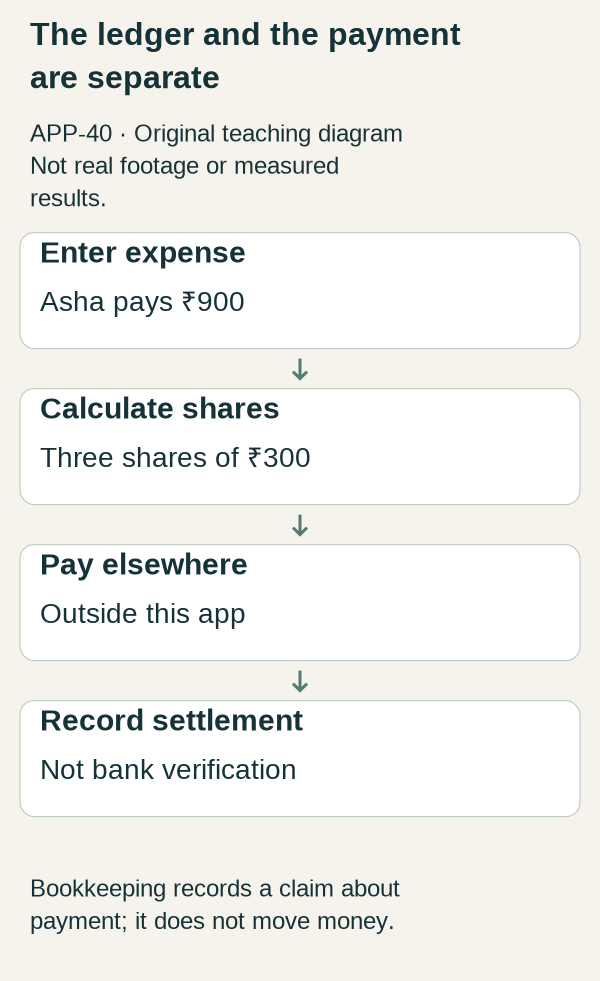
Original illustrative teaching diagram. Separate an illustrative ₹900 expense and three ₹300 shares from external payment and unverified settlement recording. This is planning guidance, not product footage, customer evidence or measured results.
Original visual by Superdirector editorial team. Created 2026-10-20.
Show a shared-expense ledger, not a payment animation. State early that the app records who paid and what others owe, while any money transfer happens separately. Repeat the distinction at the point where a viewer might otherwise mistake “settled” or “paid” for a transaction the app executed.
For Indian flatmates, the useful story is often ordinary household coordination: groceries, rent-related shared costs or a delivery order. You do not need to imitate a payment service to make that story compelling. You need a clear distinction between calculating a balance and moving money.
Establish the bookkeeping model
Our fictional app, FlatLedger, records expenses, divides them among selected flatmates and allows a user to mark an externally settled amount. It does not connect to a bank, initiate UPI payments or verify that money arrived. These assumptions illustrate the content approach, not a real product's capabilities.
Use fictional names and amounts. In the worked example, Asha pays ₹900 for shared groceries for three people: Asha, Dev and Mira. Each person's share is ₹300, so Dev and Mira each owe Asha ₹300 in the ledger. No payment occurs merely because those balances appear.
Have someone independently check the arithmetic and interface labels. If the app's own button says “Pay now” but only records a note, the product wording needs attention before launch. A disclaimer in a video cannot reliably repair a contradictory control.
Five household-expense demonstrations
1. Who paid versus who owes
First frame: “Asha paid for groceries. What does everyone owe?” Show the ₹900 expense, three selected participants and the actual resulting balances.
English narration: “This records a shared expense. It calculates each person's share; it does not transfer money.”
Optional Hinglish draft for local review: “Groceries Asha ne pay kiye. App bas share aur balance record karta hai; paise transfer nahi karta.” Keep the English meaning alongside the draft during review. Do not assume one phrasing fits every Indian audience or that code-switching itself improves results.
3. Correct a mistaken entry
First frame: “Wrong amount? Fix the record, not a bank transaction.” Change a fictional expense and show the recalculated balance. Explain whether edits are visible to others and whether history exists, only after checking those features.
Suggested narration: “This correction changes the ledger. It does not reverse or change any payment made outside the app.” That distinction is especially important when an edit produces a dramatic new total.
Avoid using bank-success sounds or familiar payment confirmation styling as decorative effects. They can imply a capability the product does not have.
4. Record an external settlement
First frame: “They paid elsewhere. Now update the record.” Show the actual manual settlement control using fictional participants. Do not display a fabricated bank receipt or UPI success screen.
English narration: “After you confirm the payment separately, you can record it here. The app does not verify that the money arrived.”
Optional Hinglish draft: “Payment alag se confirm karo. Yahan sirf settlement record hota hai.” Have a native reviewer check tone, clarity and whether “settlement” is understandable for the intended audience. If that review is unavailable, use the complete English narration above or postpone the Hinglish version; do not label the draft as validated local-language copy.
5. A new flatmate reads the balance
First frame: “What does this number mean?” Open one person's ledger and explain whether a positive amount means owed to them or owed by them. Use the app's actual convention.
Show the underlying expense rather than a detached total. End with: “This is a record of entered expenses, not your bank balance.” Invite the viewer to inspect the complete walkthrough before installing or requesting beta access.
A finished launch caption
“Shared groceries, three flatmates, one clear record. In this fictional example, Asha enters a ₹900 expense split equally across three people. The ledger shows ₹300 owed by each of the other two flatmates. No money moves through the app. If someone pays separately, the record must be updated using the available manual controls. See the current features and access details before trying it.”
This caption works only if the described split and controls match the build. Replace the names and amounts freely, but do not turn a teaching example into a customer story. The absence of real names is not enough if the post still implies a real testimonial.
Copyable capture worksheet
Scenario ___; payer ___; participants ___; total ___; split rule ___; expected arithmetic ___; actual screen result ___; payment capability explicitly excluded ___; settlement verification boundary ___; language reviewer ___; sample-data label ___; destination ___.
Worked decision: the screenshot says “Payment successful” after a manual record update. Hold the video. Change the screen wording or choose a different truthful flow, then retest. Do not crop away the misleading label while leaving it in the product prospective users will encounter.
For this worked example, assume a ₹5,000 ceiling and first identify whether the bottleneck is product wording, language review or production. Obtain actual quotes before paying. There is no requirement to buy influencer reach before the distinction between ledger and payment is understandable.
Check comprehension, not just enthusiasm
Ask a new viewer: “Where did the money move?” “Who confirms an outside payment?” and “What happens if someone enters the wrong amount?” If they think the app sends UPI payments, revise the opening and the settlement scene.
Track qualified beta interest separately from people seeking a payment app. Confusion-driven installs may look encouraging in a superficial launch report but create an immediate mismatch. Record questions in aggregate without collecting flatmates' real balances or financial records for marketing analysis.
Your next action is to film the settlement-recording flow. It contains the highest risk of payment confusion and will reveal whether the interface supports the positioning you want.
Supporting references and scope
DesiCMO's Hinglish content article, inspected in the supplied study, discusses code-switching but includes unsupported performance generalisations that are not used here. The two Hinglish lines above are original draft copy requiring native review, not evidence of regional effectiveness. This article gives no UPI integration instructions or financial-service claim.