How-To Guide
What is the best time to post on Instagram in 2026, and how do you find your own?
Six 2026 studies of the best time to post on Instagram disagree, from 12 a.m. to midweek afternoons. Compare samples and dates, then test your own times.
By the Superdirector editorial team. Study pages read November 6, 2026.
At a glance
What is the best time to post on Instagram in 2026, and how do you find your own?
There is no single best time. Six 2026 studies from scheduling and analytics companies disagree on the hour: Dash Social says 12 a.m. local time, Later 5 a.m., SocialPilot 7 to 9 a.m., Buffer Thursday 9 a.m. and Wednesday noon or 6 p.m., Sprout Social midweek afternoons, Hootsuite early-week afternoons and evenings. They mostly agree on the day: five of the six rate Saturday or the weekend lowest. Start with a weekday morning or midday slot, then run a two-week test on your own account and keep the slot that gets the most reach in the first 24 hours.
- The studies use different metrics, customers and dates; one '2026' answer rests on 2024 posts.
- Agreement is about days, not hours: five of the six studies rate Saturday or the weekend lowest, and none names a weekend day as best.
- Small accounts gain more from posting three times a week reliably than from finding the perfect hour.
The short answer
Most big scheduling and analytics companies publish a best time to post on Instagram, and in 2026 they do not agree. Their answers run from midnight to the evening. What they mostly share is the day: five of the six rate Saturday or the weekend lowest, and Hootsuite's best days are Monday, Tuesday and Thursday. So pick a weekday slot as a starting point, then let your own account decide the hour. This page lines the studies up side by side so you can see why they differ, and gives a two-week test to find your own time. We publish no best time from data of our own.
Compare what the six studies say
| Study | Headline answer | Sample | Posts dated | Metric | Time zone |
|---|---|---|---|---|---|
| Dash Social (Sep 2026) | 12 a.m.; best slot Tuesday 12 a.m. | Over 2.2M posts, Reels and Stories; 750,000+ feed posts from 1,549 brands | Jul 2025 to Jun 2026 | Average engagement rate (reach for Stories) | Recorded globally, then localised |
| Sprout Social (2026) | Mon 2 to 4 p.m., Tue 1 to 7 p.m., Wed 12 to 9 p.m., Thu 12 to 2 p.m. | Nearly 2 billion engagements, 307,000 profiles on six networks | Nov 27, 2025 to Feb 27, 2026 | Engagements | Local time |
| Buffer (Sep 2026) | Thu 9 a.m., Wed 12 p.m., Wed 6 p.m. | 9.6M Instagram posts | Jan 2024 to Dec 2025 | Median engagement rate per follower | Local time |
| Hootsuite (2026) | Mon 3 to 9 p.m., Tue 5 to 8 a.m. and 3 to 7 p.m., Wed 5 p.m. | Over 1M posts, with Critical Truth | 2025 analysis | Engagement | Localised across 118 countries |
| Later (Apr 2026) | 5 a.m.; Reels 12 a.m. Monday | Over 6M feed posts | Jan to Oct 2024 | Engagement rate | Audience's local time |
| SocialPilot (2026) | 7 to 9 a.m. | 7M posts from about 50,000 accounts | Feb 2025 to Jan 30, 2026 | Engagement | Timezone-agnostic |
Read the dates column before the answers. Later's page is titled for 2026 but says its data team analysed posts "from January to October 2024". Sprout's window is three months of winter. Dash Social's is a full year ending in June 2026. A CSV of this table is free to reuse with the sources linked.
When enlarged, scroll horizontally to read the diagram.
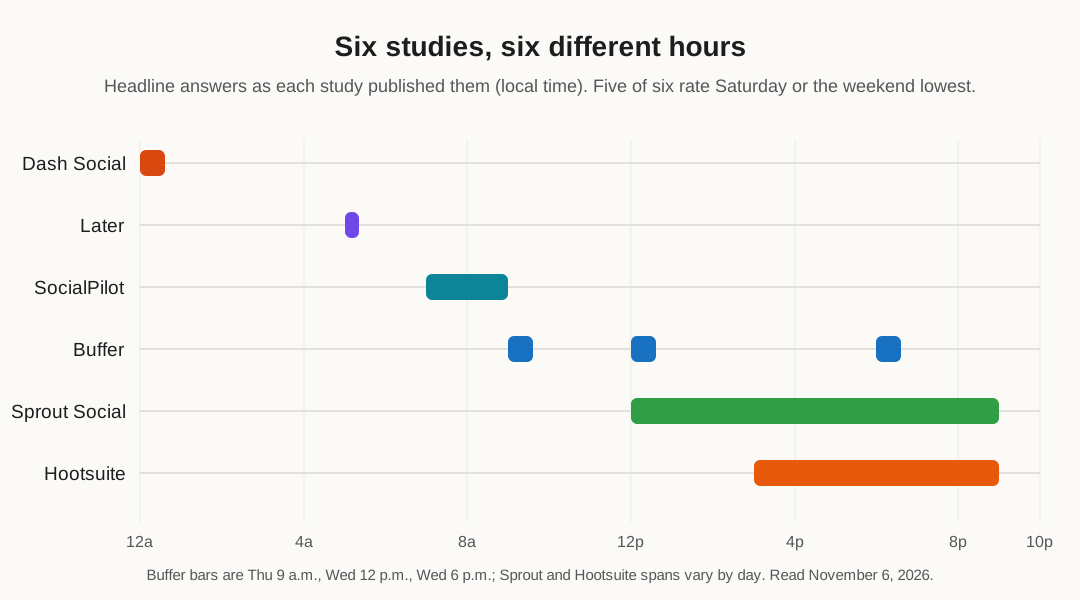
Original chart of each study's headline answer as published; no data of our own. Sources and dates in the table above.
Original visual by Superdirector editorial team. Creation date not recorded.
See where they agree and why they disagree
They mostly agree on days. Buffer finds "Friday and Saturday are the worst days"; Sprout says weekends "yield the lowest engagement overall"; Later names Saturday its worst day; SocialPilot's two weakest slots are Saturday at 5 a.m. and Friday at 9 p.m.; Dash Social's lowest slot is Saturday at 4 p.m. Hootsuite is the outlier: its best days are Monday, Tuesday and Thursday. If you only change one thing, move posts off Saturday.
They disagree on hours for three plain reasons:
- Different metrics. Dash averages engagement rate; Buffer uses the median engagement rate per follower; Sprout counts engagements. An early-morning post can win on rate because fewer brands post then, and lose on totals.
- Different customers. Each study measures its own users: 1,549 brands for Dash, about 50,000 accounts for SocialPilot, Sprout's customers on six networks. A study weighted to big brands will not look like a 2,000-follower shop.
- Engagement over time. Dash explains its midnight result this way: posts published late at night often pick up engagement in the morning, when people start scrolling. The clock time of posting and the time of engagement are not the same.
Instagram itself has not published a best time. Its ranking explainer lists, among Feed signals, "how quickly people are liking, commenting, sharing and saving a post" and "when it was posted". For Reels it lists reshares, full watches, likes and audio-page visits, with no mention of posting time. SocialPilot's guide goes further and says recency is no longer a ranking factor on Reels, Explore or Search. Timing helps a post start well with your followers; it does little for reach to strangers.
Find your own followers' active times
On a professional account, open your profile, tap Professional dashboard, then go to Total Followers and scroll to Most Active Times, as Later's guide describes. Meta's help page adds two limits: audience demographics appear only once you "reach or engage over 100 viewers" in the chosen period, and looking back beyond 90 days needs a Meta One subscription on an eligible public account.
Buffer reports that Instagram's head, Adam Mosseri, suggests posting 30 to 60 minutes before your audience is likely to come online. Use the dashboard's peak hour minus about an hour as one of your test slots.
Run a two-week test on your account
Benchmarks give you starting slots. Your account gives the answer. This test works for small accounts because it compares each post with your own normal reach, not with a study's average.
- Pick three slots: one from your Most Active Times (or a study's morning slot if you have no data yet), one midday, one early evening, all Tuesday to Thursday.
- Post six times over two weeks, two per slot, using the same kind of post each time, for example the same carousel format.
- For each post, write down reach and shares 24 hours after posting, next to your median for the last ten posts.
- Keep the slot whose posts beat your median reach by the most, and use shares to break a tie. Two posts per slot is a rough read, so if no slot clearly wins, timing is probably not your main constraint; spend the effort on hooks and formats instead.
For small accounts, pace matters more than the clock. Posting three good posts a week at a reasonable hour gives Instagram more to learn from than one post at a perfect hour, and it is easier to keep up. Mailchimp's guide puts it simply: there is "no one-size-fits-all solution for the perfect posting time".
If keeping the pace is the hard part
Disclosure: Superdirector is our product. For founders whose problem is keeping up three posts a week rather than choosing the hour, it fills the month's calendar with carousels remade from the formats taking off in your niche, and on the Growth plan ($199 a month, two accounts) it publishes Instagram carousels "at a weekly pace after your first approval or by standing Auto-post", per its llms.txt. Starter is $29 a month, has a 7-day free trial with 100 credits (card required) and does not post. AI video and full autopilot are coming soon. You remain the publisher. For the wider question of what to hand to software, see which organic social jobs to give AI; for cadence, see our posting cadence definition.