How-To Guide
Your Steam demo gets plays but few wishlists: what to test before changing the game
Define Steam demo and wishlist measures, check the store-page path and plan two content tests before deciding whether to change the game.
My demo gets plays but few wishlists. What social content should I test before changing the game?
Start by establishing what “plays” and “few wishlists” actually measure. Then test whether your social content explains why someone who tried the demo would want the full game. A new trailer cannot repair a broken wishlist path, and a low aggregate wishlist count cannot tell you that demo players disliked the experience.
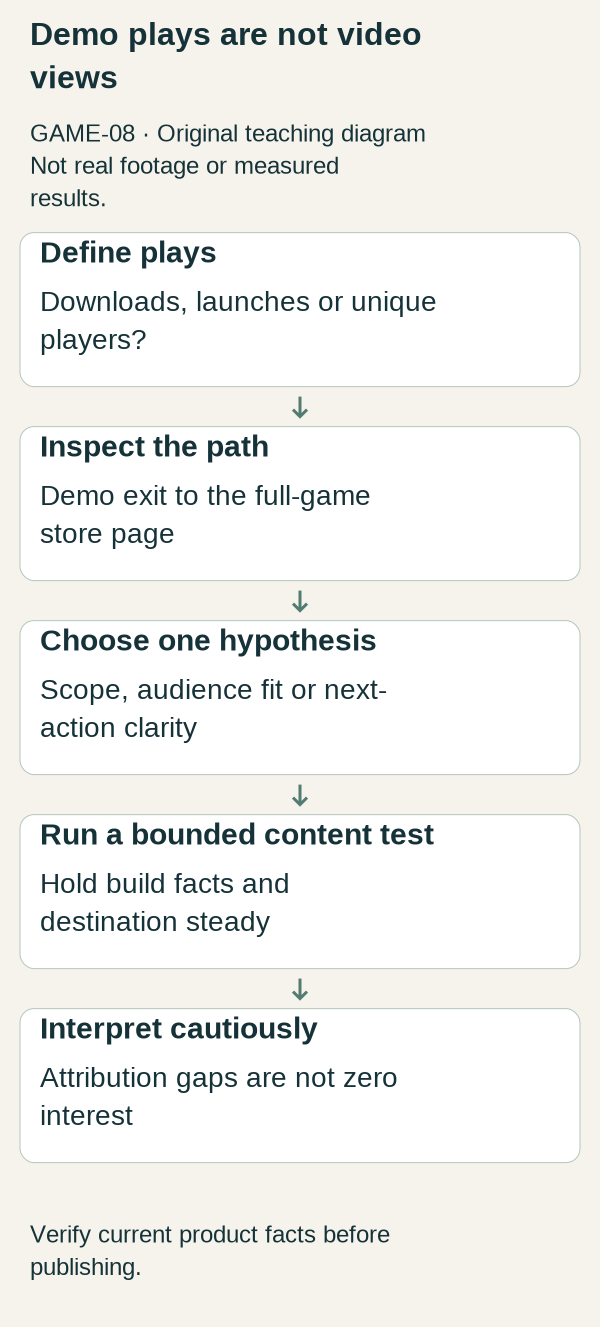
Original illustrative teaching diagram. Distinguish demo-download/play definitions from video views, inspect the store path and run one bounded hypothesis without causal attribution claims. This is planning guidance, not product footage, customer evidence or measured results.
Start by establishing what “plays” and “few wishlists” actually measure. Then test whether your social content explains why someone who tried the demo would want the full game. A new trailer cannot repair a broken wishlist path, and a low aggregate wishlist count cannot tell you that demo players disliked the experience.
This guide concerns people playing a demo, not people watching a video. Those are different populations. Its worked example, a fictional exploration game called Lantern Ferry, has a playable harbor chapter and an unreleased full game. All examples below are proposed tests; no conversion results are claimed.
 Superdirector
Make it work for your brand
Find it. Remake it. Post it. Superdirector turns the viral formats in your niche into your brand's carousels, X posts and video scripts, and keeps the calendar full.
1. Establish the denominator before writing content
A useful baseline record says exactly which report supplied each number and what period it covers. Demo downloads, launches, unique players, sessions and completions are not interchangeable. One person can start multiple sessions; downloading does not prove playing. Someone may already have wishlisted the full game before trying the demo.
Completed definition sheet for Lantern Ferry:
- Product: public harbor demo and separate full-game store destination.
- “Plays” in the initial complaint: launch events from the team's existing report, not verified unique first-time players.
- Wishlist observation: total additions in the full game's reporting period.
- Missing connection: whether the people launching the demo are the people adding wishlists.
- Known ambiguity: repeat launches and pre-existing wishlists.
- First decision: do not publish a “demo conversion rate” from these two totals.
Use that same sheet with your actual definitions. If the player-level link is unavailable, leave it unavailable. Do not create invasive tracking or imply that aggregate reports identify individual players. Even an apparent before-and-after improvement can coincide with festival traffic, creator coverage or a changed build.
2. Check the path a satisfied player would take
Play through the available build and inspect the ordinary exit point. Can a player identify the full game's name? Does any existing invitation point to the right product? Does the destination explain what exists beyond the demo? Verify the path on the devices and clients you actually support.
Write down defects separately from creative hypotheses. “The button opens the demo page instead of the full game” is a reproducible access problem. “Players need a stronger emotional hook” is a hypothesis. Correct factual errors and broken destinations first. That is not the same as redesigning your game's core mechanic.
For Lantern Ferry, the illustrative inspection finds an accurate store link but vague full-game copy: “More adventures await.” This does not prove why wishlists are low. It does give the next content test a concrete job: explain what the full game contains without inventing scope or showing its ending.
3. Run three different message tests, not three trailer styles
Test A: show what continues after the demo
Hypothesis: players enjoy the harbor chapter but think the demo represents most of the game.
Capture: five seconds of the familiar harbor, then footage of one actually implemented later region. Avoid a montage of unbuilt concept art presented as gameplay.
Script: “The harbor is the first stop in Lantern Ferry. The full game continues upriver, where you choose which deliveries to take and which routes to explore. This footage is from our current development build. The full game is not released yet.”
End card: “Want to follow the full journey? Wishlist Lantern Ferry on Steam.”
In this fictional example, the later region and route choices are assumed implemented. If they are only planned, revise the script to say so and use clearly labeled concept material. A status label belongs on the footage, not buried in a description.
Test B: help the right players recognize themselves
Hypothesis: the demo is attracting an audience expecting a different activity.
Capture: one uninterrupted delivery choice and its ordinary consequence, with the interface readable.
Script: “Lantern Ferry is about choosing routes and noticing small stories along the river. This is a quiet exploration game, not a boat-racing challenge. Here is what one delivery actually looks like.”
End card: “If this is your kind of journey, wishlist the unreleased full game on its Steam store page.”
This is not permission to label all nonconverting players as the wrong audience. It is a test of expectation accuracy. If viewers consistently describe the game as racing after watching, fix the presentation before concluding that the market rejects quiet exploration.
Test C: explain the next action to people who finished
Hypothesis: players finish the demo but do not understand the distinction between demo access and following the full release.
Capture: the demo's actual end screen, then the real full-game store page using a clean recording without personal account details.
Script: “Finished the Lantern Ferry demo? The full game is still in development. Its Steam page explains the planned release and current scope. You can wishlist it there if you want to keep track.”
End card: full game name, Steam destination label, and accurate release status.
Do not imply that wishlisting unlocks a reward or promises an invitation unless you genuinely provide that offer. Avoid guilt-based appeals about helping the algorithm; give players a reason grounded in the experience they want.
4. Record each test without confusing attribution with proof
Steam's UTM report distinguishes total, trusted and tracked visits; its conversion reporting has eligibility and privacy limits. It attributes qualifying actions within 72 hours, with conversions finalized four days after the visit. Cross-browser or device switches can break attribution, and base-game UTM conversions do not count standalone demo downloads. Steamworks UTM documentation.
Use different content labels for A, B and C on tested full-game links. Keep a shared campaign label. A completed naming example is campaign “lantern_demo_followup,” content “b_actual_delivery,” medium “organic_video.” These are labels, not real campaign links or observed results.
Complete one record per post: hypothesis; audience; build shown; exact message; destination; campaign label; publication time; reporting window; eligible reported visits; attributed wishlists; other launch activity; player comments; unresolved measurement gaps; decision. Do not calculate a tracked-visit rate using total visits as its denominator.
Choose the observation window before publishing and allow reporting to settle. You cannot fix low sample size by declaring a winner after one unusually good day. If traffic is insufficient, the result is inconclusive. Keep the production cost small enough that learning about comprehension is useful even without a clean numerical comparison.
5. Decide what deserves a product change
If people cannot find the full game, improve the route. If they misunderstand what it is, improve the message. If they understand the offer but repeatedly describe the same specific gameplay frustration, investigate that problem directly with playtesting. Social content is not a substitute for fixing a reproducible defect.
A useful final note reads: “Test B made the route-choice mechanic clearer in the review session. Wishlist effect remains unknown because observed traffic was insufficient.” That is a legitimate finding. “New hook increased conversion” is not justified without an appropriate comparison.
Your next action is to complete the denominator sheet and walk the demo-to-store path once. Only then choose the single hypothesis with the strongest evidence. The point is to avoid changing the game to solve a measurement or communication problem that has not yet been identified.
Source context
The supplied source study inspected B3 Daily's wishlist overview. It supplies tactic categories, not a validated demo-to-wishlist diagnostic or performance benchmark. The experimental worksheet and Lantern Ferry scenarios here are original; no promised lift or “good conversion rate” is inferred from that article.