How-To Guide
Before placing your work in a shop, identify what the shop is actually offering
A shop can carry your handmade work without buying it. It can also charge for display space before a customer buys anything.
By the Superdirector editorial team.
A shop can carry your handmade work without buying it. It can also charge for display space before a customer buys anything. Those arrangements create different commitments, even when each is described informally as a retail partnership.
Before building a wholesale assortment or calculating a preferred percentage, establish the route on offer: a bought order, payment after consumer sales, fixed-fee display exposure, or a combination. Then ask whether the actual stock, cash and reporting commitments fit the business.
This original decision method uses named retailer examples read on October 24, 2026. It is not a contract template, legal interpretation, profit forecast or recommendation to sign an agreement. No retailer offer to the reader has been verified.
Classify the proposed route before comparing rates
In a bought-order proposal, the retailer purchases the agreed goods. The payment date still needs to be established from the actual terms. Do not assume that every transaction called wholesale is prepaid.
In a pay-after-sale arrangement, putting goods on a shelf is not itself evidence that a consumer bought them or that the maker was paid. A fixed shelf fee adds a separate commitment, which may coexist with a share of sales. Comparing only the percentage taken from a sale can hide the fee entirely.
The Trainyard maker guide explicitly acknowledges shelf rental alongside consignment. Its simplified wholesale introduction mentions upfront payment, while its later planning questions include other payment timings. Read the whole offered process, not only the label. The page also says Trainyard is not currently offering consignment; it is a reference, not an available opportunity to assume.
Keep four events separate
For one identifiable piece, record physical location, the applicable ownership terms, any reported customer sale and the maker's payment evidence. These are separate facts. Moving a print into a shop establishes a location change, not all the other events.
Shopify's educational consignment overview describes the common model in which a maker retains ownership until sale, unlike an outright retailer purchase. That explanation is not a determination of rights under an individual agreement. Have the accountable owner resolve ambiguous terms through appropriate review rather than filling the gap with a generic definition.
Use a unit or batch reference that can be reconciled with the shop's records. For repeatable goods, record quantities and variants. For a one-off original, preserve its individual identity. A photo of a full shelf is not a sales report or a payment receipt.
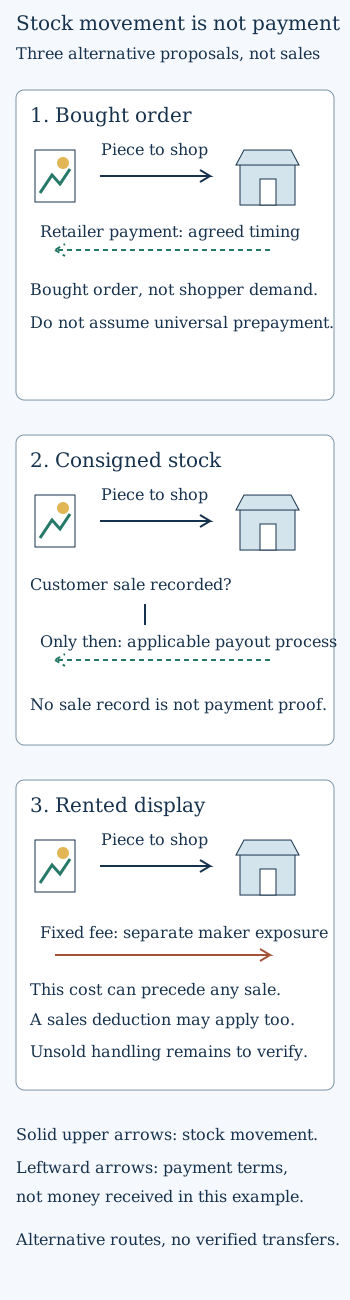
The drawing compares possible arrangements. It does not assert actual ownership, completed transfers, sales or payment dates. The same illustrated piece is used across alternative proposals, not placed in three locations at once.
Original visual by the Superdirector editorial team. Creation date not recorded.
Use named examples to expose differences, not to invent a standard deal
Paloma's maker program presents both an outright wholesale purchase and a consignment route. Its description makes the wholesale payment upfront and describes the consignment option as having no upfront cost to the maker. Those are that program's published statements, not universal properties of every store using those words.
The page is for its maker/vendor route, with a local Austin focus. Do not import conditions from a separate personal-clothing consignor page or assume an application would be accepted. Nor does “no upfront cost” prove that producing and supplying the goods requires no resources.
The artisan maker FAQ illustrates other operational details: payout holds, maker-paid shipping and return shipping, restrictions on swapping stock, and different treatment for duplicate versus one-off products. These are source-specific examples of questions to resolve. The page's crawl information is dated, so recheck current applicable terms rather than applying them to a new proposal unchanged.
Compare committed exposure with uncertain sales
Imagine a fictional print maker offered a shelf with a recurring charge and a sales deduction. They can identify the charge from the proposal, but they cannot enter a shop's optimistic sales prediction as money received.
Separate the known fixed commitment, costs of preparing and supplying stock, deductions that depend on actual sales, and any unresolved return or handling costs. Once the route is understood, check which layers protect shipment and which remain for retail display before costing the handoff. Record what period each amount covers. A weekly fee, a monthly report and a multi-month commitment should not be compared as if they share one time unit.
Keep missing amounts unknown. Avoid adopting a forum's standard split or a rule that doubles costs to create a price. The relevant question is whether this exact proposal can fit the owner's acceptable exposure and production constraints, not whether it resembles a popular percentage.
A proposal with lower sales deductions may still create more fixed exposure. Conversely, a route without a shelf fee can still tie up stock and require work. Neither is automatically the better choice. With no defensible exposure boundary or sufficient information, deferral is a valid outcome.
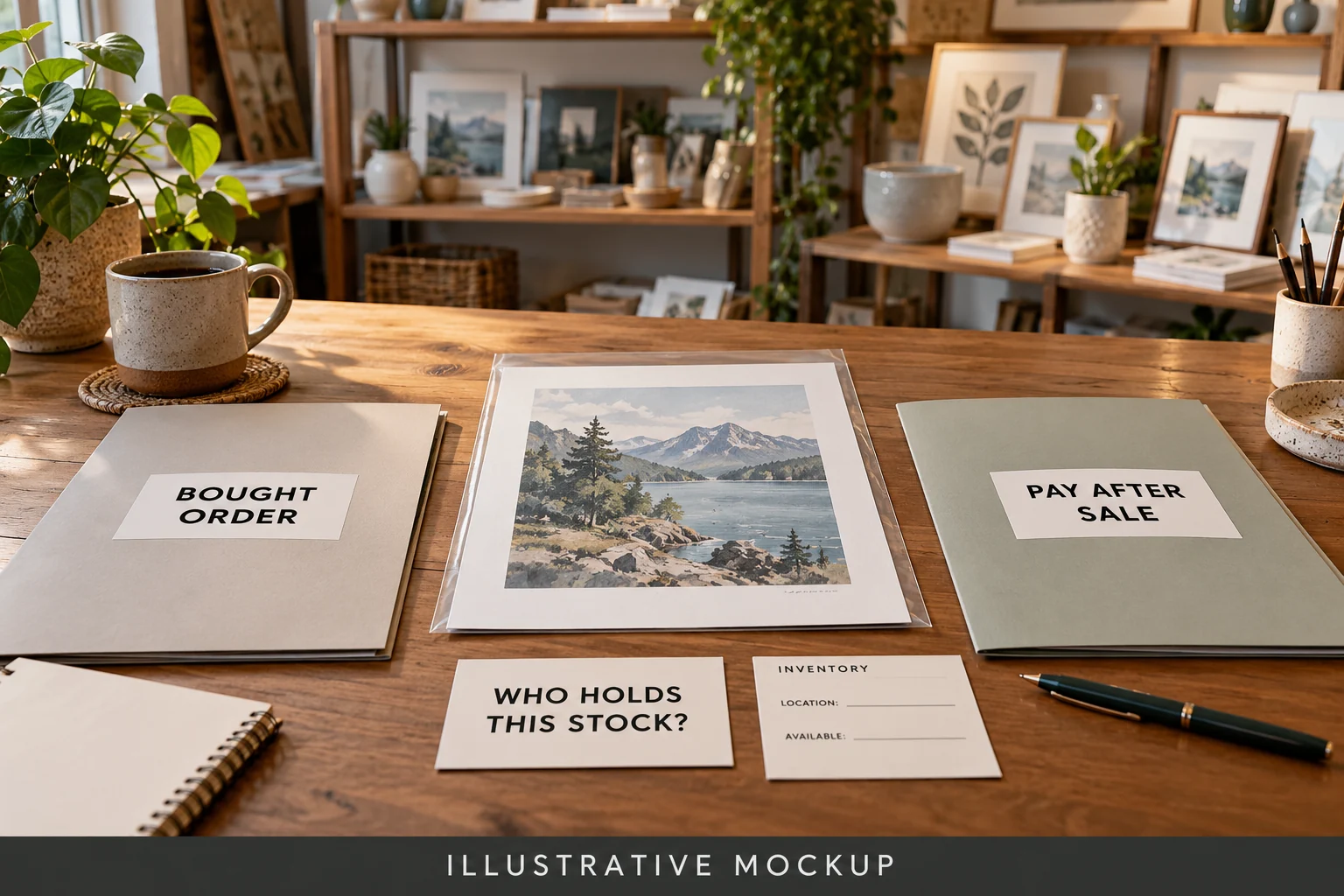
AI-generated illustrative mockup. The scene is not a retailer offer or contract. Ownership, stock availability, costs and payment events need separate evidence before the same item is promised through another route.
Illustrative mockup by OpenAI image generation, editorial direction for this article. Created 2026-10-24.
Ask for the evidence needed to make the next decision
Prepare an internal question list rather than sending an application automatically:
- What is the actual purchase or display arrangement, and which written terms govern it?
- Which charges are fixed, and which depend on a recorded sale?
- What sales, inventory and payment records would the maker receive, and when?
- Who handles display, pricing changes, replenishment and customer questions?
- What process applies to unsold work, returns, damage, loss or early withdrawal?
- Which exact stock and period would the owner be committing?
These questions identify missing information. They do not supply legal answers or authorize shipment, payment, contact or acceptance. Where a term is unclear or consequential, obtain the appropriate review before committing.
A useful outcome is a specific next step: request clarification through an authorized channel, prepare a bounded proposal for owner review, or defer the route. “The shop looks busy” is not enough to choose among them.
Keep the motivating stories in proportion
A jewelry maker's discussion raises concern about rental exposure alongside uncertain sales. Another art-goods maker asks how consignment and wholesale differ. Their reported proposals and outcomes are not independently verified; assess the written offer in front of you rather than borrowing either account's conclusion.
The next small action is to draw the stock and payment path for one actual proposal. Leave unsupported steps visibly unknown. A clearer picture of what would be committed is more useful than calling every retail placement a sale.