How-To Guide
Learn from the players who stop, not only the ones who finish
A positive end-of-demo survey can coexist with an unclear first session. The people who reached the survey may have solved problems that made someone else stop.
A positive end-of-demo survey can coexist with an unclear first session. The people who reached the survey may have solved problems that made someone else stop. That does not prove the silent players disliked the game, but it does mean the answers cannot stand in for everyone who started.
Before adding another questionnaire, choose one decision the next build could improve. For a first-session puzzle, that might be whether players recognize how to recover from a mistaken move. For an adventure, it might be whether the first objective is understandable without the developer explaining it.
The workflow below is an original proposed research plan. Its garden puzzle and short adventure are fictional teaching examples, not completed playtests or measured results.
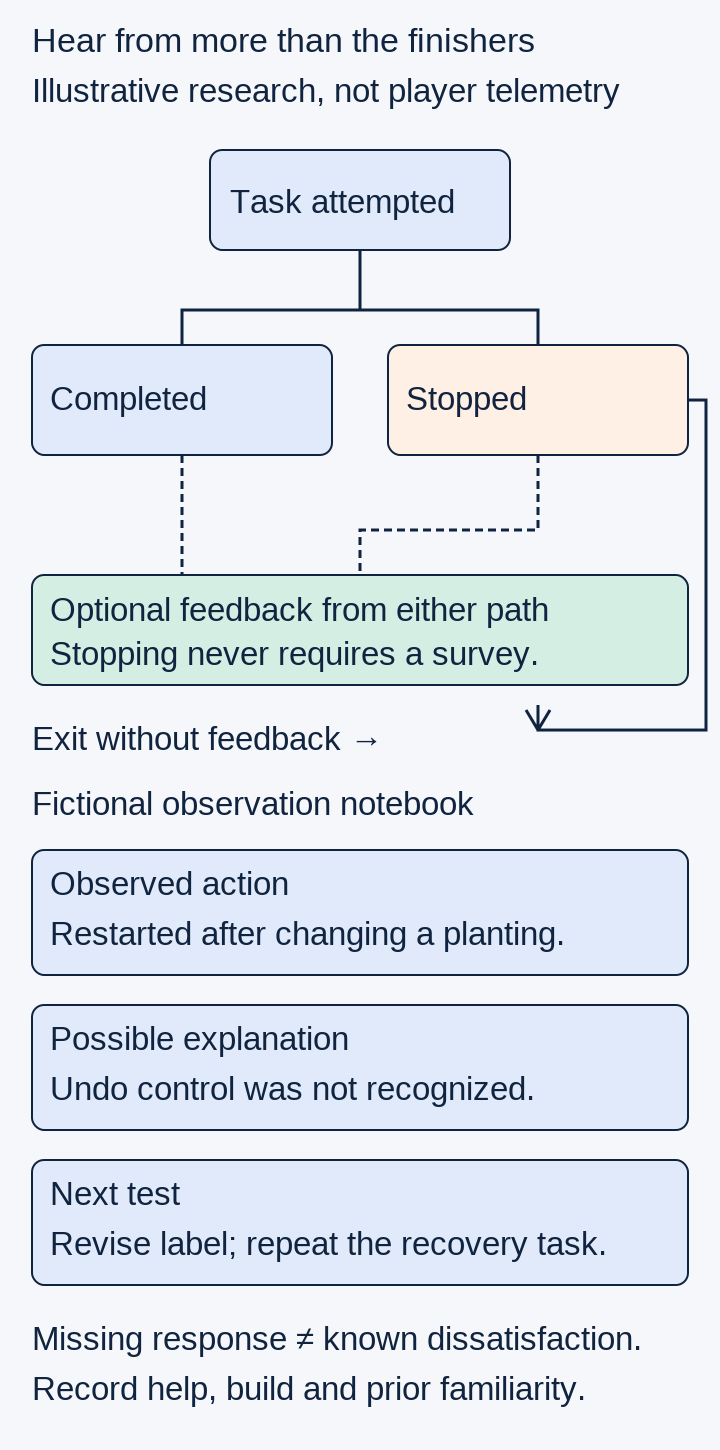
Original illustrative research map. Stopping has no survey gate, and a missing response remains unknown.
 Superdirector
Make it work for your brand
Find it. Remake it. Post it. Superdirector turns the viral formats in your niche into your brand's carousels, X posts and video scripts, and keeps the calendar full.
Give the session a question smaller than “Is the game good?”
Imagine a garden puzzle where a player can undo a planting move. The team suspects that the control is overlooked, but it has not established that this causes people to stop.
Write the research question as: “When someone wants to change a planting choice, what do they try?” That leaves room for several findings. They may discover Undo, restart the board, assume a mistake is permanent, or simply prefer a different arrangement. Those observations call for different changes.
An instruction such as “Use Undo to fix this move” answers the discovery question before the session begins. A more neutral task might be: “Make an arrangement you would want to keep. You can change your mind as you go.” If nobody wants to change a choice, the session did not test the recovery question adequately. Do not count the absence of trouble as proof that the control was found.
GDS usability-testing guidance supports defining research questions, selecting likely users, using realistic tasks that do not reveal the answer, and piloting a consistent discussion guide. It also recommends observing participants and asking open follow-up questions. Applying that method to a game is an editorial adaptation, not evidence of a revenue effect.
Separate admission from useful evidence
A Steam Playtest access grant is not a completed first session. Valve describes Playtest as a separate child app with controllable access. That distributes a build; it does not establish what every admitted person did or understood. For an invitation plan, match the Steam Playtest call to the actual access state before treating admission as participation.
Use separate records for access, launch, attempted task, completion and optional feedback, but only where your existing evidence actually supports those states. Do not manufacture a funnel from incompatible totals or install invasive tracking just to fill a worksheet.
A developer asking about Steam feedback describes the difficulty of maintaining a useful connection with testers. Another operator report distinguishes access counts from delayed play statistics. These are reported experiences, not a typical launch rate or a target for your project.
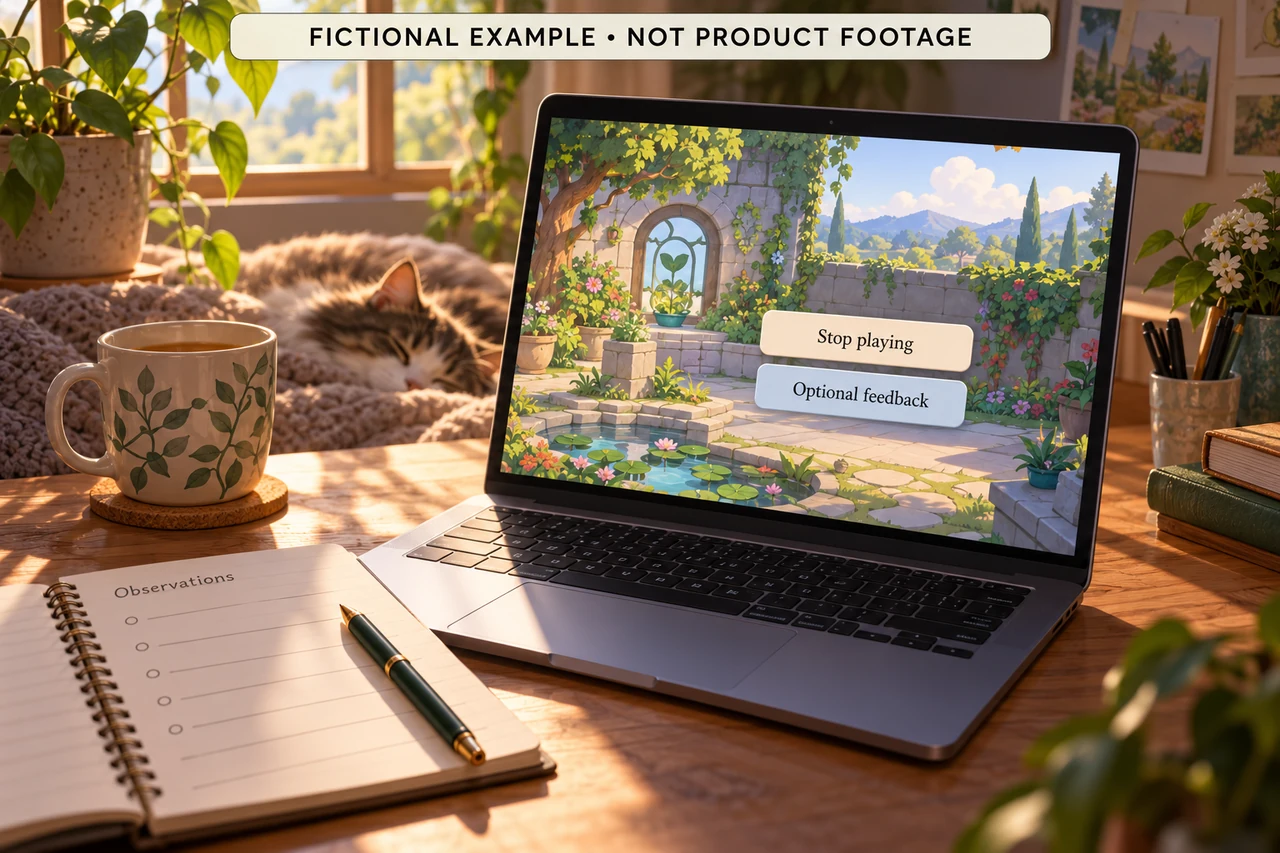
A fictional playtest setting makes stopping independent of optional feedback. Blank observation lines remain blank until real behavior is recorded. Original AI-generated editorial illustration.
Keep stopping possible
In the fictional adventure, the feedback option is available from a normal menu and at the end. A player can stop without completing a survey. For a separately agreed observation session, explain before starting that stopping is allowed and that the project, not the person, is being evaluated.
Do not turn an exit into a demand for justification. In an actual developer account, adding a form when players tried to quit produced more responses but also rushed answers and complaints. The same developer later described learning from watching people play. This is a useful counterexample to treating response quantity as learning, not proof that every feedback prompt has the same effect.
A voluntary question after someone stops can be small: “What were you trying to do just before you stopped?” They may decline. They may have left for a reason unrelated to the game. Keep that uncertainty instead of assigning every early exit to the last visible mechanic.
Write down the action before explaining it
Here is a fictional observation record for the garden puzzle:
- Observed: the participant placed a flower, opened the pause menu, returned to the board, then restarted.
- Participant explanation: they wanted to move the flower and did not notice another way to change it.
- Possible interpretation: the undo control may not be recognizable at that point.
- Alternative explanation: the participant may have preferred a clean board for reasons not captured by the task.
- Next test: revise the control's presentation, then repeat the same recovery opportunity with comparable first-time players.
The interpretation is not the observation. Keep the player's explanation distinct too. A researcher who says “There is an undo button beside the board” has changed the session. Record that assistance and do not call the resulting recovery unassisted discovery.
Do not silently substitute a request for a feature for evidence that the feature would solve the problem. “Add a tutorial” is a suggestion. The preceding confusion is the finding to investigate.
Retest the change without rewriting the original result
Suppose the team gives Undo a clearer label. Retain the previous build, task wording and observations, then run the revised task against the new build. Note differences in participants, device setup, prior familiarity and researcher assistance.
If returning testers already know where Undo is, their success answers a different question from first-time discovery. Their feedback can still reveal whether the label is understandable, but it should not erase that familiarity difference.
A useful report might say: “The revised label was found without assistance in these observed sessions. We have not established its effect on wider demo completion.” If the result remains mixed, retain the conflicting observations and investigate the next specific uncertainty.
The immediate outcome is a defensible next-build decision, not a satisfaction percentage, a marketing testimonial or proof that every early quitter has been heard. One clearly observed problem and a careful retest are more useful than a larger pile of answers whose selection and meaning remain unknown.