How-To Guide
Launch a co-op game with three small creators and one coordinated play session
Plan one co-op session with three small creators using fit checks, a 75-minute run of show, recording tasks and agreed clip rights.
How do I launch my co-op game with three small creators if I can only afford one coordinated play session?
Spend the session on a clear cooperative experience, not on troubleshooting invitations or negotiating clip rights while everyone is waiting. Confirm that the three creators fit the game and each other, rehearse the connection path, and agree what can be captured and reused before the paid or scheduled time begins.
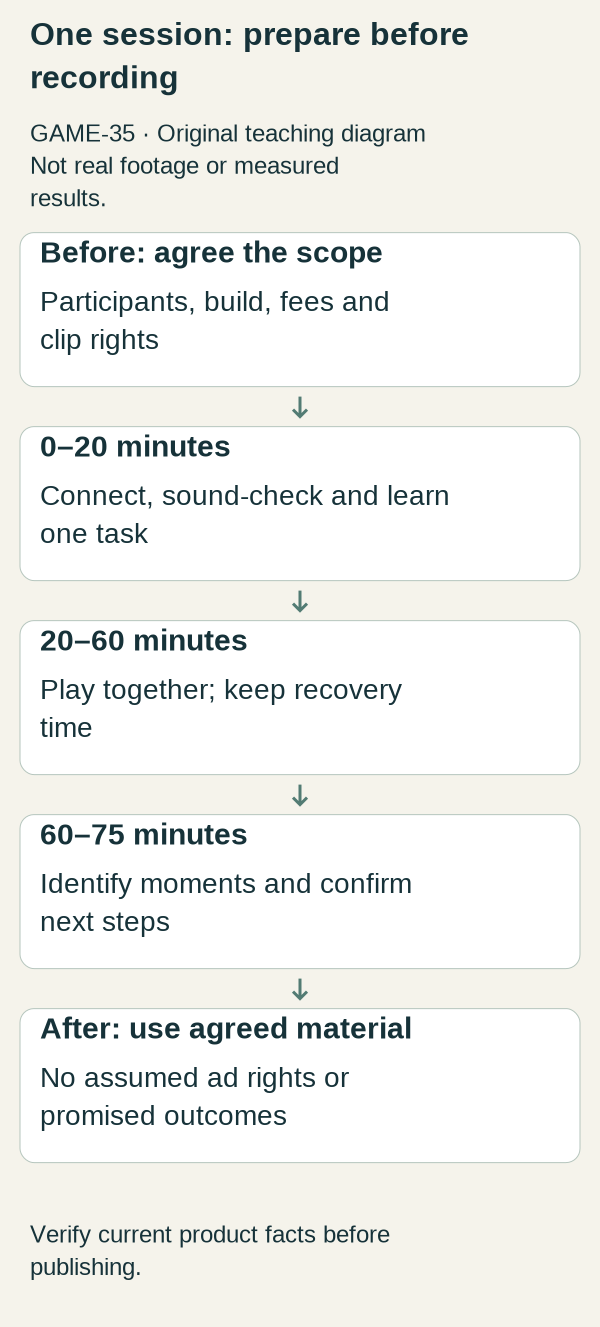
Original illustrative teaching diagram. Prepare participant/build/fee/clip-rights scope before one 75-minute session, then use only agreed material. This is planning guidance, not product footage, customer evidence or measured results.
Spend the session on a clear cooperative experience, not on troubleshooting invitations or negotiating clip rights while everyone is waiting. Confirm that the three creators fit the game and each other, rehearse the connection path, and agree what can be captured and reused before the paid or scheduled time begins.
A single session can produce a genuine shared playthrough and useful follow-up clips. It cannot guarantee coverage, sales or three enthusiastic endorsements. The plan below uses an invented three-player co-op game, Bell Tower Crew, where players coordinate switches to move supplies through a tower. The session is a proposed 75-minute recording appointment, not a performance benchmark or a real booking.
 Superdirector
Make it work for your brand
Find it. Remake it. Post it. Superdirector turns the viral formats in your niche into your brand's carousels, X posts and video scripts, and keeps the calendar full.
Decide what the one session must accomplish
Choose a primary outcome you can control: a complete cooperative play session with usable recordings, or a live broadcast with a clear game invitation. Do not casually promise both if the creators' setups or fee only cover one. A livestream and an edited video involve different production responsibilities.
For Bell Tower Crew, the teaching brief chooses a recorded session. Each creator may decide whether to publish their own coverage under the agreed arrangement. The developer wants permission to use specific approved excerpts on owned channels, but that permission is not assumed. No paid advertising, perpetual reuse or access to a creator's account is included by default.
Completed session objective: get all three participants into the same verified build, teach the basic coordination, play one complete mission and capture each person's local recording. Secondary objective: identify short moments that explain the game accurately. Not promised: a positive review, minimum views or a particular wishlist count.
Select a compatible trio, not three isolated audience sizes
Inspect each creator's recent cooperative-game coverage and public collaboration style. Can they explain a system while playing? Are they comfortable with the session's language and content? Do their usual formats fit a recorded group experience? Check the actual availability and business contact route rather than relying on a database label.
Define “small” for this campaign before researching. Record the observable measure you will use, such as public subscriber count, your chosen range, the reason it suits the budget and format, the source URL and the date observed. This is a campaign screen, not a universal creator category or a predictor of results. If an unusually strong fit falls outside it, record the exception instead of silently moving the boundary. Do not prioritize size over relevant recent co-op coverage, compatible schedules or the actual quoted fee.
Then assess the group. Three individually suitable creators may have incompatible schedules, technical setups or expectations about tone. Ask whether they are comfortable appearing with the other named participants before confirming the lineup. A creator agreeing to play your game is not blanket permission to join any collaboration you assemble.
Use a short compatibility record: creator identity; campaign size range and rationale; observed public size measure, source and date; relevant videos; communication language; hardware and build requirements confirmed; session availability with time zone; recording ability; participation conditions; approved co-participants; unresolved questions. No field needs an invented score. A missing technical answer is a hold, not a minor deduction.
The complete pre-session brief
Game and build: Bell Tower Crew, example build BTC-R7; actual download destination supplied only after verification.
Session: 75 minutes, with the actual calendar date and time zone confirmed in the invitation.
Participants: three verified creators plus the developer as technical host, not a fourth player unless the game and agreement support that arrangement.
Gameplay aim: complete the introductory supply mission, then attempt the first coordination challenge if time allows.
Preparation: install the specified build, confirm audio capture and check access before the appointment. Do not record private login screens or distribute credentials in the shared brief.
Content boundaries: use the game's actual content notes; agree on any restrictions or sensitivities beforehand. Do not promise a family-friendly result merely because the artwork is colorful.
Publication: identify whether the session is private recording, live, embargoed or unrestricted. State exact embargo details only if actually agreed.
Support: one named technical contact and a backup contact route. Include the fallback plan below so failure does not become a surprise negotiation.
A 75-minute run of show
0–10 minutes: connection and consent check. Confirm the build, lobby, voice channel and recording status. Restate whether recording has started and which uses are agreed. Resolve capture problems before moving into the mission. A short sound check should include all voices and game audio.
10–20 minutes: teach through one real task. Let the players carry a supply crate and operate one switch. The developer explains only what the build fails to communicate. This is not the time to deliver a long pitch about the roadmap.
20–45 minutes: uninterrupted first mission. Let the creators discover coordination and make ordinary mistakes. Capture genuine moments rather than directing them to repeat excitement. The host stays available for technical issues without narrating every move.
45–60 minutes: one additional challenge or recovery. If the first mission went smoothly, try the next bounded challenge. If not, use this time to finish or diagnose the obstacle. Do not force a second mission just because the schedule says so.
60–70 minutes: explain and identify moments. Ask what the players understood, where cooperation mattered and what was confusing. Note timestamps for potentially useful clips. A timestamp is a candidate, not approval to reuse the footage.
70–75 minutes: close and confirm next steps. Verify recordings were saved, state the agreed transfer route and identify any questions about publication or excerpt approval. Do not add new deliverables while people are leaving.
This schedule reserves time for failure without turning the entire session into a technical rehearsal. If your game normally needs longer to teach, change the brief before booking rather than hiding the mismatch.
Capture three clips that teach different things
Clip A, “Why you need each other”: one participant holds a switch while another carries the crate and the third clears the route. Include enough setup to make the dependency understandable. Do not edit out the teammate who makes the action possible.
Clip B, “A recoverable mistake”: a failed timing attempt, the team's explanation and a successful retry if one naturally occurs. Preserve the context; do not manufacture incompetence for a reaction clip.
Clip C, “What one mission feels like”: a short sequence of planning, execution and the actual outcome. Label it as edited gameplay, keep the build status accurate and use the agreed destination.
These concepts are original editorial suggestions. If the session produces none of those moments, do not fabricate them. Use an honest gameplay excerpt or make a separate developer demonstration with clearly different provenance.
Rights, fees and failure decisions
Before the session, record the fee and what it buys: attendance, a live broadcast, an edited upload, raw files or some combination. Specify who owns each recording and which excerpts the developer may use, where, for how long and with what review. For this session plan, put any paid-ad reuse or advertising use of a creator's likeness in the agreed scope before using it; do not treat a game key or session fee as the approval record.
This is an operational checklist, not legal advice or a substitute for an appropriate agreement. Verify current disclosure obligations for the actual creators, platforms and markets before publication. Do not write a universal disclosure formula without that context.
For connection failure, choose a bounded fallback in advance. Example: after the agreed troubleshooting allowance, end the session and discuss the contract's rescheduling terms. Do not charge into an unapproved paid extension. If one participant drops, continue only if the game supports the remaining players and everyone agrees; otherwise the experience you promised has materially changed.
The next action
Complete the objective and compatibility records before inviting anyone to a date. Then run the connection path internally with the exact build. One session has little room for preventable confusion, but it has plenty of room for authentic play when preparation removes the administrative work.
The source studies supplied for this batch do not establish a task-specific three-creator performance benchmark. This run of show, capture plan and rights checklist are original planning tools. They make no claim that a coordinated session outperforms separate videos or guarantees a launch result.