How-To Guide
Your Steam game is missing from a festival view. Should you change its tags?
An absent tile is a reason to investigate, not a reason to replace an accurate genre label. Before editing anything, separate three questions: does the…
By the Superdirector editorial team.
An absent tile is a reason to investigate, not a reason to replace an accurate genre label. Before editing anything, separate three questions: does the game support the proposed classification, is its festival setup correct, and what exactly did this visitor view show?
These questions need different evidence. A gameplay recording can explain a mechanic. Registration settings can reveal a configuration mistake. A screenshot of one carousel records a particular display. None substitutes for the others.
Why this distinction matters
One developer reported being unable to find a registered strategy game in an October Next Fest category, then said they found it after refreshing different displayed sets. That is a useful troubleshooting account, not evidence that every missing game is configured correctly. Another developer described unexpected adult-game neighbors for a cozy game and a later change after retagging. Their before-and-after report does not isolate the cause of that change. Operator placement account · Operator tag-neighbor account
The practical lesson is to keep product classification, configuration and display observations in separate records. This is an editorial diagnostic method, not a claim about Steam's ranking formula.
Start with an action, not a popular label
For each candidate tag, write one sentence describing what a player actually does in the current build. Add a screenshot, short clip or precise location where a reviewer can check it. Also write the strongest reason the tag might mislead someone.
Consider a fictional spaceship game. A recorded turn asks the player to spend scarce fuel on a shortcut or reserve it for a later route. That supports considering Resource Management. Merely placing a spaceship in the artwork does not establish that mechanic. This is a teaching example, not an official definition of the tag or evidence from a real product test.
Use a compact evidence sheet:
- Candidate tag: the exact term being considered.
- Player action: what happens, not the intended emotional effect.
- Build and location: where the action can be checked.
- Counterexample: a part of the experience that could contradict the label.
- Editorial decision: retain, remove, reorder or investigate, with the reason.
If a second reviewer cannot locate the action, mark the evidence incomplete. Do not substitute a competitor's tag list for knowledge of your own game.
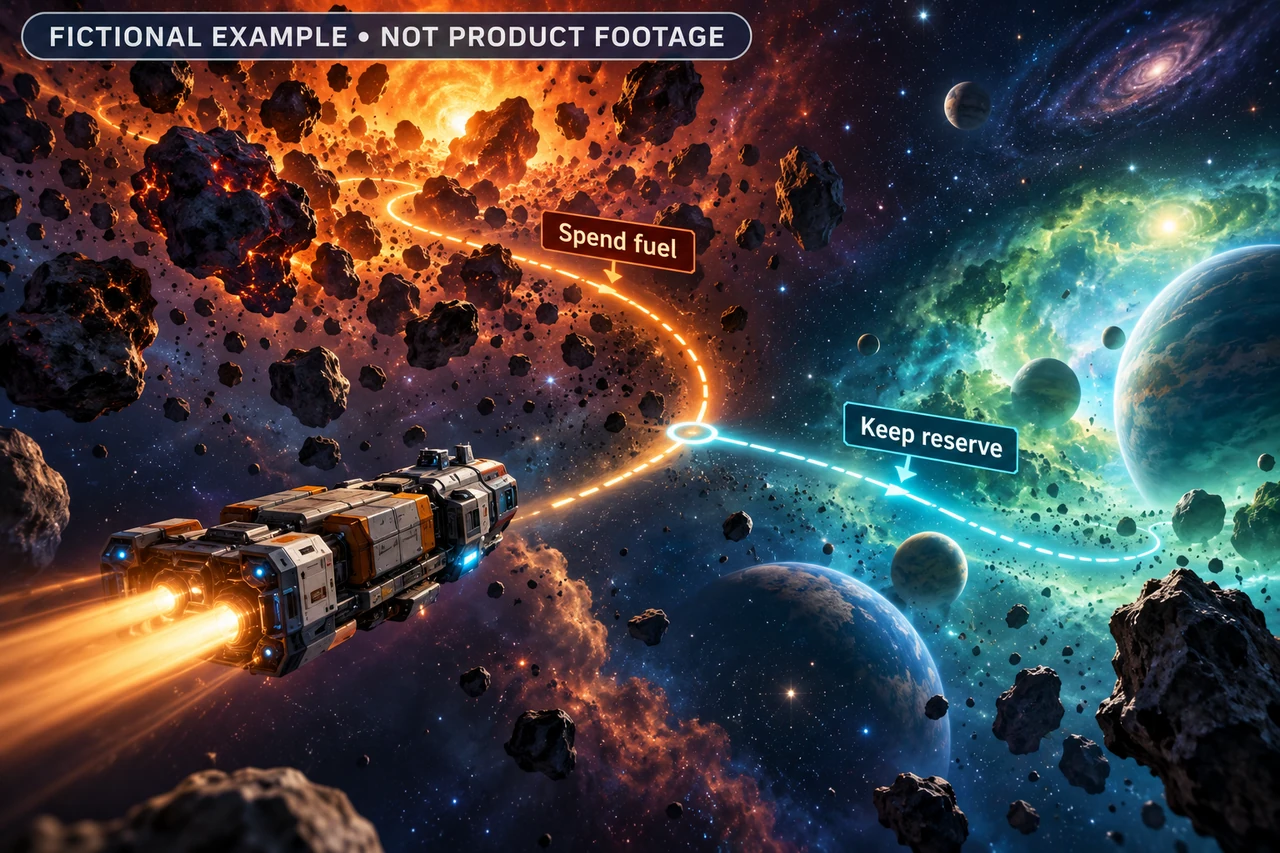
A fictional fuel decision illustrates a resource-management activity. Spaceship artwork alone would not establish the mechanic or explain festival visibility. Original AI-generated editorial illustration.
Original visual by Original editorial illustration generated with OpenAI’s built-in image tool. Created 2026-10-24.
Check the current tagging rules once
Valve explains that tags contribute to discovery and classification. Its guidance emphasizes accurate, relevant tags and clear leading tags; the top 20 are used in relevant store visibility mechanisms. The Tag Wizard's prioritization is a starting point, not knowledge of the game. Its similar-title display is not a direct preview of More Like This. Tags can also change through community contributions. Demo tags inherit from the base game. Tag publication is separate from publishing other store-page edits. Valve's Steam Tags guidance
That creates two useful review tasks. First, compare the proposed classification with actual play. Second, inspect the current public result after any authorized metadata change. A worksheet saying “approved” does not prove the public tags changed, and a changed tag does not prove the desired visitors saw the page.
Check festival setup separately
Valve's Next Fest troubleshooting guidance directs developers to inspect registration categories, demo release and accurate tags, using the developer preview to review placement. Its current guidance also describes randomized early displays with exceptions and later personalized sections. Festival organization varies, so check the documentation for the relevant edition rather than treating one event's arrangement as permanent. Valve's Next Fest guidance
Make a configuration record with the event edition, registered application, category selection, demo release state and preview observation. Record what was inspected and when. If the setup is correct but an unexplained problem remains, preserve that evidence for the appropriate support route rather than repeatedly changing unrelated metadata.
Do not confuse the base game's classification with a separately invented demo identity. Do not claim that a visible preview guarantees placement in every visitor's view.
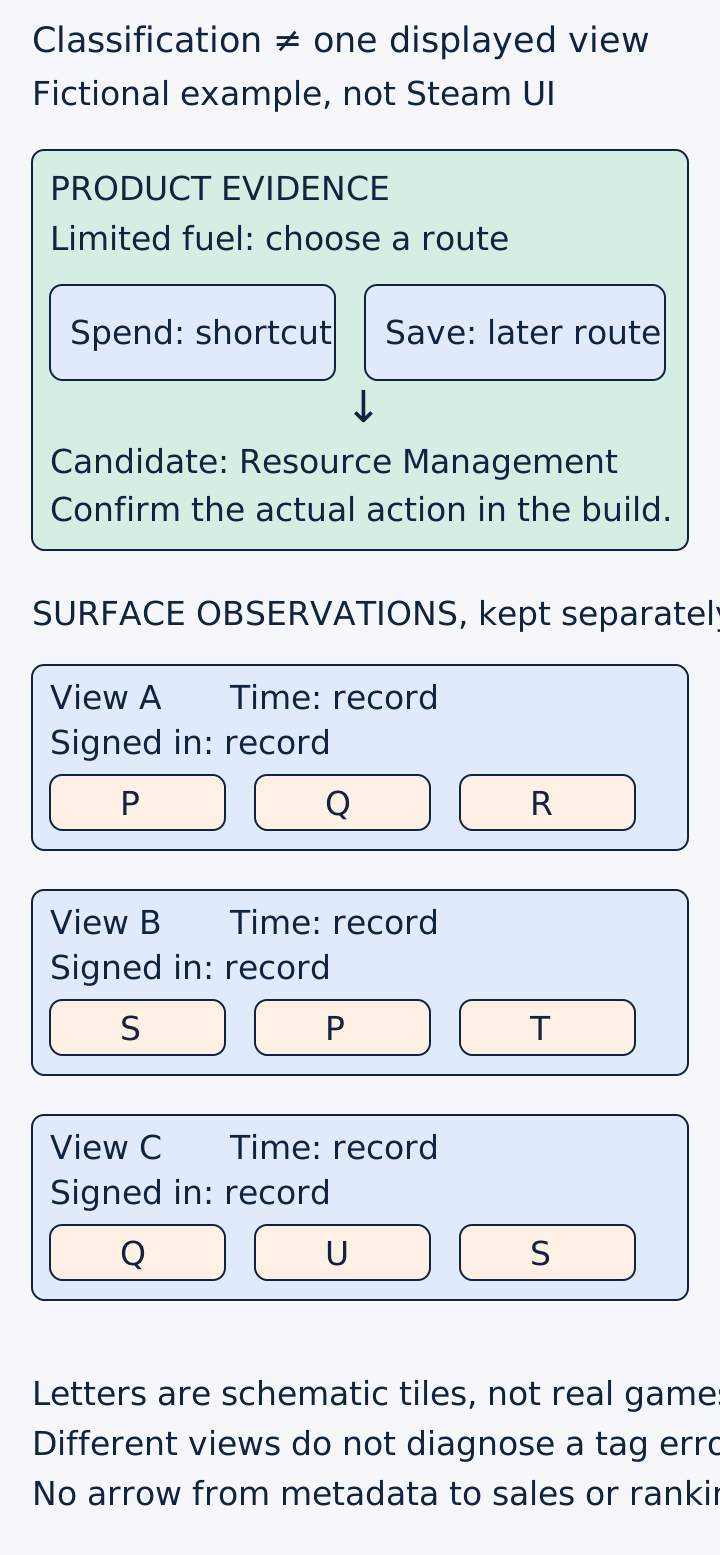
Original conceptual illustration. The game state and sample views are fictional, not Steam screenshots, analytics or a visibility experiment.
Original visual by the Superdirector editorial team. Creation date not recorded.
Make the visitor observation reproducible
In an illustrative investigation, the developer checks a category page while signed in, sees no tile for the game, and starts editing tags. Stop before that last step. Preserve the observation first:
- Exact event page and section, including any selected filters.
- Observation time and time zone.
- Signed-in or signed-out state, without storing credentials.
- What was visible and what search or navigation action was used.
- Whether the observation concerned a category list, a recommendation surface or the game's own page.
A later view may differ. Save it as a second observation. Do not overwrite the first, and do not automatically attribute the difference to a tag edit, a refresh or a supposed algorithm reset.
The useful question is “which uncertainty has this observation reduced?” A successful direct visit establishes that the page is reachable in that context. It does not establish how often a target buyer encounters it elsewhere.
Change only the thing the evidence challenges
If the mechanic sheet shows an inaccurate tag, prepare a precise metadata correction with the supporting action and counterexample. If registration is wrong, address the registration issue. If neither is established, retain the unknown rather than creating an experimental change merely to feel productive.
A poor response would be adding an inaccurate popular cozy tag, refreshing until a tile appears, then announcing improved discovery. That sequence combines a misleading description with an unsupported causal claim.
A better change record distinguishes proposed, approved, published and observed. It names the exact changed field and preserves the before-state. Any claim about qualified visits, useful demo play or wishlists belongs in a separate outcome analysis with an explicit window and known attribution limits.
A small completion test
Finish the audit when another reviewer can follow the mechanic-to-tag reasoning, inspect the relevant event configuration and reproduce the recorded page context. List remaining unknowns instead of forcing every row to pass.
Revisit the public metadata after an authorized correction, and revisit the relevant festival surface at an appropriate later observation window. Those checks verify different things. Neither alone demonstrates better ranking, more discovery or additional buyers.
Evidence and limits
Festival behavior is edition-sensitive, so recheck Valve's guidance for the edition you plan to enter. The operator posts are self-reported examples, not representative evidence of developer prevalence or a verified ranking formula.