How-To Guide
Write a maintenance notice around what players can actually do
A maintenance notice that says “servers down” may leave the most important questions unanswered. Can an existing match finish?
A maintenance notice that says “servers down” may leave the most important questions unanswered. Can an existing match finish? Can a new player sign in? Does a local practice mode work? Is the announced end time an estimate or a confirmed reopening?
For a small live-game team, the useful step is to tie each affected player action to the current operating state and to the evidence that must exist before the team announces a change. A more confident promise is not the fix.
The co-op examples below are fictional. They demonstrate a proposed communication workflow, not a live incident, a tested recovery procedure or a service-level commitment.
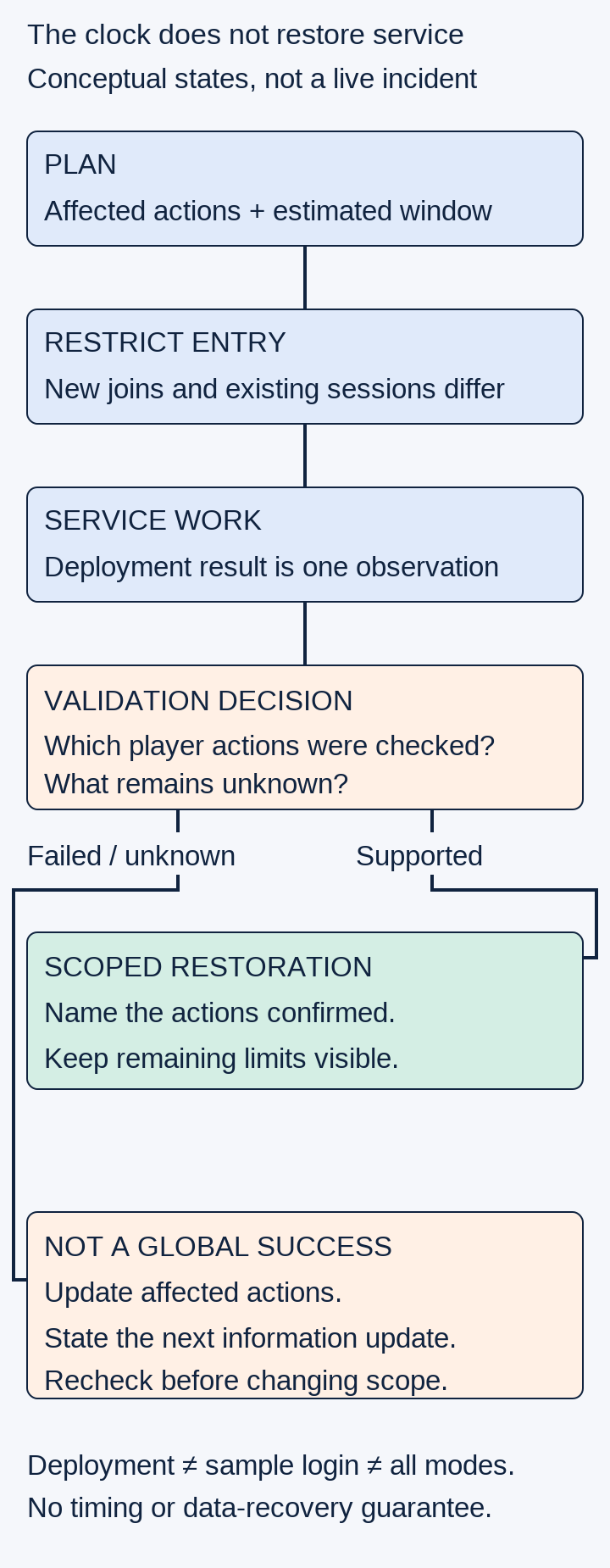
Original conceptual state map. No live checks or restoration outcomes are represented.
 Superdirector
Make it work for your brand
Find it. Remake it. Post it. Superdirector turns the viral formats in your niche into your brand's carousels, X posts and video scripts, and keeps the calendar full.
Name the actions before naming the window
Start with the parts of the game players use, not only the infrastructure being changed. A player may understand “joining a new match is unavailable” more readily than the name of a backend component.
In a fictional co-op game, the team plans to stop new joins before ending active sessions. Those are separate boundaries. Write them separately if that is how the actual service behaves. If the team has not checked local practice during the outage, do not list it as available merely because it appears to be an offline mode.
A scope note can separate login, new sessions, existing sessions and any other affected function. Until the owner supplies evidence, mark unknown behavior as unverified internally. Do not copy another game's scope, and do not assume that every mode shares the same dependency.
An official Knights of Fiona maintenance notice separates its parts clearly: it lists the schedule, the scope and the unavailable actions, including login and play, and says the end may shift. It describes the plan and says it will be updated when the work is complete. The scheduled date has passed, but that does not show the work finished as planned.
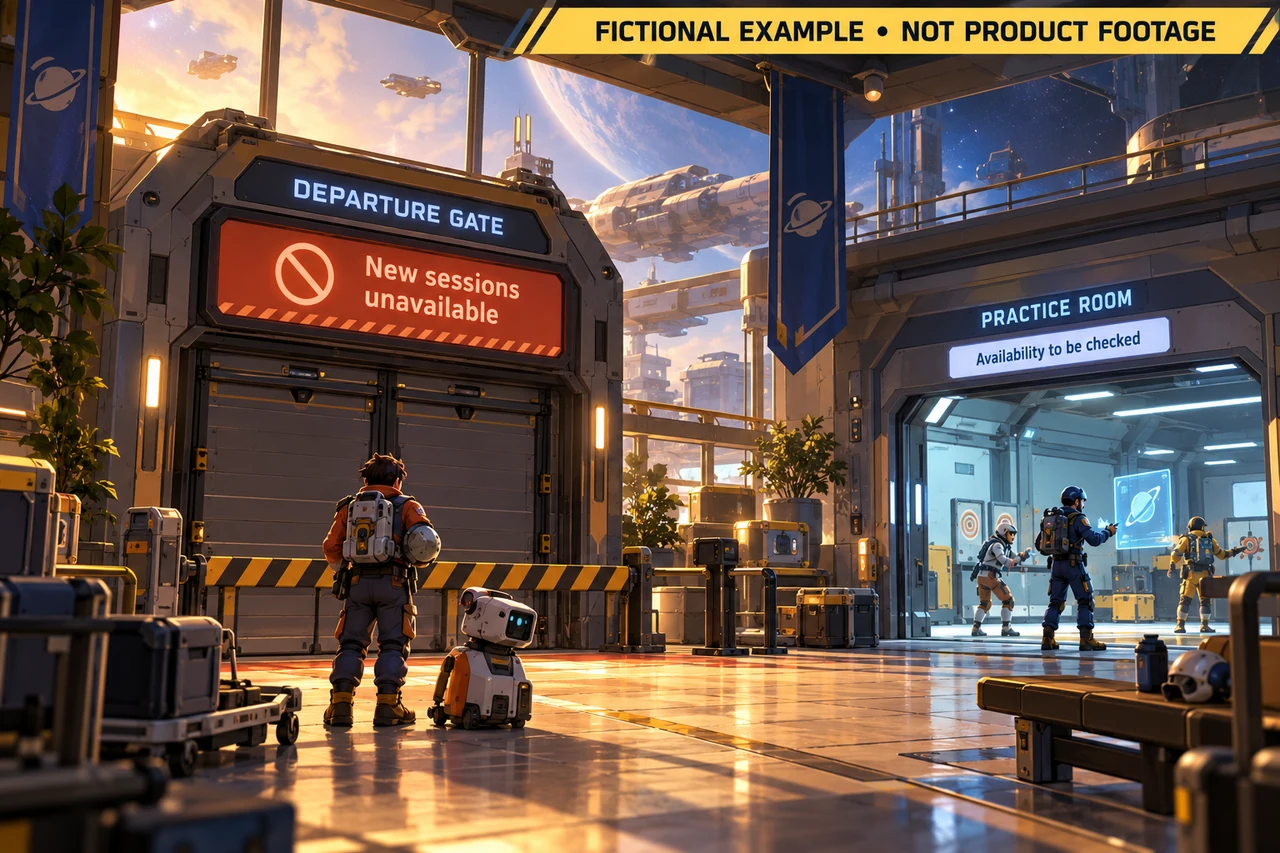
A fictional spaceport separates new-session access from a practice-mode question. It represents planning, not a live outage or confirmed availability. Original AI-generated editorial illustration.
State the date, timezone and uncertainty together
Do not write an isolated “tonight” or “back at six” in a message that may be shared across regions. Give a complete date and an explicit timezone, and check any local-time conversions before you publish them.
Label the expected window as expected. An estimate helps players plan, but it does not switch the service to restored when the time runs out. If you cannot support an end estimate, say what is known and when the next update is due, and stop inventing short reopening promises.
The next update time is a communication commitment too. Assign someone to provide it, even if the operational result is still uncertain. Do not publish a cadence that the team cannot maintain.
RSI's first-party status history shows new connections being disabled before the later server shutdown, listed as separate steps. Its September 2026 entry also records an extended estimate. These show how one other operator communicated changes. They are neither a recommended maintenance duration nor evidence about your service.
Separate deployment from restoration
A deployment can finish before all player-facing behavior has been checked. In the fictional co-op game, the new server build is installed, but an authorized login check fails. The maintenance message should not become “all systems restored” simply because the deployment job ended.
Before the window, decide which observations the intended restoration statement needs. For this fictional release, the owner might require a permitted test login, session creation, joining and a short representative session. The exact checks depend on the affected functions and on the team's existing test process. They are not a universal checklist, and they do not give anyone permission to interact with production users.
Keep the evidence distinct:
- Deployment result: what technical operation completed?
- Player-action result: what was actually attempted, on which environment and build?
- Remaining limits: which modes, regions, account types or paths were not checked?
- Restoration statement: what scope does that evidence support?
One successful sample login does not prove that every mode or account is healthy. Conversely, an untested, unrelated feature does not mean the tested action failed. State the scope the evidence covers, and do not stretch incomplete evidence into a blanket success or failure.
Keep the overrun visible without inventing a cause
If the expected window changes, keep the earlier notice and add a dated update. Say which actions remain unavailable and what is being checked. Share a cause only after the responsible operator has confirmed it and disclosing it is appropriate.
A February 2026 Project Celeste incident thread is a useful first-party example. A staff member labeled Server Engineer explained that a problem restarting the server forced a move, and posted a separate back-online update the following day. It shows what that operator reported and nothing more. The statement about retained data applies to that incident, so do not reuse it as an assurance that maintenance cannot lose progress.
For the fictional co-op game, an honest intermediate update might say that the deployment is complete but nobody has yet validated joining sessions. It should not name a successful match result that nobody observed. If the next update is due before the check finishes, report the check as incomplete and revise the update plan if needed.
Close with evidence that can inform the next notice
After the incident, keep the planned window, the actual updates, the relevant test receipts and the final scope statement. Review where players were confused and whether the message used terms they could act on. Do not judge the communication only by how few people complained or how quickly a technical job ended.
The next useful improvement might be as small as separating new joins from active sessions, surfacing an untested offline-mode assumption, or naming the person who owns the next public update. Those changes make the notice more reliable without promising a perfect maintenance window or universal recovery.