How-To Guide
Use a Steam update-visibility round now or save it? Make the allocation decision before activating it
A major update is ready, the Steamworks button is available, and a discount may be approaching.
By the Superdirector editorial team.
A major update is ready, the Steamworks button is available, and a discount may be approaching. That does not yet answer whether this is the right moment to allocate an update-visibility round.
You are allocating a limited promotional resource to a particular audience, and that audience needs a real reason to reconsider the game. Compare using a round now with saving it for another milestone. An available button is not a recommendation, and a well-written update post is not an active round.
Establish the actual resource and audience
Valve currently starts each product with five update rounds shared between Early Access and full release. Further rounds may be granted, but are not an automatic new allowance at 1.0. The store-homepage feature targets people who own or have wishlisted the game. A round can begin only after initial launch visibility ends, and it needs a community announcement posted within the preceding 30 days. It runs for up to 30 days or until one million homepage impressions, whichever comes first, and that number is a cap, not promised delivery. Major seasonal-sale days still count toward the span even though the regular update placement does not appear on them. Read the current update-round rules.
Before comparing options, record your actual remaining balance, the relevant announcement’s date, the update’s playable state and the intended owner/wishlister task. A public guide cannot verify those account-specific facts for you.
Do not build the plan around reaching an entirely cold audience. An existing owner may need a reason to return; a wishlister may need to reconsider a purchase. The same update can matter differently to each group, and neither response is guaranteed.
Separate the update, its announcement and the round
The product change, the community post and the allocation are three different things. A team can release an important fix and communicate accurately without automatically consuming this particular promotional opportunity.
Valve’s Major Update documentation describes its event category and separately identifies the store-homepage route available through an update-visibility round. Publishing the category is not the same operation as starting the round. Major Update event behavior.
The separation matters when there is little news to support a broader reintroduction. Routine maintenance should not be dressed up as a major milestone because a promotional slot sits unused, and essential patch information should still reach existing players while you save a round.
A developer asking about rounds after launch initially understood the opportunity as general storefront time, then discussed the distinction between owners, wishlisters and new viewers. The thread also contains a useful caution: another developer’s stronger result coincided with a festival, while a later attempt differed. Those experiences cannot isolate the round’s effect. Read the original operator discussion.
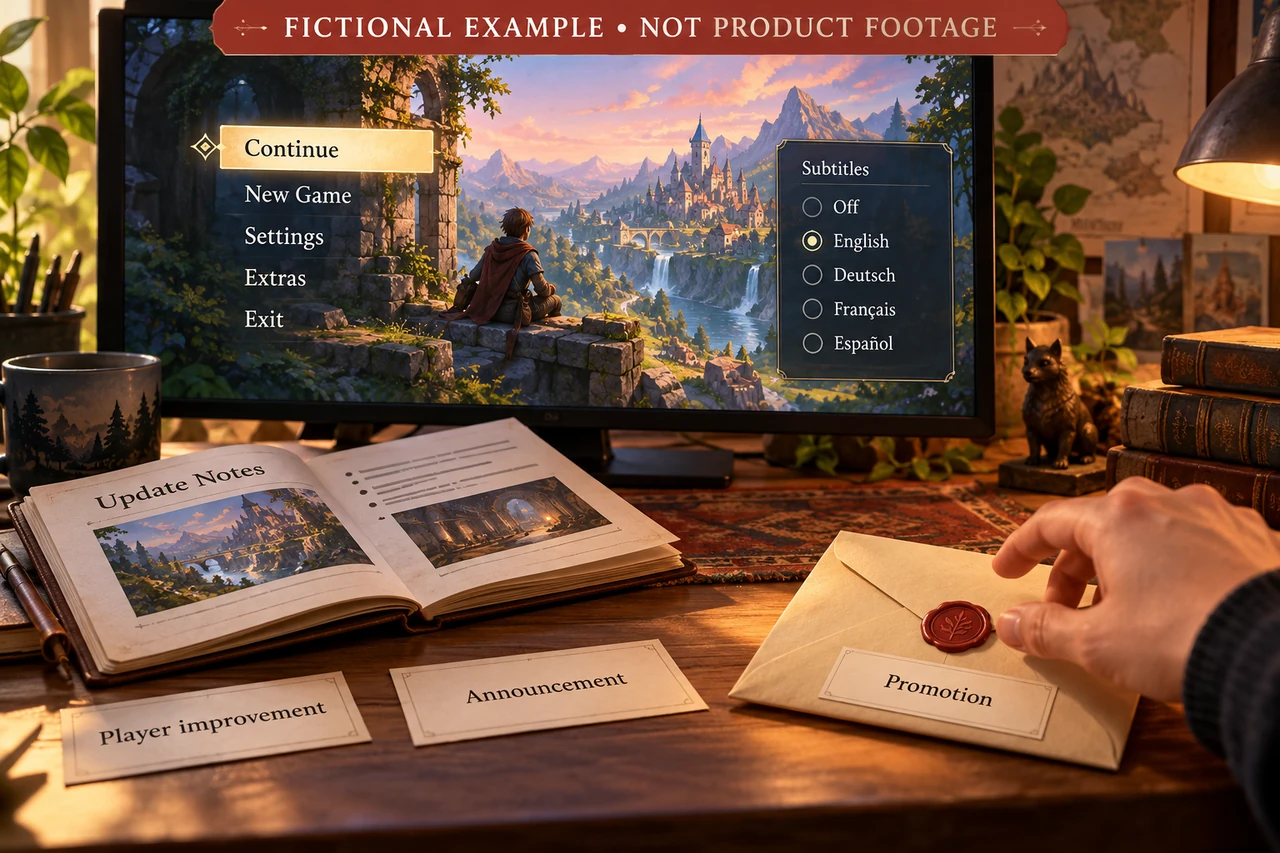
A fictional studio separates the implemented player improvement, its announcement and a promotional allocation. The image does not show an activated visibility round. Original AI-generated editorial illustration.
Original visual by Original editorial illustration generated with OpenAI’s built-in image tool. Created 2026-10-24.
Compare use-now and reserve on the same evidence
Create two short records, not two revenue forecasts.
For use now, name the implemented change, who has a concrete reason to care, the working destination, the eligible announcement, available support and what remains afterward. Include the work required to explain the update truthfully: representative captures, a clear full-game offer and a route to the changed experience.
For reserve, name the specific later milestone. Which feature, evidence or readiness would make that milestone a better use of the round? Who owns the work, and what would make the plan no longer credible? A round saved indefinitely is not automatically a strategy.
Use the same comparison fields: player reason, readiness, audience fit, remaining balance, calendar conflict, explanation assets, support capacity, unknowns and the next evidence that would change the choice. Leave estimates blank when you do not have a defensible basis.
Take a fictional Early Access game with two rounds remaining. Its menu and accessibility overhaul is implemented, and the planned 1.0 milestone is still uncertain. The team weighs what current players gain from the overhaul now against what the later milestone would add. If it uses one round now, one remains in this fictional balance, and the team does not budget a fresh set at full release because the rounds are shared across both stages. If the overhaul still fails its intended tasks, a finished post does not make the round ready.
Inspect the announcement date, not just the build date
Another operator’s postmortem asks whether a round can accompany an update released several weeks earlier. That is a real planning question, but the build’s age says nothing certain about when the required announcement was posted or whether the account is currently eligible. Read the Curious Paws question.
In a fictional version of this situation, the team has a shipped improvement but no reliable record of the associated post. Its first step is to find the actual announcement and read its date. It does not assume permission or present an old change as a new update. It also checks that the destination still describes the current game and that the claimed improvements can be demonstrated.
If the update explanation needs revision, handle that editorial work on its own merits. A rewritten announcement does not show that the product has had another major change.
Show the calendar cost explicitly
Draw the proposed maximum span and mark any overlapping major seasonal sale. Keep the elapsed-time bar unbroken through the sale, because a gap would wrongly suggest that days without display pause the clock.
Leave predicted impressions and daily revenue off the diagram. It should show a known constraint and what the chosen start costs, and it should not suggest that every remaining day delivers equal attention. A discount is a separate commercial decision with its own eligibility and authorization, and this worksheet does not include one automatically.
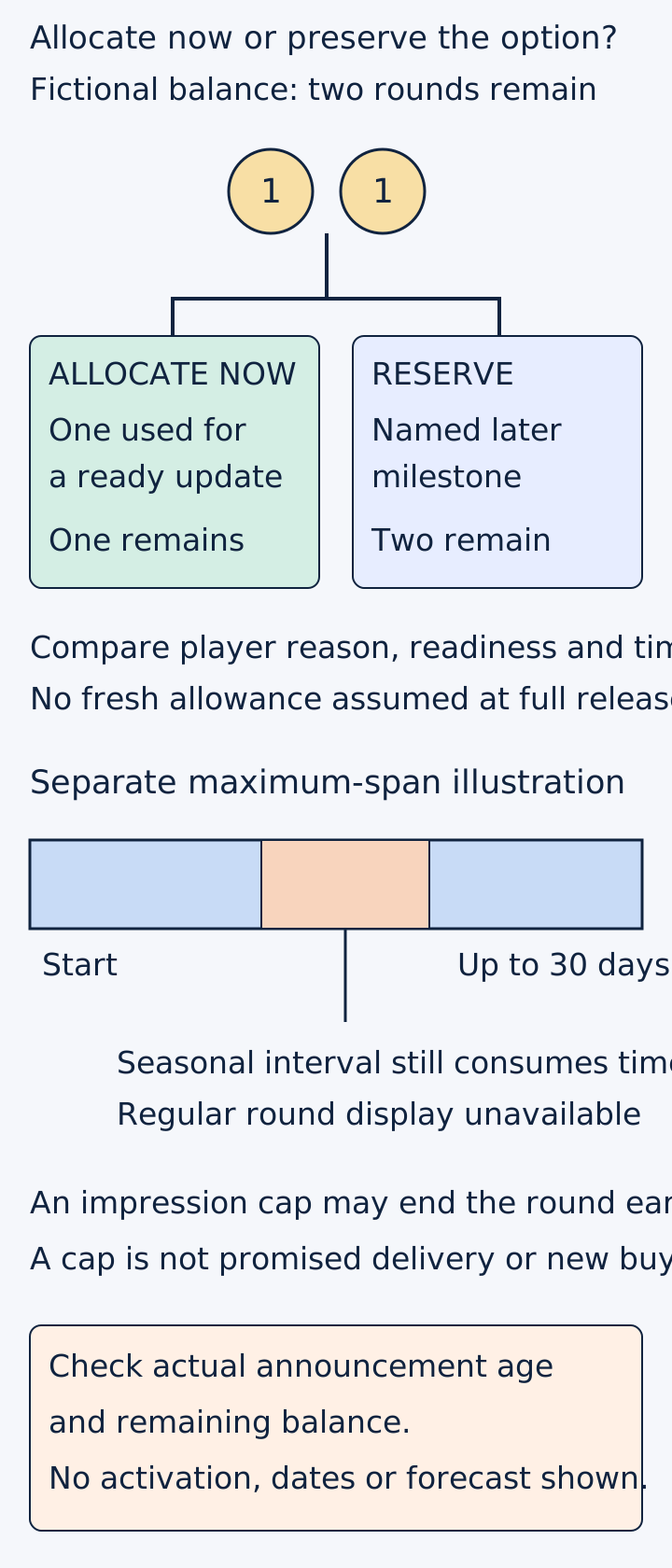
Original allocation diagram. The two-round balance and timeline are illustrative, not an account reading, actual schedule or forecast.
Original visual by the Superdirector editorial team. Creation date not recorded.
Plan what you can learn without inventing causation
Record the chosen update, announcement revision, round state and observation window. Keep impressions and clicks separate from returned play, purchases and useful player feedback. Note overlapping discounts, festivals, creator coverage or other changes that could influence the same period.
A third developer’s postmortem describes preparing a substantial update, forgetting the round and planning to try one later. That supports keeping an explicit execution record, but it does not show that the missed activation caused the commercial result or that a later one would recover the investment. Read the Ursid account.
If the round is authorized and activated, keep the activation receipt apart from what was actually displayed and what players did afterward. If you defer it, write down the readiness or opportunity condition that will bring you back. Either record is more useful than checking repeatedly whether the button is still there.
Next, complete the two-option comparison with actual account and product evidence, and decide only then whether this update justifies using a round now. Nothing in this guide activates a round or promises a return.