How-To Guide
Test whether newsletter readers need your paid companion app
People can enjoy your recipes and have no reason to maintain a pantry database.
People can enjoy your recipes and have no reason to maintain a pantry database. That difference matters when a food-content business launches a paid meal-planning app. The existing audience is a relationship to understand, not a list of assumed buyers.
Before planning a promotion, compare the promise that brought readers to the newsletter with the recurring job the app asks them to do. Your useful deliverable is a task-transfer worksheet: what stays familiar, what new effort appears, what additional benefit is actually available, and what evidence supports investigating that offer with a particular audience.
This guide proposes that comparison. It does not send email, inspect private subscribers, change subscription preferences, or claim that a campaign or product experiment has succeeded.
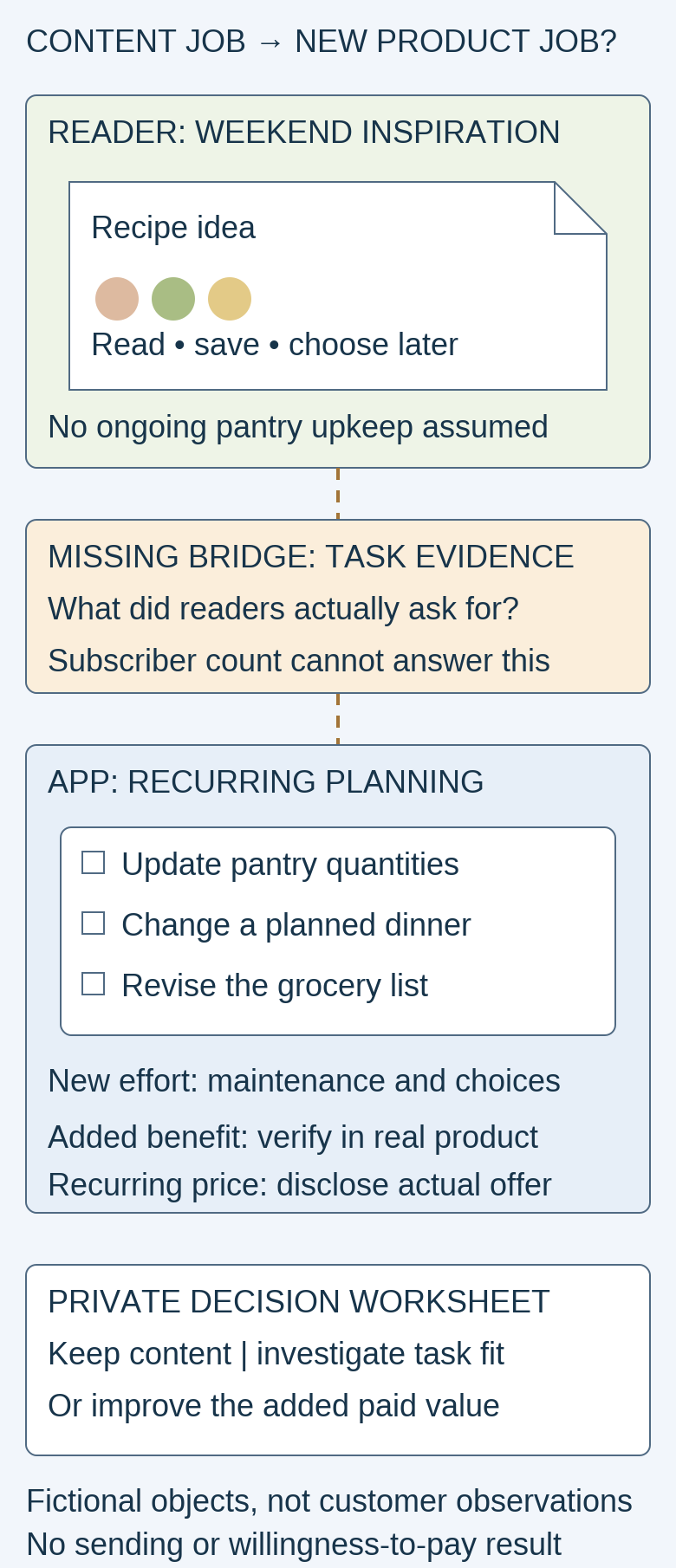
Fictional task objects, not customer observations. The missing bridge must be filled with actual volunteered task evidence, not newsletter size, opens, or an invented willingness-to-pay score.
 Superdirector
Have your AI do this for your brand.
7 days free, then $29 a month.
Do not diagnose the audience from one disappointing send
In a January 28, 2026 founder post, Justin Howell describes launching a meal-planning app after building a food-blog newsletter and asks how to find paying customers. The discussion raises a plausible difference between wanting recipes and wanting software.
That is an appropriate hypothesis, not a proven explanation of the reported results. Low clicks alone do not establish that the list is the wrong channel. They can coexist with unclear value, an unsuitable offer, delivery or measurement limitations, an inaccessible destination, or insufficient observation.
An independent newsletter-and-app founder question asks whether to focus on a newsletter, an API, or narrower use cases. In a follow-up, its author acknowledges that the paid difference may not feel clear enough. This is adjacent developer-tool context, not evidence about meal-planning buyers. Its relative dates conflict across retrieved views, and neither source supplies independently verified conversion outcomes.
Use those questions to frame an investigation. Do not import their reported counts as your forecast or assume every reader has the same need.
Write the old promise and the new job separately
Find the actual newsletter signup promise, a representative recent issue, and any existing, voluntarily supplied audience feedback you are authorized to review. The original reason for subscribing may have been inspiration, recipes from a particular cuisine, or a printable weekly plan. Do not substitute your current product positioning for that earlier promise.
Next, describe one paid app task in plain operational terms. For example, maintaining pantry ingredients and revising a grocery list as dinners change is more specific than “AI-powered meal planning.” Verify which parts the actual product supports before treating the task as an offer.
Compare four things:
- What the reader already receives without the app.
- What additional work the reader must perform inside the app.
- What useful result the app adds beyond the content.
- What continuing payment or commitment the offer requires.
The comparison may reveal an attractive additional job, an unnecessary burden, or a gap you cannot yet judge. All three are more useful than calling every subscriber a warm lead.
Example one: inspiration does not require pantry upkeep
Imagine a fictional group of readers who joined for weekend recipe ideas. They occasionally save a recipe and choose something appealing later. Your proposed app requires them to enter ingredients, keep quantities current, and review a plan through the week.
Do not describe that transfer as effortless. The app may add useful structure, but it also adds maintenance. A reader who likes a photograph has not asked for that maintenance or accepted the recurring price.
On the worksheet, mark the known content job as inspiration and the proposed product job as ongoing planning. Leave the overlap unknown unless actual feedback supports it. The next useful research question concerns whether the planning problem exists for these readers and how they currently handle it, not which subject line will make them click faster.
If the evidence only supports continued interest in recipes, preserve that relationship. You do not need to redefine a satisfied reader as a failed buyer.

Original AI-generated editorial illustration. Enjoying a recipe and maintaining pantry records require different kinds of effort. This is not a product capture, customer scene or completed test.
Example two: a task request still leaves the paid difference unproven
Now imagine a fictional group that already makes a weekly grocery list and has explicitly asked how to handle ingredient substitutions when plans change. That is more specific evidence of a task than general praise for your newsletter.
The app's additional job could be preserving a usable shopping list while dinners and ingredients change. Before presenting that as value, inspect the real workflow with owned or synthetic content. Can the app actually perform the changes? What must the user enter? What remains manual? What does the recurring offer include?
Even a genuine request does not prove willingness to pay. Keep task relevance, product usefulness, and purchase behavior separate. A request for a printable list may be better served by the existing newsletter than by a new subscription app. The appropriate decision might be to clarify the paid benefit, narrow the intended task, or leave the reader in the content audience.
These are original planning examples, not accounts of tested customers or promised results.
Treat preferences as evidence with a source and a date
Mailchimp's groups documentation describes organizing subscribed contacts by their stated interests and preferences. It also notes that unsubscribed contacts retain group designations. A stored interest category is therefore not the same thing as current subscription status, and neither establishes that someone wants your paid app.
For each relevant preference, retain how it was obtained and what it actually meant. An old “meal ideas” category should not silently become “ready for a paid planner.” Avoid inferring dietary, health, family, or financial circumstances from browsing or a name. Use only the information the person supplied for the relevant purpose.
Any new survey, contact, targeting change, or email send requires the applicable authorization and current permission checks. This worksheet is preparation, not an instruction to import subscribers, rewrite their preferences, or resume a campaign.
Use engagement reports to investigate, not settle the question
Mailchimp's current bot-activity guidance explains that non-human interactions can inflate opens and clicks. Its filtering identifies most bot activity, not a guarantee that every remaining interaction represents a buyer. Keep the report's filtering scope and observation dates when interpreting it; do not alter account settings merely to produce a more appealing result.
A click can help identify where to investigate next. It cannot tell you, by itself, whether the reader understands the recurring task, can complete it, or accepts the price. Likewise, a lack of clicks does not identify one cause. Compare the message's promise and actual destination before blaming the audience.
In a current Kit interview with FoodByMaria, the creator describes a change from plant-based content to Greek recipes relative to what her earlier readers subscribed to. The useful principle is the changed promise. Her choice to rebuild a list is not a recommendation to delete yours, and the vendor case study's reported performance is not a benchmark for app demand.
Make the next decision smaller than a launch
Complete the blank task-transfer worksheet with the original promise, new effort, demonstrated benefit, price commitment, and evidence gaps. Have a reviewer explain the difference without relying on your product slogan. If they cannot identify what the app adds, improve the offer before expanding promotion.
When an appropriately authorized learning activity becomes available, choose a narrow task and record what was actually observed. Do not announce that you ran a test simply because the questions are prepared. Useful task completion, repeated use, payment, and mature renewal remain different outcomes.
Your final decision can be to preserve the content relationship, investigate a specific task segment, or improve the paid product's additional value. It should not be a verdict that every newsletter reader will buy, or that the whole audience is worthless because one promotion disappointed you.
Frequently asked questions
A newsletter reader asks for a printable shopping list. Is that evidence they want the paid app?
SuperdirectorHave your AI do this for your brand.
7 days free, then $29 a month.