How-To Guide
Test the baskets customers can actually build before choosing a free-shipping threshold
Those are three different questions.
A cart can be two dollars below free shipping without containing any useful way to spend just two dollars more. If the next relevant item costs twelve dollars, the actual choice is a twelve-dollar purchase. A progress bar describes an arithmetic gap, not necessarily an attainable basket.
For a small DTC catalog, start the shipping-offer decision with real product combinations. Compare what customers can buy, what qualifies under the intended offer and what the business would need to absorb. Those are three different questions. A threshold copied from another store answers none of them.
This is an original planning method, not a recommended price or profitability forecast. Sources were checked on October 24, 2026. No actual store, cost ledger or live offer was tested.
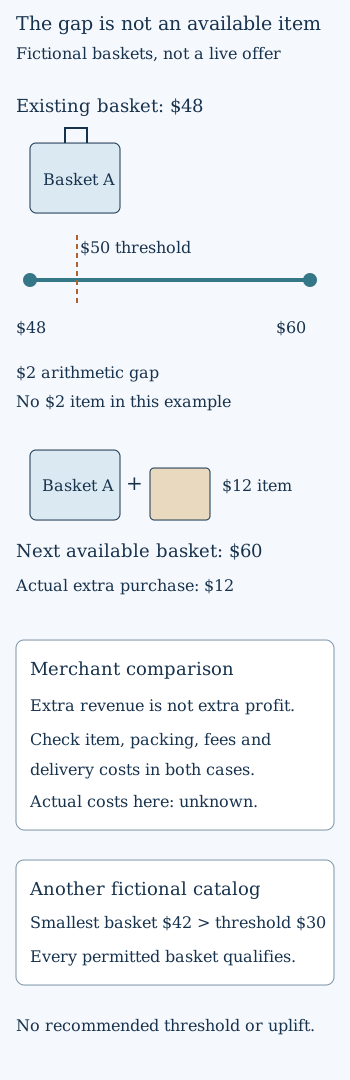
All amounts in this original diagram are fictional. It explains a discrete product choice, not an observed order distribution or a recommended offer.
 Superdirector
Make it work for your brand
Find it. Remake it. Post it. Superdirector turns the viral formats in your niche into your brand's carousels, X posts and video scripts, and keeps the calendar full.
First ask whether the threshold changes any available choice
List the products and combinations that a customer can currently buy, including stock restrictions and applicable discounts. Start with the smallest permitted basket. Do not use a discontinued low-priced accessory to make the offer look easy to reach.
Consider a fictional catalog with one item priced at $42, no cheaper item and no relevant discount in this example. A proposed $30 threshold would qualify every permitted nonempty basket. It would behave like blanket free shipping for those baskets within the offer's other conditions, rather than encouraging someone to add another item.
That does not automatically make the offer wrong. It changes the decision the owner is making. They are choosing to cover delivery for the existing purchase, not creating an extra-item incentive. The expected cost and the public explanation should reflect that choice.
This example deliberately leaves actual costs unknown. It does not recommend either $30 or $42, and it does not establish that blanket shipping coverage is sustainable.
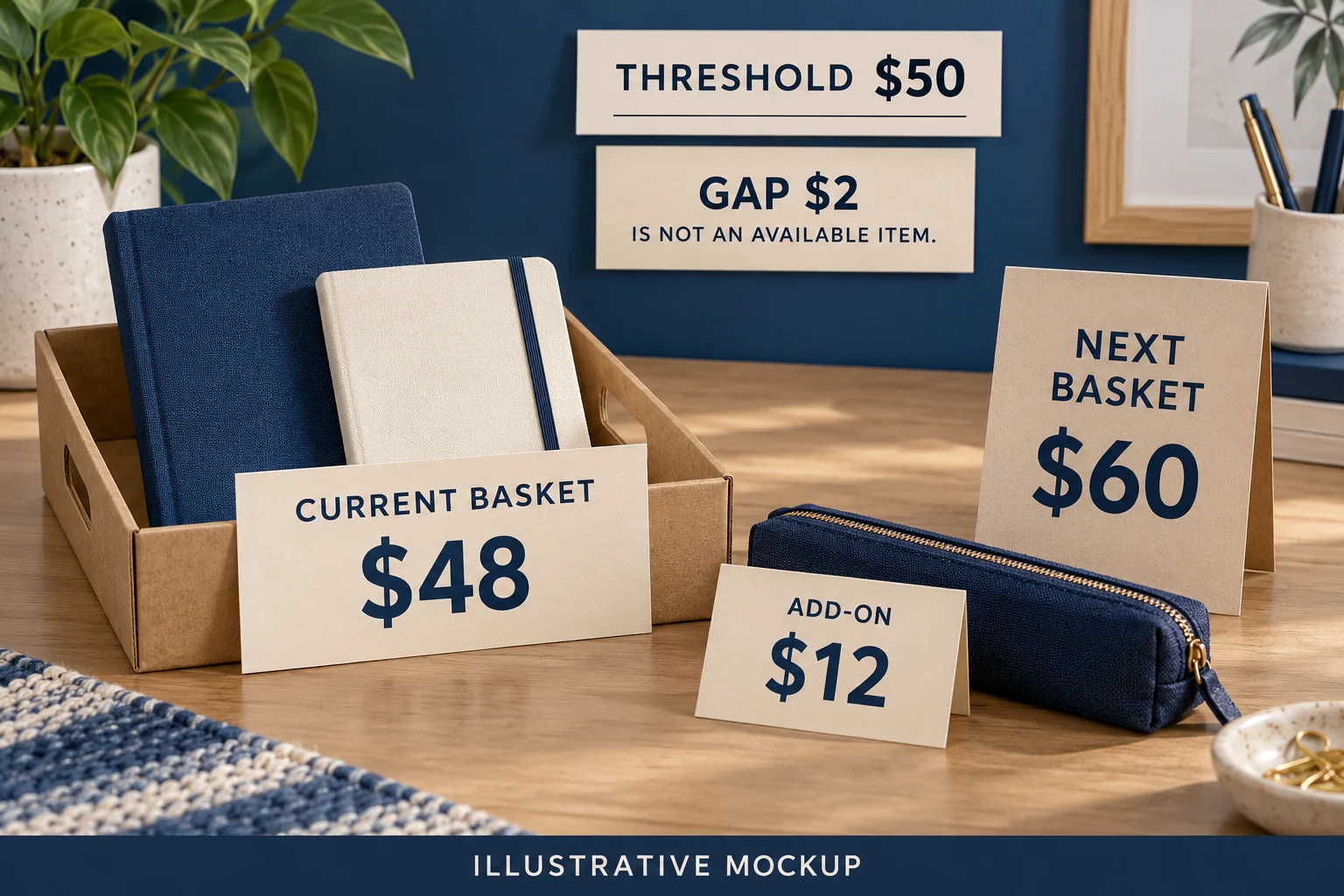
AI-generated illustrative mockup. The example prices are fictional. A $2 arithmetic gap does not make a $2 item available, and added revenue is not the same as contribution after fulfillment costs.
Draw the reachable baskets instead of a smooth spending scale
For a second fictional catalog, a selected basket costs $48 and the proposed threshold is $50. The cheapest relevant available addition costs $12. The next basket is therefore $60, not $50. The additional customer spend is $12 even though the displayed threshold gap is $2.
Write down the actual combinations on either side of each candidate threshold. For each, record the products, eligible price basis, extra item required and whether that addition serves a plausible buyer need. A useful complementary item is different from filler added merely to make a meter turn green.
Do not assume the shopper wants another unit. A replacement part, consumable and decorative add-on serve different purposes. Use actual customer questions or observed basket behavior when available, and mark an untested preference as a hypothesis.
Separate eligibility from the cost of fulfilling the basket
A customer-facing free shipping amount, the amount used to qualify for a promotion and the business's delivery expense are not interchangeable.
Shopify's free-shipping discount guidance says the minimum purchase amount uses product prices, not taxes. Where discounts can combine, discounted product prices count. Consequently, a qualifying-looking list-price basket can have a different eligible amount after an applicable discount. Check the actual configured offer rather than assuming every displayed subtotal has the same meaning.
That documentation concerns free-shipping discounts. Do not silently transfer every rule to a different shipping-rate arrangement. The same article contains differing product-scope wording in some mobile instructions; verify the actual store configuration instead of building an offer around that ambiguity.
For each proposed basket, keep a separate line for what the buyer pays for shipping and what fulfillment costs the business. A zero charge to the customer does not make postage, packaging or handling disappear. Use the actual applicable cost records, not a competitor's advertised delivery fee.
Compare the change in contribution, not just the extra revenue
Return to the fictional $48-to-$60 choice. The $12 difference is additional product revenue under the example's stated price basis. It is not automatically $12 available to pay for delivery.
The extra item has its own cost. It may require different packaging, a heavier parcel or another fulfillment step. The shipping offer can also remove a charge the business would otherwise collect from the buyer. Compare both complete order cases consistently rather than counting only the favorable change.
A compact internal record can show, for each basket: net product revenue, customer shipping charge, product costs, applicable transaction costs, packing and fulfillment expense, and unresolved inputs. Use a consistent treatment of tax, returns and other adjustments. Do not count an expense twice or silently omit it because it is inconvenient.
The result is contribution within that record's defined scope, not total company profit. Shopify's shipping strategy article likewise distinguishes additional gross profit from the shipping cost it may or may not cover. Its examples are not a universal threshold formula for your catalog.
If an input is unknown, the offer's economics remain unknown. If the larger basket contributes less under verified assumptions, more product revenue alone does not repair that case. The owner can consider a different supported offer or retain paid shipping rather than assuming every store must use a threshold.
Check the offer's actual coverage before making it the headline
Specify the destination, service, products and other eligibility conditions. Do not turn a domestic standard-delivery offer into an unrestricted “free shipping” promise across every market and service.
Shopify's current rate documentation describes a gradual migration from shipping profiles and rates to shipping options by market. It also explains that applicable price-based rates can combine across profiles. Identify the store's actual model before copying a setup procedure or assuming a mixed basket has one simple delivery charge.
Use an authorized preview or test arrangement to compare the intended baskets and destination with the actual displayed result. Keep implementation review separate from the commercial decision: a correctly configured threshold can still be an unsuitable offer, while an attractive cost case does not prove that checkout implements it.
Do not activate a discount, change live rates or place an order as a side effect of planning this article's example.
Design a comparison that can remain inconclusive
Write down what the proposed change should accomplish before launch. Is the hypothesis that a relevant addition becomes worthwhile to shoppers, or that including delivery makes the existing offer easier to understand? Those are different hypotheses and should not share an invented success claim.
Record the offer revision, available products, audience or traffic sources, observation period and measurement limitations. If a later test changes the threshold and advertising at the same time, do not attribute every change in order value to shipping. A sequential comparison can be informative without proving causality.
At review, consider completed orders and the contribution evidence within the agreed scope, not just average order value. More expensive baskets do not establish a better result if other relevant outcomes or costs deteriorate. Conversely, too little evidence should produce an inconclusive finding, not an automatic rejection of the offer.
The owner should define the conditions for retaining, revisiting or stopping expansion of a new test. This article does not set a spending allowance, traffic requirement or universal test duration.
Explain the supported offer without manufacturing a bargain
Once the owner selects and authorizes an offer, show the real condition where customers make the decision. An Instagram product explanation or a YouTube buying walkthrough can demonstrate useful product combinations, provided the actual prices, availability and shipping scope remain accurate.
Do not claim “add only $2” when the only relevant addition costs $12. A statement about the arithmetic gap can be true while still leaving the practical choice unexplained. Keep a useful addition's purpose visible rather than presenting unnecessary spending as a guaranteed saving.
The source questions include a new brand comparing blanket coverage with a threshold below its smallest basket and a seller questioning a threshold change made alongside advertising changes. Both are historical individual accounts, not current demand volume or proof of a causal outcome. Recent vendor-heavy discussions were not treated as independent merchant confirmation.
Map one actual below-threshold basket and its next relevant available combination. If that map changes the apparent offer, revise the decision record before producing the campaign headline. Check the real costs and checkout behavior before launch.