How-To Guide
Test an owned-social move toward your independent store without misreading marketplace sales
This guide proposes a bounded learning plan.
A seller can promote an independent store while continuing to receive marketplace orders. That does not automatically mean the promotion failed, that the same shoppers switched destinations, or that the marketplace should be closed. The two stores may be receiving different demand, and their reports do not establish a shared customer journey simply because the totals move in opposite directions.
The useful decision is narrower: where should the next piece of your own, independently originated promotion send its audience, and what would you need to observe before changing that allocation? Keep marketplace-native discovery separate from the audience you can actually reach through your own channels.
This guide proposes a bounded learning plan. It does not report a completed campaign, a measured migration rate or a recommendation to divert an Etsy transaction. Primary references were checked on October 24, 2026.
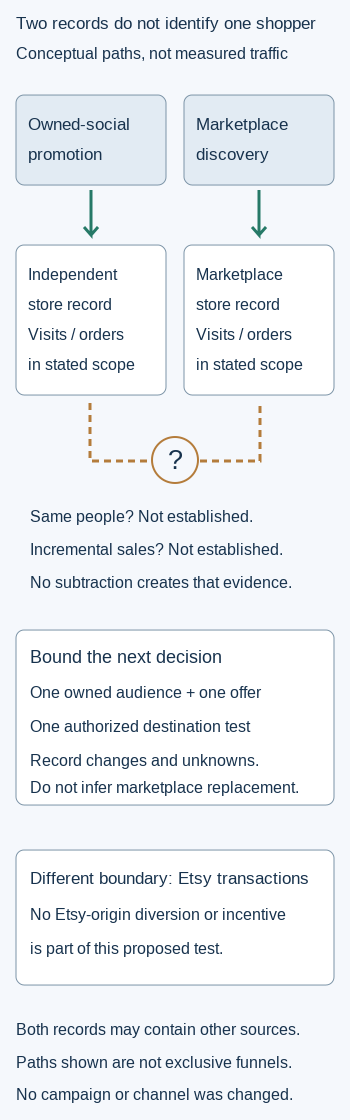
Original evidence-boundary diagram. It does not depict measured traffic, matched people or a completed migration experiment.
 Superdirector
Make it work for your brand
Find it. Remake it. Post it. Superdirector turns the viral formats in your niche into your brand's carousels, X posts and video scripts, and keeps the calendar full.
Define the decision you can actually make
Start with one offer and one owned promotional surface for which you have an appropriate audience. If an Instagram product demonstration is the planned asset, the decision might be whether its next approved version should direct interested viewers to the independent store. It is not yet a decision to remove every marketplace listing or assume every marketplace buyer belongs to your social audience.
Choose the surface from actual audience evidence, not a general platform ranking. The seller discussion that prompted this research describes TikTok; it does not prove the same behavior on Instagram, YouTube or X. A professional tutorial or brand demonstration on those channels needs its own supported route and relevant audience.
Record the business reason for considering the change. It might be a clearer product explanation or a buying option genuinely offered by the independent store. Do not invent a better margin, lower support burden or stronger repeat-purchase result before the corresponding records exist.
Separate three sources of demand
Keep three groups in the working explanation: traffic that the marketplace itself brings, visits associated with your independently originated promotion, and traffic whose origin is uncertain. These are evidence categories, not a claim that every person can be placed neatly into one group.
Etsy’s glossary distinguishes traffic sources and warns that the category and the immediate page shown in its breakdown can differ. Its Social Media category can include organic sharing and offsite advertising; its app category includes several kinds of app activity. Do not rename an entire category “my Instagram campaign.” Etsy Shop Stats glossary
Shopify’s acquisition reports describe visits to its Online Store channel, not a census of people shopping elsewhere. Their visitor information is not the same as order data. Separate marketing reports allocate credit using selected attribution models. Neither report supplies a cross-marketplace identity link merely because you own both storefronts. Shopify acquisition reports · Shopify marketing reports
A buyer’s voluntary comment about where they purchased can be useful context, but a few comments do not classify every order. Do not export or join customer records just to force a complete-looking attribution story. Use only information and processing appropriate to the authorized review.
Write competing explanations before changing the channel
Suppose a fictional maker sees fewer independent-store orders while marketplace orders remain steady. Several explanations remain possible: fewer relevant people reached the independent store, a temporary outage affected the experience, the offer changed, the marketplace found different buyers, or measurement changed. A perceived preference for a familiar checkout is another hypothesis, not an established finding.
For each explanation, write the observation that would support it and one that would weaken it. For example, an observed unavailable product could explain some missed purchase opportunities without proving a broad preference for the marketplace. Healthy page behavior does not, by itself, prove the audience wants the offer.
Use comparable observation windows and annotate disruptions. Shopify documents September 2026 changes affecting session measurement and marketing-report populations. A before-and-after comparison crossing those changes requires care; do not interpret every report movement as a response to your creative.
This is not an invitation to keep checking the same link forever. Fix a verified route or availability problem through its owner, then return to the allocation question. A technically working destination is a prerequisite, not the entire experiment.
Prepare one small destination test
Keep the product, availability and material offer terms as consistent as practical. Choose one specific promotional asset and record its version, audience, placement, publication window and destination. State what will change and what will remain unchanged before reviewing the result.
If the test uses successive organic posts, acknowledge that the audiences and timing may differ. Do not call that a randomized experiment or attribute a sales difference solely to the destination. A controlled allocation, where available and authorized, requires its own design; this article does not claim one has been set up.
Define the immediate learning outcome. Can the intended audience recognize the offer and reach the independent buying option? What product questions arise? What identifiable visits and orders are reported under the recorded settings? Those observations can inform the next test without proving incremental sales or person-level migration.
These reports alone do not justify closing the marketplace. Review its ongoing costs, obligations and useful discovery separately rather than inferring closure from an unresolved owned-channel test. Any consequential channel closure, campaign activation or spending decision needs separate evidence and authorization.
A fictional allocation record that can change the next post
Consider an illustrative maker promoting one wall hanging through an independently originated Instagram demonstration. The two candidate destinations are the exact marketplace listing and the exact independent-store product page, not either storefront’s homepage. No actual maker, prices or results are represented here.
For the independent page, the hypothesis is that a clearer installation explanation helps this audience decide whether the wall hanging fits their situation. Before choosing it, verify that the explanation is genuinely present, the advertised version is available, the actual delivery and return terms are supportable, and the order-level costs fit the owner’s constraints. For the marketplace listing, the competing hypothesis is that the familiar purchase setting reduces unresolved buying questions. Familiarity is not assumed to win, and any difference in price, delivery or included items must be recorded rather than attributed to the destination itself.
The maker’s provisional next-post choice is the independent page only if its promised explanatory benefit and operating constraints check out. At the agreed review, retaining that route requires evidence relevant to the decision: intended visitors can identify the offer, observed questions do not reveal a material missing explanation, and any actual orders remain serviceable within the stated constraints. That is a reason to continue learning, not proof of superiority. Revisit the route if the promised buying option is unavailable, the page creates persistent unresolved questions, or actual support and fulfillment costs violate those constraints. If exposure or orders are insufficient, leave the comparison inconclusive rather than naming the marketplace a winner.
The actionable record ends with the owner’s next approved destination and its reason. It does not end with an attribution chart or a claim that a particular shopper changed stores. Keep a separate decision for whether maintaining both venues remains worthwhile.

AI-generated illustrative mockup. This fictional owned-social test compares destinations without claiming sales results. It does not authorize diverting marketplace-origin transactions or establish why buyers chose a channel.
Keep Etsy-origin transactions outside the experiment
The scope here is independently originated promotion on your own authorized channels. It is not an instruction to move an Etsy-initiated transaction to another checkout.
Etsy’s current off-platform policy addresses directions to buy elsewhere, transaction-related contact sharing, off-platform incentives and QR-code redirection. Do not copy forum suggestions to move Etsy members toward a cheaper outside purchase or use a package insert as an assumed exception. Review the applicable policy for the real situation rather than treating an acquisition experiment as permission. Etsy off-platform transactions policy
No messages, links, offers or storefront settings were changed for this guide.
Decide what the evidence supports next
At review time, keep each storefront’s results in its own record with the source, period, definitions and attribution settings attached. Do not subtract one store’s order decline from the other store’s increase and label the difference “customers moved.” Do not sum credit from multiple attribution models into a count of unique purchases.
The next decision can be modest: retain the current mix, repair a specific verified problem, or run a better-scoped owned-channel test. If the available evidence cannot distinguish the competing explanations, say so. Uncertainty is a reason to improve the next observation, not to invent a winner.
Two posts by the same seller discuss venue choice and later sales changes. A separate seller asks about operating both stores. These self-reports are not independently verified customer journeys and cannot establish that shoppers moved between stores.
The practical outcome is a defensible next allocation decision that preserves what you do not yet know. Prepared creative, an authorized test, observed visits, paid orders and an accepted channel change remain separate stages.