How-To Guide
Test a feasible boutique assortment before moving your whole catalog into wholesale
That changes the starting question.
A retailer is a different buyer from a direct customer who wants more pieces. The retailer needs a coherent assortment it can display, sell and replenish under workable terms. The maker needs a first order that can be produced, packed and supplied, because hoped-for reorders will not repair an unsuitable first transaction.
That changes the starting question. Skip the search for a normal wholesale discount and ask whether one proposed assortment fits both the retailer's buying job and your operating constraints. A broad catalog can hold good wholesale candidates next to one-off work that should stay out of the proposal.
This guide offers an original feasibility exercise. Faire documentation was checked on October 24, 2026, but no account, order, fee schedule applicable to a real merchant or retailer agreement was verified. All quantities in the teaching diagram are fictional, not recommended minimums.
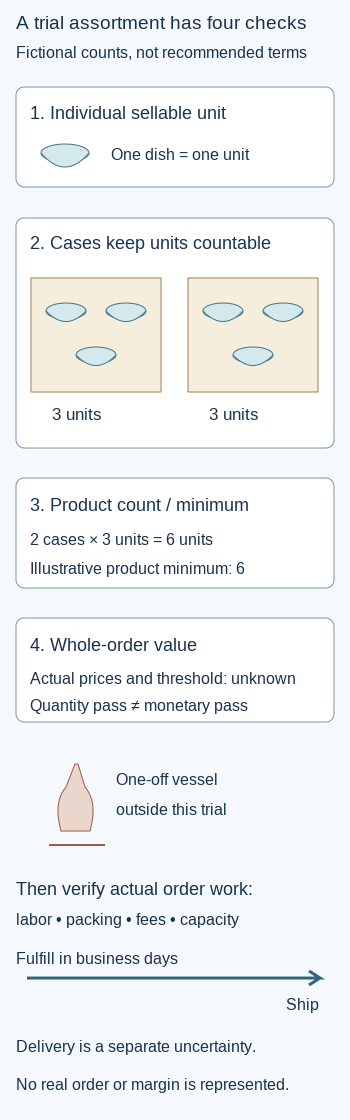
The monetary check remains blank because no actual wholesale prices were supplied. Six units meeting a product-count rule does not prove that the whole order reaches its value minimum, earns an acceptable contribution or can be fulfilled.
 Superdirector
Make it work for your brand
Find it. Remake it. Post it. Superdirector turns the viral formats in your niche into your brand's carousels, X posts and video scripts, and keeps the calendar full.
Choose the retailer's trial, not your entire range
Take a fictional ceramics maker with repeatable small dishes and individually made large vessels. A boutique could reasonably evaluate a small, coherent dish assortment without the large vessels. That is a planning hypothesis, and it is no evidence that a particular shop wants the dishes.
Write the proposed retailer use: a counter display, a coordinated shelf collection or another specific setting. Then list only products that could support it. Identify the exact sellable unit, production method, replenishment limitation and packaging work for each. Exclude pieces whose variability or production commitment makes the proposed promise unreliable.
Do not pick a number of designs because a forum calls it the ideal catalog size. Ask whether this assortment is understandable and serviceable. Retailer interest needs its own evidence, and any contact is a separate authorized action.
Draw four constraints before discussing the opening order
A unit, a case, a product minimum and a whole-order monetary minimum answer different questions.
- The sellable unit is what one item represents in the order record.
- A case groups individual items for the applicable selling configuration.
- A product minimum sets how many of a particular product must be ordered.
- The brand's order-value minimum applies to the monetary total of the order.
Faire's order-minimum guide describes a brand-set monetary threshold and allows different first-order and reorder minimums. Its minimum-quantity guide distinguishes optional per-product quantities from cases. The documented quantity minimum cannot be smaller than the case size, and it is not configured per product option in that workflow.
Do not invent a supported mixed-case or variant rule from this summary. Verify the actual product configuration before promising an assortment. Lowering an order-value threshold would not, by itself, remove a product-level quantity constraint.
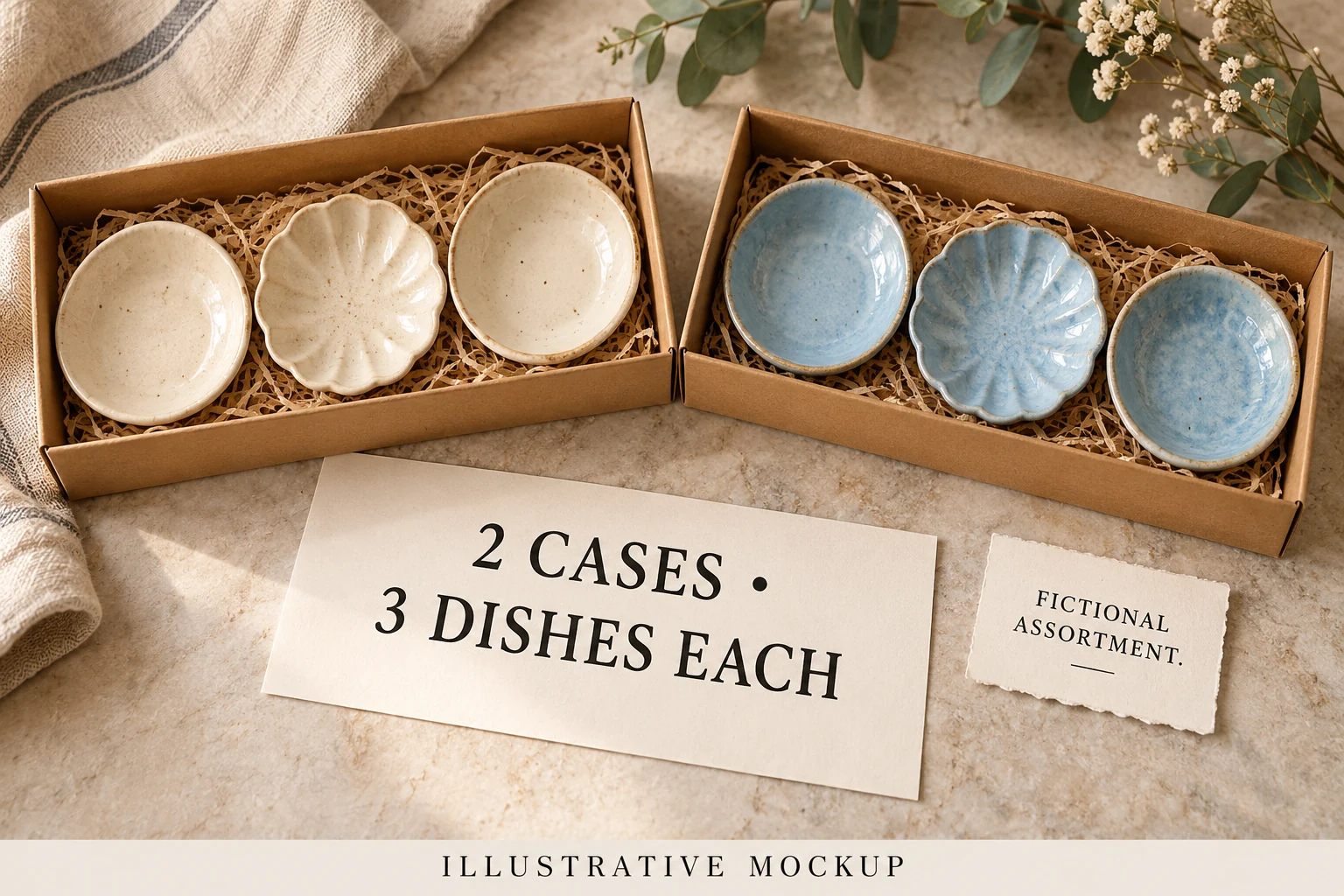
AI-generated illustrative mockup. The quantities and arrangement are teaching examples, not recommended minimums, a verified Faire configuration or a completed wholesale order. Production and first-order feasibility remain to be checked.
A fictional packing mat makes the distinction visible
Consider a purely illustrative trial with two cases of one dish design. Each drawn case contains three individually counted dishes, so the proposed product count is six. The diagram uses a hypothetical product minimum of six to make the comparison visible. It does not claim these settings exist in an account or suit the maker's business.
A separate stationery product could have a different selling configuration. Do not combine unlike products into a single unnamed “starter bundle” and assume the platform accepts it. Faire's quantity guide expressly distinguishes cases of individually accounted items from items packaged and billed as one bundle. Check current rules for the intended listing, because a presentation sketch is not permission.
Evaluate the whole first order from actual records
For the exact proposed mix, gather material cost, production labor, finishing, rejects or other relevant production allowances, packaging, handling and fulfillment work. Add the applicable platform, payment and other fees using current sources for the real merchant's region and arrangement. Record taxes and shipping on the same basis as the rest of the worksheet, so that inclusive revenue is not set against exclusive costs.
Keep the worksheet empty where the evidence is missing. An unknown fee or labor allowance is a reason to investigate, not a zero. Do not deduct the same packaging or labor amount twice just because it appears in both a unit-cost sheet and an order-level sheet.
Faire's EU and UK pricing guidance is written for those regions, and its pricing policy has regional and currency scope. Do not transplant a dollar fee quoted in a community reply into a UK calculation, assume a universal wholesale margin or raise a marketplace price without checking the applicable terms.
The first-order decision should hold without an invented reorder forecast. Future retailer relationships may be valuable, but they are not completed transactions. If the first batch uses more cash, labor or production capacity than the owner accepts, label that as a constraint and do not present it as a customer-acquisition success.
Check whether the assortment can fit the production queue
Map the proposed order against available production and packing capacity, existing commitments and the owner's reserve. A small product can still require substantial handling when every unit needs inspection and protective packing. A product's attractive unit cost is not enough if its order mix creates a bottleneck.
Separate three timing statements: normal fulfillment lead time, an expected ship date for a particular order and delivery after shipment. Faire's lead-time documentation defines lead time in business days and distinguishes it from a selected expected ship date. Transit time is not part of a production estimate.
Use the maker's observed process and current queue before promising a timeline. If those records are unavailable, the offer can remain a private proposal. Do not assign a date merely to make a line sheet look finished.
Choose among a smaller trial, a revised configuration or deferral
Return to the retailer's buying job after the arithmetic. A stationery maker may discover that a proposed case rule forces too many units of one design into the intended trial. Reducing the monetary minimum would not fix that mismatch. The maker could investigate a different permitted configuration, a different product selection or a different intended retailer use, then recalculate the actual first-order work.
The ceramics maker above may instead find that the selected dishes are repeatable but the limited vessel is not. Leaving out the vessel can make the proposal clearer without implying that it is an inferior product. It may simply serve a different buyer and production model.
The possible outcomes are concrete: a feasible proposal for owner review, a named revision to investigate, or a decision to defer wholesale for this assortment. None proves retailer demand. Do not proceed to onboarding, price changes, minimum changes or outreach merely because a worksheet is complete.
Give the retailer a truthful explanation only after feasibility
A proposed line sheet should make the actual unit, case and minimum rules legible, identify the offered designs and explain supported fulfillment expectations. A short demonstration can show the real product assortment and how individual items are packed, without presenting staging props as included stock. Do not show a fictional packed order as a completed retailer shipment.
Have an internal reviewer describe what they would receive and what constraints remain. If they confuse a case with the entire opening order, revise the explanation before seeking any approved retailer feedback.
The research starts from a maker's ceramics-and-art-goods feasibility question and a separate brand's question about a broad wholesale catalog with little traction. These are historical self-reports, not measured current demand. Commenters' commission arithmetic, seasonal theories and revenue stories were not adopted as benchmarks.
The next small action is to sketch one real proposed assortment and leave every unsupported cost or timing field visibly unresolved. The useful result is an offer you can explain and fulfill, or an early decision not to commit to one you cannot.