How-To Guide
Show assembly time as one observed build, not a promise for every buyer
A ten-second montage can make a demanding setup look effortless.
A ten-second montage can make a demanding setup look effortless. That is not inherently misleading if viewers can distinguish the edited video from the time needed to do the task. The problem begins when a creator's speed, a seller's estimate or a clipped sequence becomes an unsupported universal promise.
For a DIY party kit, the useful evidence is one clearly defined build with its conditions recorded. Show what was assembled, who did it, which tools were used and what the clock included. Then label the result as a sample rather than claiming every buyer will match it.
No assembly test was performed for this article. The examples below describe a proposed measurement and production method. References were inspected on October 24, 2026.
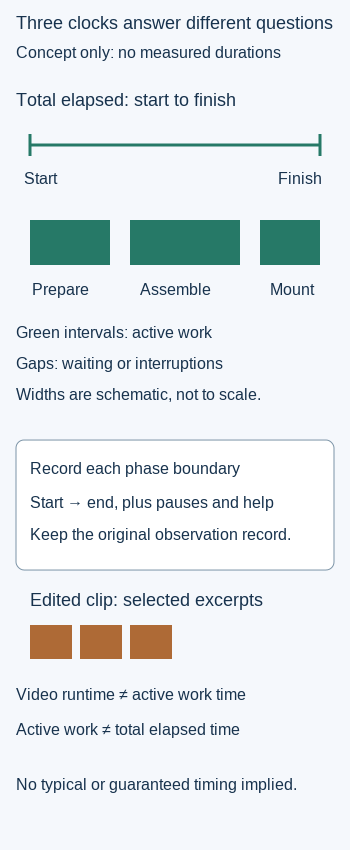
The visual deliberately contains no invented timing result. It shows the information to collect, not a completed test or a universal benchmark.
 Superdirector
Make it work for your brand
Find it. Remake it. Post it. Superdirector turns the viral formats in your niche into your brand's carousels, X posts and video scripts, and keeps the calendar full.
Start with the product configuration
Write down the exact kit version and selected size before planning the timing shot. Record the number of assemblers, their experience, the pump or other tools and whether any parts were prepared earlier.
For a balloon garland, inflating, tying, arranging and mounting are distinct activities. A measurement that starts with pre-inflated balloons cannot represent the entire process from opening the package. Neither can an expert's repeated demonstration automatically represent a first-time buyer.
The same reasoning applies beyond party kits. A furniture assembly clip, craft tutorial or display setup should identify its starting state. Otherwise, an impressive duration may answer a different question from the one the customer is asking.
Treat existing estimates as context, not borrowed results
ThePartyCollectiveCo's balloon-garland listing includes a size graphic with different estimated times for different lengths. OhhHowCharming's listing also varies its assembly estimate by garland length and offers an optional pump.
These are seller-provided estimates for their respective products, not controlled benchmarks. Their differences are a reason to state conditions, not an invitation to copy the fastest number into another kit's launch.
The retrieved listings include cached commerce details. This article makes no claim about current stock, prices, delivery dates or purchasing availability. It uses the descriptive structure of the references, not their commercial promises.
Define the clock before starting it
Create a simple timing sheet with a beginning and end for each phase. For example: unpack and read instructions; prepare materials; assemble; mount or position; finish and tidy. Adapt the phases to the actual product instructions and the question being measured.
Decide whether interruptions, waiting and cleanup are included. If you report active work separately from total elapsed time, retain both and label them. Do not silently remove a confusing step or a failed attempt because it makes the result less attractive.
Keep the raw timing record. That might be an uncut video, a timestamped observation sheet or both. The promotional edit is a derived asset, not the measurement itself. Preserve enough context that a reviewer can understand how the displayed number was obtained.
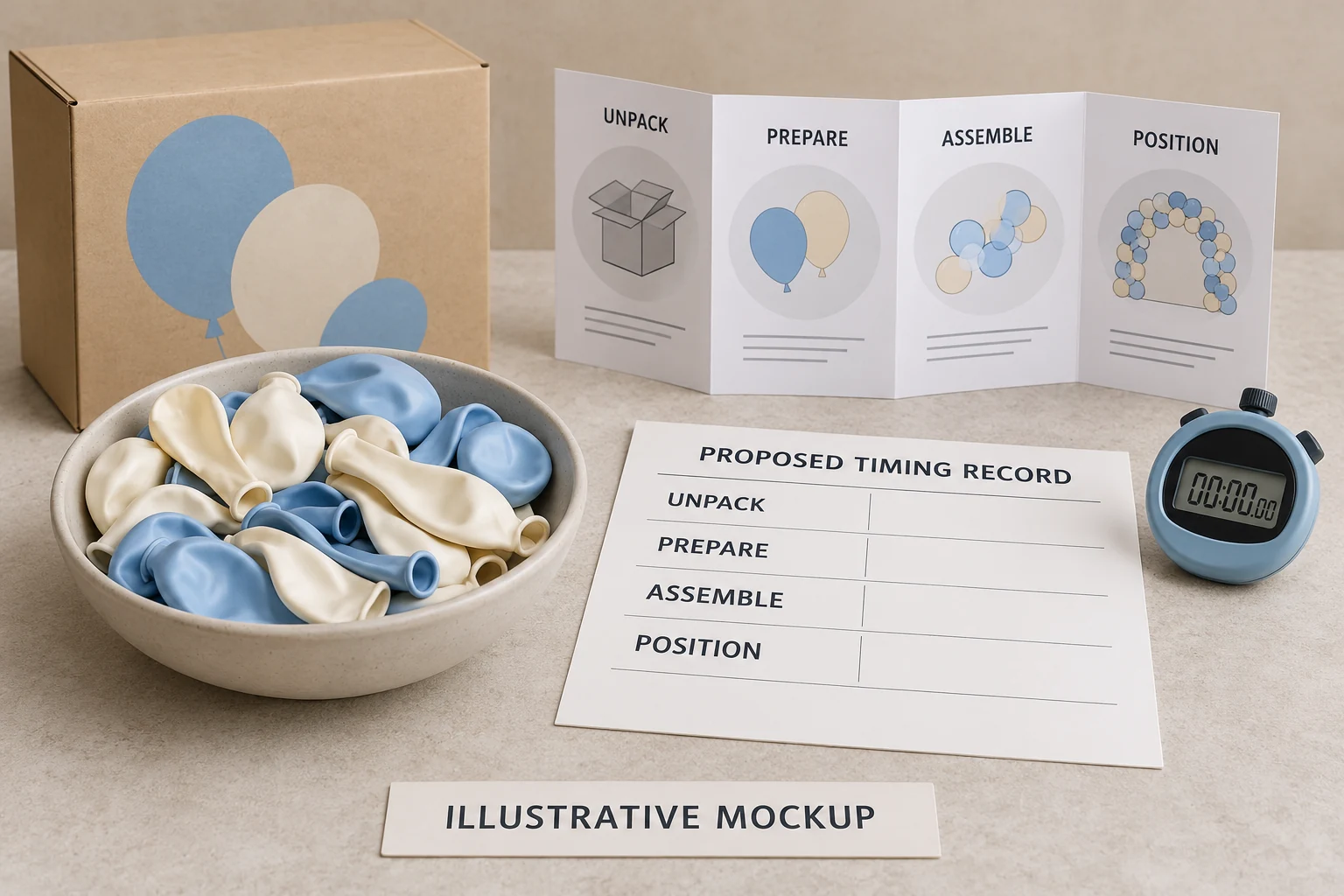
AI-generated illustrative mockup. No build was timed. The scene shows how to define preparation and assembly phases before recording one observed build, rather than promising a universal completion time.
Run a safe, ordinary demonstration
Use the manufacturer's instructions and an appropriate workspace. Do not add unapproved chemicals, unusual shortcuts or unsafe mounting methods just to reduce the duration or improve appearance. A faster demonstration that cannot reasonably be repeated under the intended conditions is not useful buyer evidence.
For an illustrative first-time assembly, the recorder should note when help is requested and what help is provided. If another person ties balloons off camera, record that contribution. Do not present a two-person process as a solo result.
This is a proposed protocol, not a claim that a particular person has completed it. Until an actual observation exists, leave the timing fields empty rather than filling them with plausible sample minutes.
Label the result beside the number
A completed observation should identify the product size, assembler context, tools, helper count and scope of the clock. The label should travel with the number when the asset is cropped or reused.
Instead of a broad “ready in minutes” claim, the internal draft can reserve space for a statement such as one observed build under the recorded conditions. Replace that placeholder only with a real result. Do not call it a typical duration without evidence that supports a broader characterization.
Make the edit honest about compression
A montage can be useful for showing the overall sequence. Label speed changes or compression where needed and keep the measured duration on a separate evidence card. The length of the video is not the length of the task.
Do not use a continuous-looking clock over footage that skips work. If the clock is an illustrative design element rather than a record, avoid styling it as proof. A viewer should not need access to the editing project to understand what was measured.
For a longer YouTube demonstration, show transitions between phases and explain why a particular tool was used. For an Instagram cutdown, retain the setup conditions with the result instead of preserving only the fastest-looking shots.
Ask what the buyer still needs to plan
Timing is only part of preparation. The second reference listing includes a dated buyer review about instructions and transporting inflated balloons. That individual observation does not establish typical setup time, but it highlights a related planning question: where will assembly happen and what must be moved afterward?
A useful review asks whether the asset makes the start state, tools, help and remaining steps clear. If viewers assume mounting is included when the clock stopped at arranging, revise the scope label or measure the broader task.
No conversion improvement is implied by clearer explanation. The immediate acceptance test is whether the claim matches the recorded observation.
Keep sample evidence narrow
A second novice build can reveal whether the first observation was unusual, but two observations still require careful description. Report the conditions and differences rather than automatically promoting a small sample into a universal claim.
Measure one real configuration and let the observed result determine the wording. Keep the start state, tools, help and timing scope attached to that result.