How-To Guide
Show an optional rewarded-ad offer without hiding the choice
A reward animation is not enough to demonstrate an optional ad.
A reward animation is not enough to demonstrate an optional ad. A useful launch clip shows what the player is offered, how they decline, what happens when an ad is unavailable, and whether the promised item actually reaches the game state.
For a small mobile-game team, the immediate task is not proving that rewarded ads improve revenue. It is making one offer understandable and checking that the recorded build supports the promise in the creative.
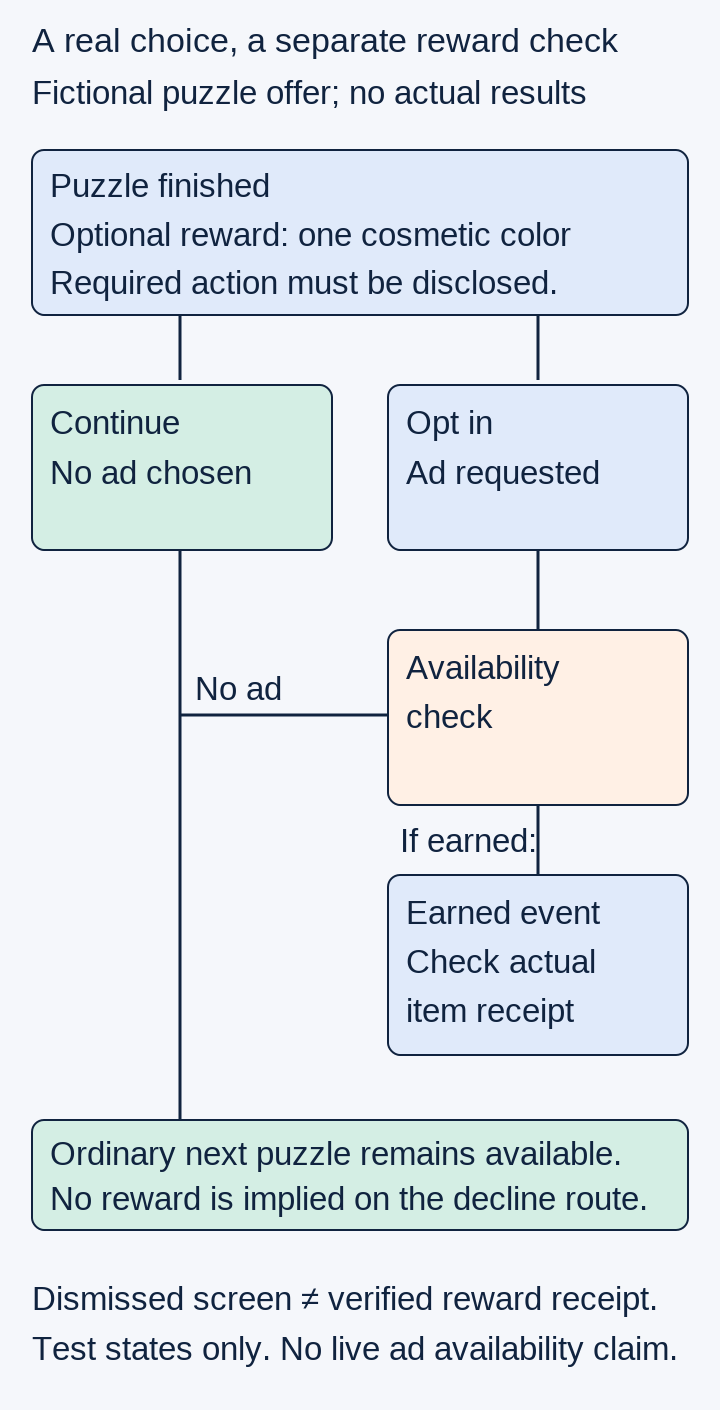
Original conceptual diagram. It is not a working ad implementation, a real game screenshot or evidence that any reward was granted.
 Superdirector
Have your AI do this for your brand.
7 days free, then $29 a month.
Begin with the route that does not watch
Suppose a fictional puzzle game offers a cosmetic tile color after a voluntary ad. Write the ordinary next action first: continue to the next puzzle without claiming that color. Then write the optional action and its exact reward. Keep the item, eligibility and required action specific enough to inspect in the build.
Record a take where the player chooses ordinary continuation. Does the next puzzle start? Does an unavailable offer block that route? Do the labels still make sense on a narrow phone screen? These are test questions, not results implied by drawing a button.
A second take can demonstrate the optional route. Do not splice the two recordings so that the cosmetic appears to be granted after a decline. If the clip is shortened, preserve the distinction between the user's choice and the later reward receipt.
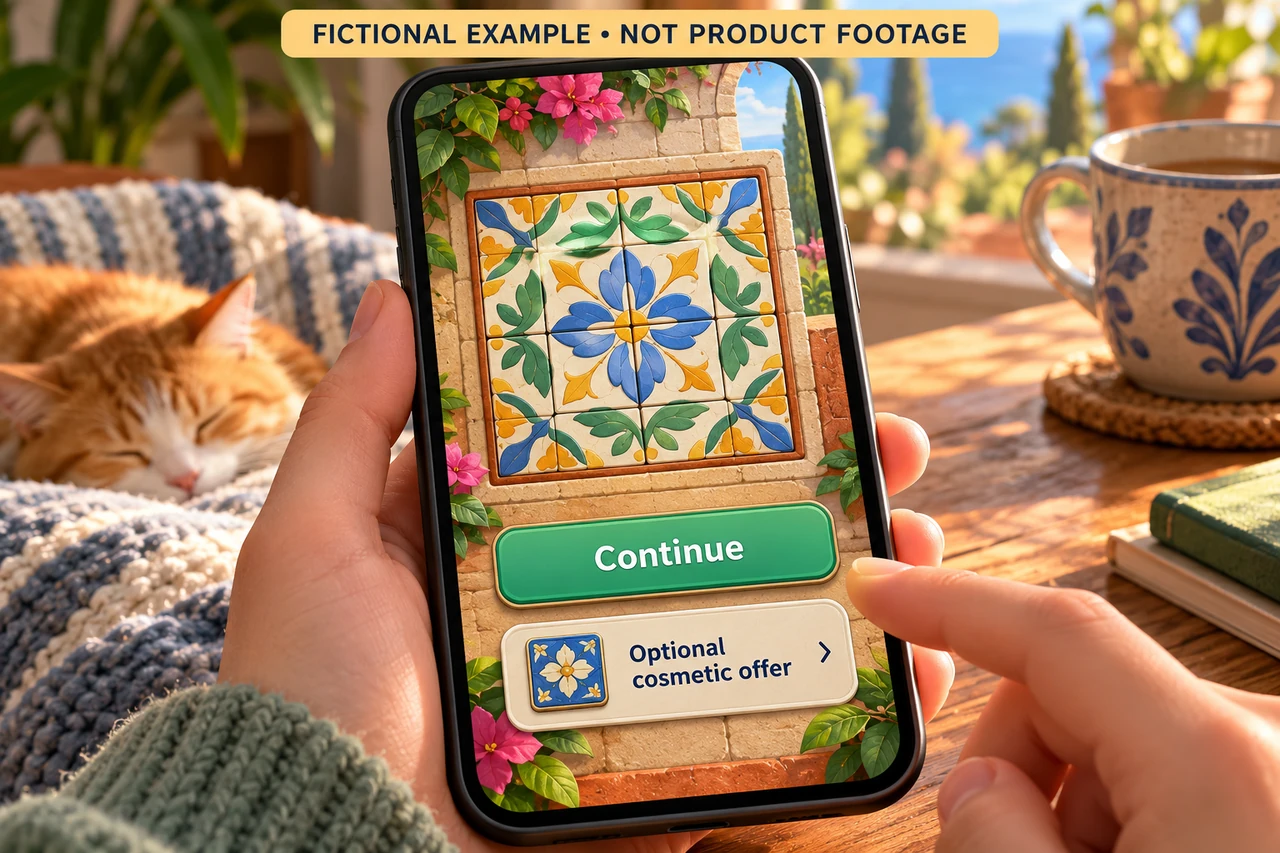
The fictional puzzle leaves ordinary continuation visible beside an optional cosmetic offer. Ad availability and reward receipt are not demonstrated. Original AI-generated editorial illustration.
Use the policy to challenge the wording
Google's policy for Google-served rewarded ads requires clear disclosure of the required action and offered reward. Ordinary rewarded ads require affirmative opt-in; rewarded interstitials have separate introductory-screen requirements. Declining or skipping must not impede normal use. The policy also prohibits choice-framing such as asking viewers to support the business, and places responsibility for delivering earned rewards on the publisher. This is a summary of that specific policy, not certification of every network, app-store requirement or legal obligation. Google AdMob rewarded-ad policy
Use plain offer wording rather than guilt, urgency or a suggestion that the player owes the developer attention. The hypothetical cosmetic example here is not a recommendation to add ads to a game that does not need them. It is a way to examine a proposed feature without making its commercial success a foregone conclusion.
Keep operator opinions separate from product proof
A developer discussion asks whether voluntary rewards make ads acceptable to players. A separate developer describes a replayable game with optional cosmetics and says play can continue without watching. These are genuine operator questions, but the replies disagree. They do not establish your audience's preference, a revenue benchmark or an acceptable interruption frequency. The first author's cross-post is one evidence cluster, not a second independent signal. Optional-ad discussion · Cosmetic-offer discussion
The second discussion's support-the-developer framing is especially useful as a counterexample to check against current Google policy. Do not turn a question from an operator into approved offer copy.
Separate the events in the evidence
Google's iOS integration guide distinguishes loading, presentation, reward handling and dismissal. It requires test ads during development and testing. For Google ads, the reward handler precedes the dismissal callback; mediated networks can determine ordering differently. A dismissed presentation is therefore not a universal reward-receipt signal. The sample still leaves the application responsible for awarding the item. Google's iOS rewarded-ad guide
For an editorial review, ask engineering for a small evidence record rather than prescribing a new SDK implementation:
- Offer displayed: exact wording and reward identity.
- Choice made: accepted or declined.
- Presentation state: available, shown, failed or unavailable, using the actual integration's terminology.
- Earned event: whether the integration reported it, and when.
- Application result: whether the correct item was recorded and visible to the player.
- Return path: what the player could do next.
Do not force every integration into one invented event order. Preserve what happened and identify any gap between the earning signal and the game's own record. An attractive animation can play even when the underlying award is wrong; a quiet inventory change can be correct even when its feedback is unclear. Both deserve inspection.
Capture the awkward case before the polished one
In a fictional test build, the optional button is present but no ad is available. Record the actual state and whether the player can continue normally. If the interface keeps promising an immediate reward, the issue is the mismatch between offer and availability, not the lack of a dramatic transition for the trailer.
Next, record the supported earning route with the appropriate test setup. Keep the evidence linking the displayed offer to the resulting item. Label test footage wherever viewers could otherwise mistake it for live availability. Do not interact with production ads merely to obtain a demonstration.
Finally, inspect dismissal without assuming it means success. If the observed result is ambiguous, keep the capture out of the reward-proof section until the owner can explain it. Do not fill the gap with a manually granted item and leave the audience to infer that the real route worked.
Review the final edit as a promise
Give a reviewer the proposed clip and offer copy before showing the implementation notes. Ask them to describe what they think is optional, what they expect to receive, and what happens if they decline. Compare their interpretation with the tested route, not with what the editor intended.
Check three boundaries:
- Choice: the ordinary route remains visible and understandable.
- Evidence: the clip does not equate closing a screen with earning an item.
- Availability: the edit does not imply that every request immediately produces an ad.
These are proposed review criteria. They are not completed user-research findings. If the reviewer misunderstands the offer, revise the wording or sequence and repeat the interpretation check with the revised version.
Record completion without inventing business results
A useful completion record identifies the build, device, test configuration, offer revision and captured cases. It links any unresolved award discrepancy to an owner and next test. The final creative should correspond to that exact inspected revision.
Keep generated footage, reviewed creative, approved publication and live behavior separate. Later retention or revenue analysis needs actual data and its own design; a clear offer demonstration does not establish either outcome.
Evidence and limits
Operator accounts are self-reports, not a representative survey. Privacy, age-related requirements and platform-specific implementation need separate review; the diagram does not establish compliance.
Frequently asked questions
Can shortened rewarded-ad footage make the reward appear to follow a decline?
SuperdirectorHave your AI do this for your brand.
7 days free, then $29 a month.