How-To Guide
Show a working prototype without making it look like a finished production product
A polished product story can accidentally combine three different things: an attractive enclosure, a working mechanism and a plan to manufacture the result.
A polished product story can accidentally combine three different things: an attractive enclosure, a working mechanism and a plan to manufacture the result. Backers need to know which of those exists now. A beautiful shot of one prototype cannot silently supply evidence for a different prototype's function or for a production process that has not been established.
For a physical-product founder, start the launch story with a versioned demonstration. Identify the exact sample, show the baseline action it can perform and keep unfinished work visible. This is a proposed creative workflow, not a prototype test, platform approval or funding forecast. Sources were checked on October 24, 2026.
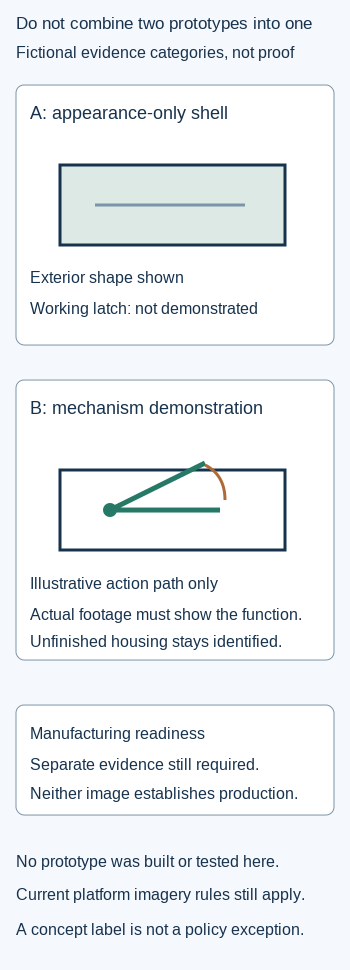
The schematic explains evidence categories. It is not a product rendering for a campaign, a photograph of a prototype or proof of functionality.
 Superdirector
Make it work for your brand
Find it. Remake it. Post it. Superdirector turns the viral formats in your niche into your brand's carousels, X posts and video scripts, and keeps the calendar full.
Apply the current platform rule before planning the visuals
Kickstarter's current hardware and product-design guidance, dated August 6, 2026, requires working prototypes in those categories and prohibits photorealistic renderings. It also asks creators to explain how they will produce the product and their relevant production experience.
Do not treat a “concept” label as permission to use imagery that the current rule prohibits. A disclosure may clarify what an asset means, but it does not override the platform's content restrictions. Check the actual category and current requirements before choosing campaign assets.
This article does not decide whether a particular project qualifies or should launch. That requires the real product, current platform workflow and responsible owner's review. Do not spend on a full creative package merely because a speculative visual looks persuasive.
Separate appearance, operation and manufacturing readiness
Create a record for each physical prototype. Give it a version identifier, capture date, demonstrated functions and known limitations. Record which appearance features belong to that exact sample rather than the intended future version.
Consider a fictional compact desk accessory with a folding latch. Prototype A has the intended exterior shape but no working latch. Prototype B has a working latch in an unfinished housing. Neither should be presented as if it combines A's finish with B's function unless a real sample actually does so.
Keep manufacturing readiness in a separate record. A successful latch demonstration does not establish tooling, repeatable production, quality control or delivery readiness. Conversely, an unfinished surface does not by itself show that the mechanism fails. These are different questions with different evidence.
This example is invented to explain the distinction. No sample was built, operated or assessed for this article.
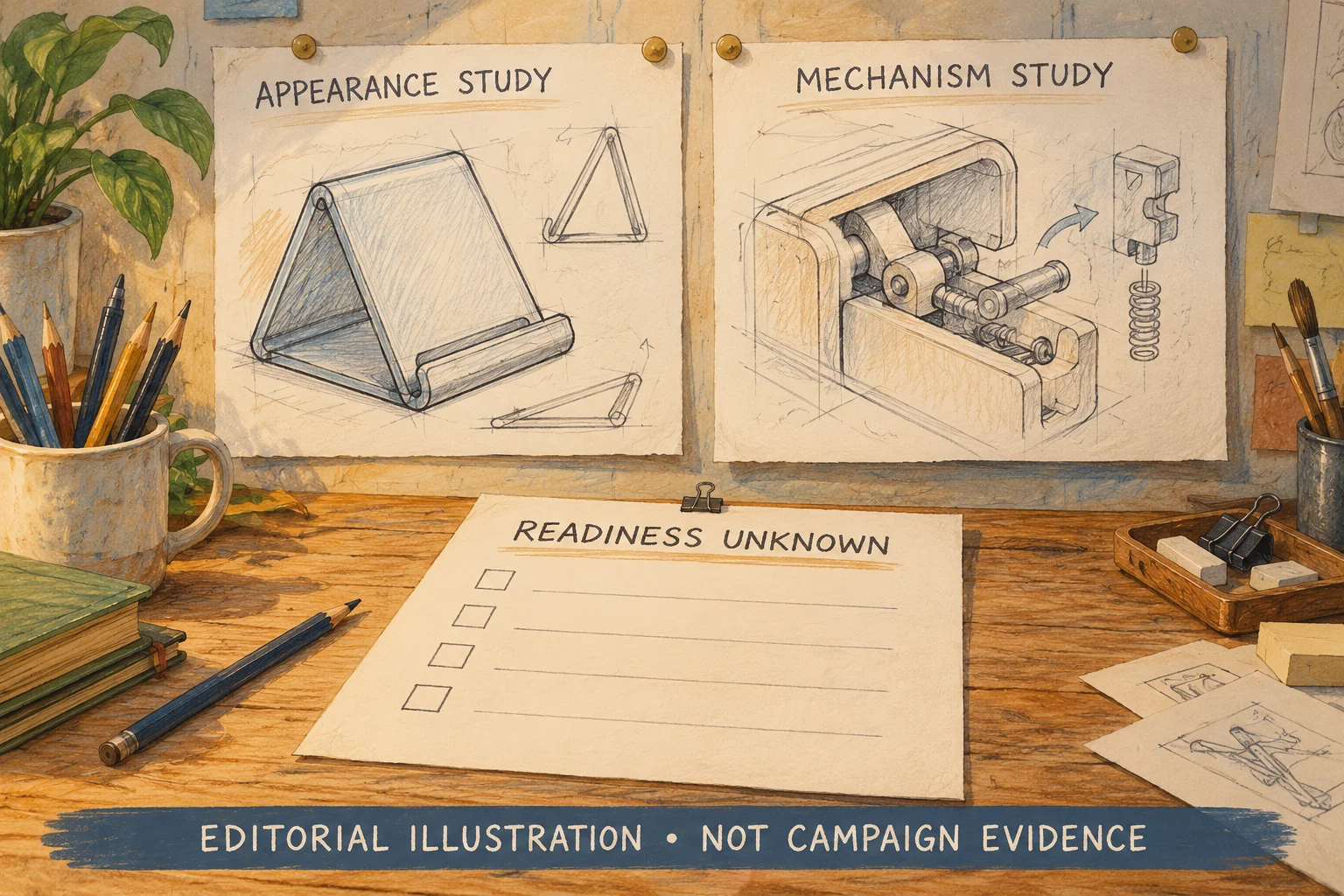
AI-generated illustrative mockup. This is nonphotorealistic editorial illustration, not a prototype photo, demonstration or campaign asset. A concept label does not override a platform’s prohibition on photorealistic product renderings.
Choose a baseline function the viewer can inspect
Write one plain description of the action the product is supposed to perform. Then identify the beginning, action and end state that would let a viewer see it. Avoid a slogan such as “works seamlessly” when the actual question is whether one component moves and remains in the demonstrated position.
Kickstarter's archived 2016 prototype guide recommends showing baseline functionality and, for hardware-software interactions, a seamless demonstration. It also advises distinguishing prototype versions. The article is useful production context, but its older wording about some renderings must not be used to bypass the current prohibition.
For the fictional latch, a proposed shot would begin with the exact prototype in its starting position, show the real operating action and end with the resulting state visible. Any assistance, off-camera preparation or limitation relevant to interpreting the action belongs in the record. Do not remove a necessary manual step to suggest automation that is not present.
Make the version label travel with the footage
Place the prototype identifier near the relevant demonstration and keep it in derivative edits. If an Instagram cutdown removes the opening card, the remaining clip still needs enough context to prevent a viewer mistaking it for a production unit.
When a later prototype replaces an earlier one, preserve the earlier footage as history rather than quietly changing its label. A new enclosure can require a new demonstration if the integration changed. Do not assume that a mechanism working on a bench proves it works in the final assembly.
A short YouTube chapter can compare the versions honestly: what changed, what was demonstrated and what remains untested. The comparison should reveal development, not use old and new shots to manufacture the appearance of a completed product.
Use context shots without promoting them into proof
A lifestyle photograph can help people understand where a product might fit into a routine. It cannot establish that an unseen mechanism works or that the depicted experience is reproducible. Give context footage its own job and keep the functional demonstration separately identifiable.
The historical reference illustrates products in everyday settings. That helps explain purpose, but an attractive room does not answer the engineering question. Similarly, a person holding a sample is not automatically an independent product review.
If a creator later receives an actual prototype, brief them on its exact version and limitations. Do not ask them to describe use they have not experienced. Any external arrangement, shipment or outreach requires its own applicable authorization; none was undertaken here.
Review the inference, not only the caption
Ask an internal reviewer what they believe exists after watching the draft. Do they think the surface finish and working mechanism belong to the same unit? Do they infer that manufacturing has started? Can they identify what remains planned?
Compare those answers with the prototype records. If the viewer infers more than the evidence supports, change the sequence, labels or imagery. Adding a remote disclaimer while retaining a misleading main demonstration is not a sound correction.
Keep this review separate from market validation. Understanding the current prototype does not prove that people will pay, that a campaign will fund or that manufacturing will succeed. Those outcomes need their own evidence.
Finish with a precise next development step
Founder discussions about prototype-versus-production timing and prelaunch creative illustrate the uncertainty. They do not establish a universal launch threshold; use the current platform rules and evidence from the actual prototype.
Select one real sample and produce a version-bound baseline demonstration. Check the current project requirements and identify the most important claim the sample still cannot support.