How-To Guide
Should your indie game support mods? Start with what a player wants to create
A player who wants to arrange a new puzzle and a player who wants to invent a new enemy rule are asking for different products.
A player who wants to arrange a new puzzle and a player who wants to invent a new enemy rule are asking for different products. A layout editor might serve the first person beautifully while leaving the second unable to begin. Calling both requests “mod support” hides the decision a small team actually needs to make.
Before promising a modding feature, name one creation task, identify the controls it requires, and decide what ongoing work you can support. Then investigate that bounded proposal with intended creators. Workshop presence, enthusiastic comments and editable values are not evidence that this particular creation task will work or attract buyers.
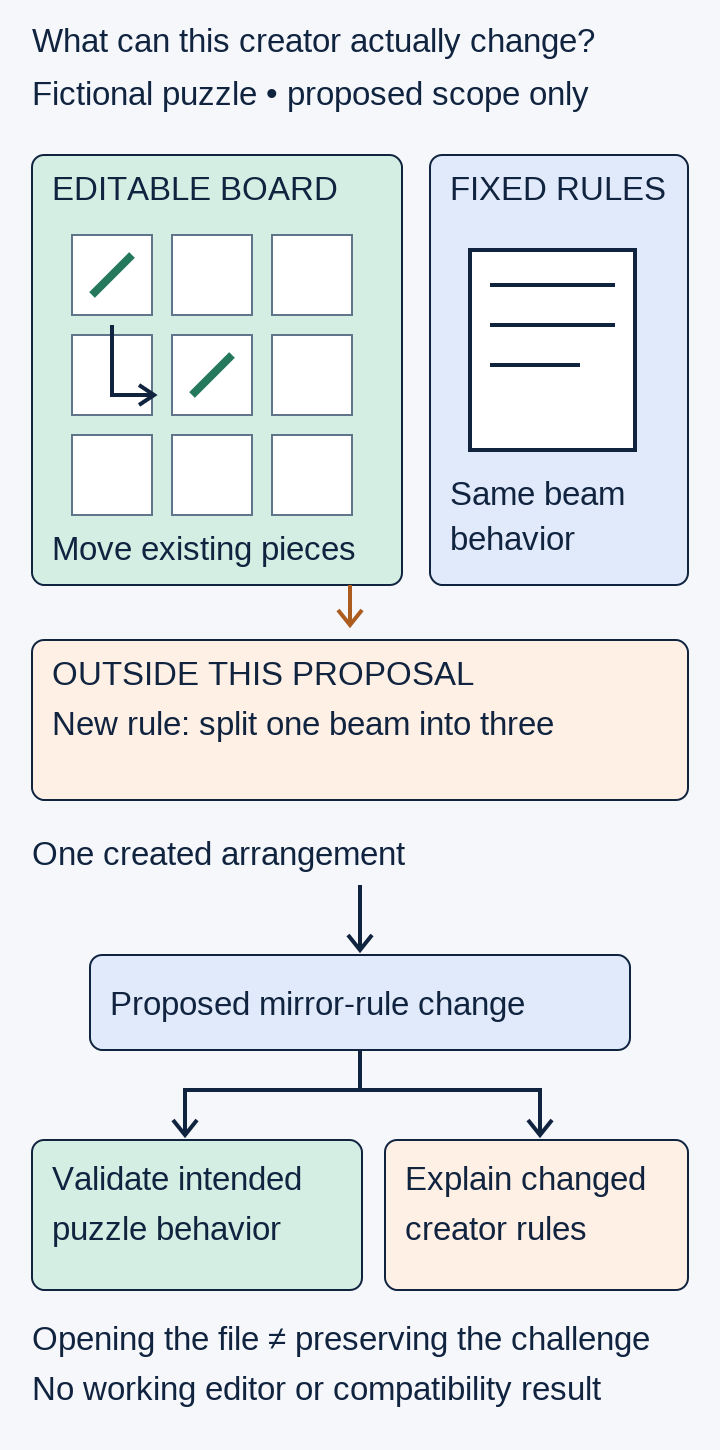
Original conceptual illustration. It is not a working editor, a player-created artifact, or a compatibility test.
 Superdirector
Make it work for your brand
Find it. Remake it. Post it. Superdirector turns the viral formats in your niche into your brand's carousels, X posts and video scripts, and keeps the calendar full.
Separate interest in mods from a task someone will attempt
In an arcade roguelite discussion, solo developer fatpugstudio considered investing in mod support for an already data-driven game. Their later replies questioned whether their own enthusiasm translated into a selling point. That is a useful uncertainty, not proof that mod support succeeds or fails at a particular audience size.
A separate developer discussion by LillyByte asks how much creative power a game editor can offer without a scripting system. The author clarifies that their game involves simulation, crafting and role-playing servers. Their question is about the boundary of the tool, not just whether a feature sounds desirable.
These are two attributable operator contexts, not a demand survey. Their displayed dates conflict with search metadata, so they should not be treated as a precise current trend. Neither establishes how many people would create content for your game.
Ask an interested player to describe a creation they cannot currently make. “I would use mods” leaves the essential work unspecified. “I want to build a puzzle where the exit can only be reached after moving these existing mirrors” gives you something to examine. A player can also prefer consuming other people's creations without wanting to author any. Keep those roles separate.
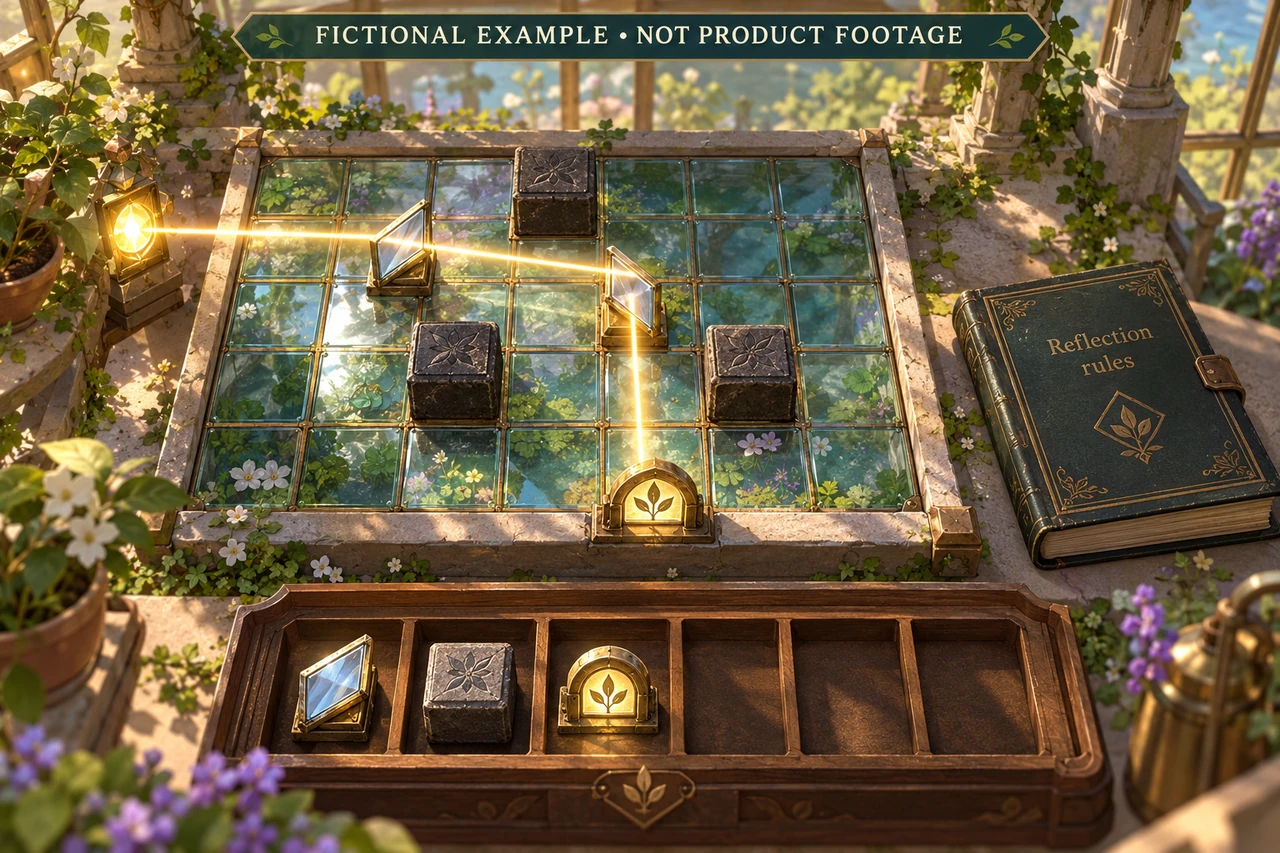
The fictional Glass Garden editor lets creators arrange existing pieces while the reflection rules remain fixed. It illustrates a bounded authoring task, not shipped mod support. Original AI-generated editorial illustration.
Draw the editable boundary before choosing the technology
Consider a fictional puzzle game, Glass Garden. A proposed editor lets creators place existing mirrors, blockers and exits on a board. It keeps the original reflection rules fixed.
That boundary could support new arrangements and original solutions. It would not support a new rule in which a mirror splits a beam into three colors. A request for that behavior is not evidence that the placement editor needs a few more buttons. It might require a different authoring surface, or it might sit outside what the team is prepared to support.
Write a short creation contract:
- The creator can arrange these existing pieces within these board constraints.
- The resulting challenge uses these unchanged game rules.
- The creator can inspect and revise the arrangement before another person plays it.
- These requested behaviors are outside this proposal.
This is an internal scope statement, not a public commitment. Its value is making disagreement visible before development expands around an ambiguous label.
Test the smallest meaningful creation, not the largest feature list
For Glass Garden, a useful proposed exercise is to ask an intended creator to make one challenge they can explain, using the bounded editor concept. Observe the task rather than teaching every step and then counting completion as independent success.
Record where the creator's intended design diverges from the available controls. Was the missing capability central to their idea, or could they create a different satisfying challenge within the stated rules? Did they need undocumented knowledge? Could another intended player understand the resulting challenge? These are questions to investigate, not results already obtained.
Now consider a fictional arcade game whose proposed panel changes spawn timing and existing weapon values. A creator wants to make an enemy that bargains with the player instead of attacking. That panel does not support the requested behavior merely because it exposes many settings. The team can investigate a different scope, deliberately serve a narrower creation job, or defer authoring support. Adding controls without resolving the mismatch is not progress on the creator's task.
Choose the smallest prototype that can reveal this distinction. Do not infer that a sketch proves a working tool, or that one successful creation proves a sustainable ecosystem.
Carry one creation into the next game change
The investment does not end when someone produces the first artifact. Imagine that Glass Garden later changes how a mirror behaves. The original challenge may still open while its solution no longer works. Loading is not the same as preserving the creator's intended experience.
Valve's item-versioning documentation describes version support introduced with Steamworks SDK 1.60 and emphasizes deliberate build history and a consistent testing process. This is a scoped capability with implementation requirements, not an automatic promise that every mod survives updates.
Use a representative creation to plan the continuing work: which rule changed, which creator-facing explanation must change, what needs validation, and what supported-version statement can actually be justified? This article is not instructing you to change branches or execute mods. It asks whether those responsibilities fit the product you are considering.
If keeping that small example understandable already requires work nobody can own, narrow the proposal before expanding it. Conversely, a bounded creation task may remain worthwhile even without arbitrary new rules. More freedom is not automatically more useful to the particular creator you intend to serve.
Decide from the creation evidence
Continue when you have a specific task, a plausible supported boundary and an owned next investigation. Narrow the proposal when the task is valuable but the controls or maintenance burden exceed what you can support. Defer it when the only case is assumed free content or marketing.
Keep separate records for expressed interest, attempted creation, a usable result and later voluntary participation. None is a substitute for the next. If acquisition is part of your hypothesis, you still need evidence that the supported creation experience matters to prospective players. A completed editor does not, by itself, establish that outcome.