How-To Guide
Should you make a short game longer because you fear Steam refunds?
Before adding another corridor, repeated task or compulsory replay, identify what the addition gives the player. Does it supply missing information…
By the Superdirector editorial team.
Before adding another corridor, repeated task or compulsory replay, identify what the addition gives the player. Does it supply missing information, create a meaningful choice, deepen a consequence, or simply delay an ending that already works?
A refund-policy threshold is not a design target. It cannot tell you how long your story should be, whether a replay route is worthwhile, or what a particular customer will do. For a short-game founder, the useful decision is whether to repair the experience, expand it for a clear creative reason, or keep its deliberate brevity. None of those choices guarantees fewer refunds.
Separate the policy from the product question
As checked on October 24, 2026, Steam's published refund policy describes its general offer for store games and software as within two weeks of purchase and under two hours of playtime. It also says requests outside the described rules can still be considered, and notes possible additional rights in some jurisdictions for faulty games. This is a summary of Valve's published policy, not a decision about an individual request or legal advice.
Do not infer that adding enough elapsed time makes a purchase nonrefundable in every circumstance. Equally, the policy alone does not establish that everyone who finishes a short game will return it. Neither inference supports a sound product edit.
A short-RPG developer asked about precisely this concern. In a later reply, they clarified that they wanted a compact experience and had already intended replayable elements. That artistic motivation matters. A short game is not automatically an attempt to deceive, and an additional route is not automatically padding.
In a separate discussion about episode length, a developer encountered advice to exceed two hours. Their later replies describe wanting an enjoyable, non-clickbait experience. The disagreement is a real qualitative design concern, not evidence for a universal minimum length or a reliable refund forecast.
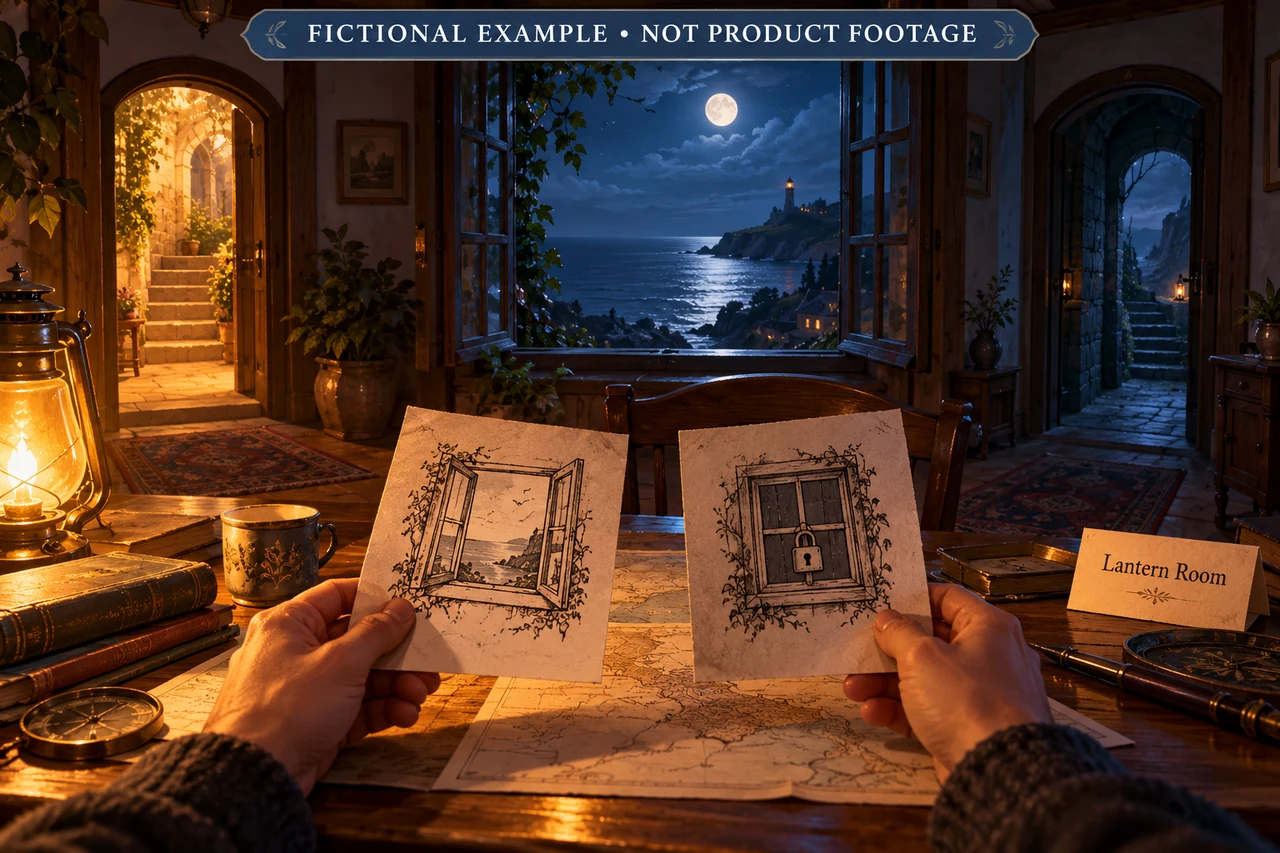
The fictional Lantern Room centers a clue that can change a story choice. It illustrates meaningful content rather than padding an experience to reach a duration. Original AI-generated editorial illustration.
Original visual by Original editorial illustration generated with OpenAI’s built-in image tool. Created 2026-10-24.
Draw the experience before extending it
Use a simple map of what the player learns, decides and changes. For a story-led game, that might include an opening question, a clue, an interpretation and a consequence. This is an editing aid, not a formula every game must follow.
Consider the fictional Lantern Room. A visitor discovers two conflicting notes, chooses which account to trust, and sees how that choice changes the final conversation. Suppose an early review of the design finds that the second note does not actually provide information relevant to the choice. The problem is not necessarily that the game is short. The choice may lack a meaningful basis.
One candidate repair is to make the second note reveal a detail that changes how the first is understood. Another is to alter the interaction so the player can investigate the contradiction. Both aim at the missing reasoning step. Their success would need observation in the actual build.
Now compare a different proposal: require the player to walk the same corridor several more times before the conversation unlocks. If nothing new can be learned, chosen or changed during those trips, the diagram has gained a delay, not a new reason to play. That is a reason to reject this particular edit, not proof that traversal or repetition is always bad design. Repetition can serve a deliberate purpose when its meaning changes.
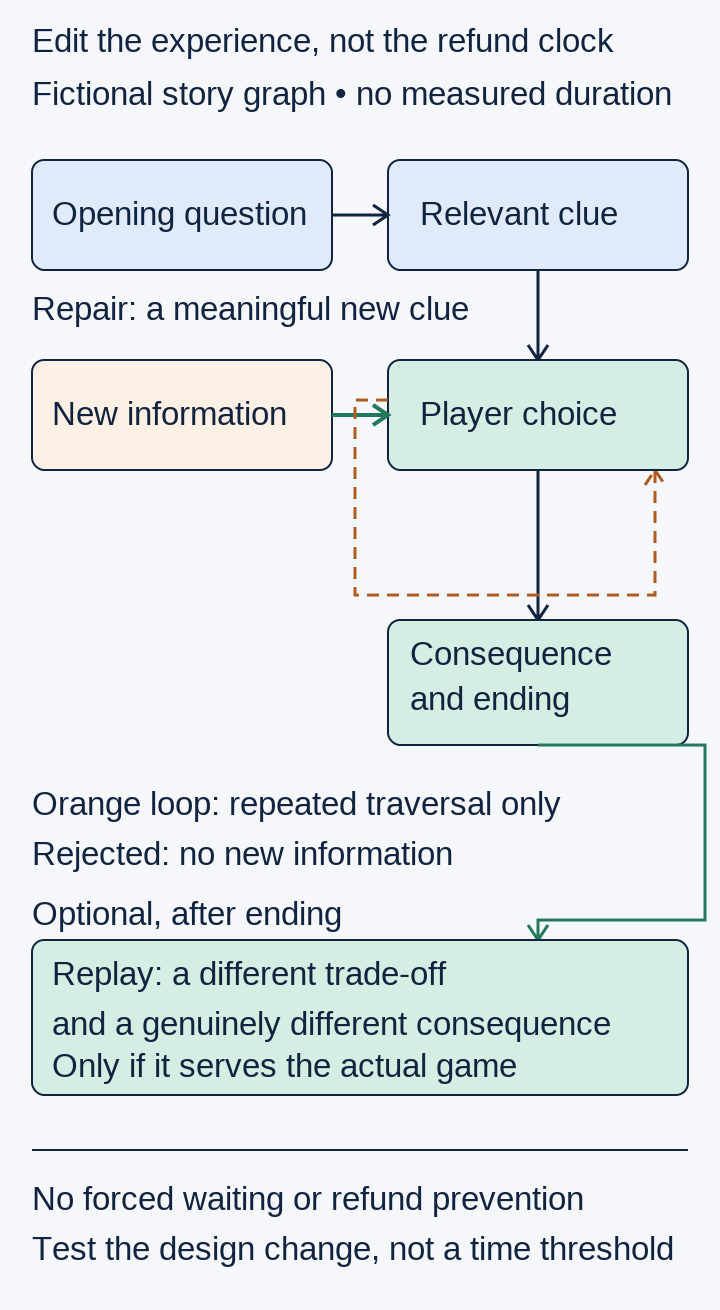
Original editing illustration, not observed gameplay, measured completion time or a refund-prevention method.
Original visual by the Superdirector editorial team. Creation date not recorded.
Distinguish a repair from a genuine expansion
For each proposed segment, complete three sentences: “The player can now…”, “This changes the experience because…”, and “We would observe the difference by…”. If the only answer is that the clock advances, reconsider the proposal.
A repair addresses a missing or confusing part of the intended experience. An expansion adds a worthwhile experience the original did not promise. Both require work, and neither should be described as complete merely because it is on a roadmap.
For a second fictional game, Echo Table, assume the first ending already resolves its central decision. An optional replay route could ask the player to make a different trade-off and reveal a consequence unavailable on the first route. That may be a coherent creative extension. It does not need to be made compulsory to lengthen every customer's session.
Assess the route's purpose and production demands before adding it. Can the team actually implement and test the new consequence? Does it deepen the existing game, or distract from a stronger ending? If those questions remain unresolved, keeping the original compact experience is an available choice. Do not advertise an unbuilt branch as current replayability.
Communicate scope without turning an estimate into a promise
Explain the actual purchase: whether it is a self-contained story, an episode with a stated boundary, or a replayable activity with specific available variation. Avoid disguising an unresolved ending as a complete narrative merely because the build reaches credits.
If you describe expected playtime, base it on relevant observations and state the conditions. A creator who knows every solution, a first-time player who explores, and someone who encounters a technical problem do not provide interchangeable observations. Do not select only the slowest session to make the offer appear larger, or give an exact completion guarantee that the evidence cannot support.
Clear scope helps a prospective buyer judge the offering. It does not remove refund eligibility or guarantee satisfaction. Do not ask players to leave the game running, force waiting solely to consume time, or hide ordinary exit controls to pursue a threshold.
Investigate actual problems instead of assigning motives
A short-horror developer seeking acquisition advice reports creator attention, weak sales and refunds. Their explanation attributes some returns to people finishing the game. The post does not independently establish individual motives or the causal effect of length, so its reported figures are not benchmarks here.
Valve's developer refund reporting documentation describes access to refund statistics and player-provided reasons. Its period rate divides units returned during a period by units purchased during that period. Valve warns that recent views can be volatile, including after discounts, when returns may concern earlier purchases while current sales have fallen. That rate is not automatically the refund probability for a matched purchase cohort.
Where authorized evidence is available, separate reported technical failures, mismatched expectations, dissatisfaction and unclear reasons. A player's note is evidence of what they reported, not a complete causal diagnosis. A technical failure calls for different investigation from a deliberately short story that was advertised as a long campaign. Neither is resolved by adding compulsory walking.
Choose one edit with a reason to test it
For Lantern Room, the next useful action is to revise the missing information at the decision and inspect whether an unfamiliar player can make sense of the consequence. For Echo Table, it is to determine whether the optional route offers a genuinely different trade-off worth building. These are fictional planning examples, not completed tests.
Record the exact build, proposed change, relevant observation and remaining uncertainty. Keep completion, enjoyment, reported refund reasons and actual returns separate. Do not claim a refund improvement without suitable evidence, or treat a longer session as proof of a better experience.
The aim is a paid experience whose scope you can explain and whose design choices you can defend. Sometimes that means adding something meaningful. Sometimes it means removing a delay and allowing a good short game to end.